


Our first question concerning the value of a book, a man, or a piece of music is: Can it walk? Or still better: Can it dance?
Nietzsche, The Gay Science
Philosophy is like dancing and understanding why is incredibly important.
If you are someone who wants to understand how you can become a more philosophical person, what it means to live philosophically, and how to get in touch with one of the deepest parts of your humanity, you are in the right place.
How I Introduce New Students To Philosophy
Every semester, I teach a handful of lower-level philosophy courses, many of which contain students who have never taken a philosophy class before.
Regardless of the specific topic of the course, it is always important to spend some time at the beginning of the term giving a brief introduction to philosophy, since philosophy is unlike any other discipline, and most people have rarely been exposed to it before college.
I often tell my students that philosophy is like dancing, and that what they have signed up for is more like a dance class than a physics or math class.
For a long time the primary reason I would say this is that I wanted the students to understand philosophy as a kind of activity or skill which can be improved upon, rather than an established body of knowledge which must be memorized.
It can be tempting to view the study of philosophy as requiring mastering the writings of great philosophers like Plato, Kant, and Marx.
This is a reasonable assumption to make from the perspective of someone completely new to the subject, but it couldn’t be farther from the truth.
Many professional philosophers today do not know the history of philosophy very well, if at all, and the idea that philosophy must be studied chronologically is something that everyone gives up once they make it past the first few dialogues of Plato.
While I certainly love the history of philosophy, it is also incredibly important for students to understand that they can think philosophically without knowing any of this.
In fact, it is incredibly important for them to realize that they have already been thinking philosophically for most of their lives!
I could have chosen many skills other than dancing to make the point that a philosophy class is, or should be, something that helps them understand that philosophy is a unique kind of human activity with which they are already familiar.
I could have said that philosophy is like learning a new language, or writing, or painting.
So why do I choose dancing?
Well, for one thing, it gets their attention and surprises them a bit.
Another reason is that for the past several years I have been taking latin dance classes, so it is often top of mind for me.
More recently, though, my thoughts about the relationship between philosophy and dancing have taken a deeper turn.
I have come to believe that philosophy is like dancing in surprisingly important ways, and that reflecting on the similarities between the two can help us better understand the answer to two big questions that I have been researching and writing about heavily this year:
What does it mean to be a philosopher?
What does it mean to live philosophically?
In this essay, I explore several illuminating connections that I have discovered between philosophy and dancing, and explain how they can teach us important lessons about what it means to be a philosopher and live a philosophical life.
In the end, I hope to show that philosophy is as natural and fundamental a part of what it means to be human as dancing, and that no one needs a formal education in philosophy to either be a philosopher or live philosophically. Through this and other essays, I also hope to articulate and defend a vision of philosophy that ordinary people can identify with and benefit from.
Question 1: What Does It Mean To Be A Philosopher?
What does it mean to be a philosopher?
This is deeply difficult and controversial question.
Although this question cannot be fully answered here, and it is not the last thing I will write about it, I hope that what I write here starts a conversation that moves differently from the many conversations I have had about this subject in the past.
Although I don’t particular like this way of approaching the question, it can be clarifying to ask:
What are the minimum requirements for being considered a philosopher?
There are a few answers that immediately come to mind.
I think all of them are dumb in some obvious way.
Option #1: A philosopher is full-time professional philosophy professor, author, or speaker.
This is the most natural answer, I think.
A philosopher is someone who practices philosophy as a profession and makes a living doing so.
This would include philosophy professors, researchers, writers, speakers, and perhaps even content creators.
While this seems to be one common way that people use the term “philosopher”, I think it is both highly objectionable and overly restrictive.
One of the main issues I have with this use of “philosopher” is that it gate-keeps philosophy for no good reason.
If someone starts earnestly writing on Substack about philosophy and calls themselves a “philosopher”but is not a full-time professional philosopher, people get offended and often comment that this person is misapplying this title to themselves. There is a kind of “stolen valor” objection that someone has given themselves a title without doing the work to deserve it.
There can be instances where there is some truth to this, but I simply don’t see the point or benefit of this gate-keeping practice.
Does it really matter to philosophy professors if people go around calling themselves philosophers?
My guess is that this way of thinking assumes that “philosopher” is akin to “scientist” or “doctor” such that people can’t just call themselves these things unless they are a professional.
But there are often good reasons for gate-keeping titles like doctor — people might get hurt.
Are philosophers going to harm their readers by posing as philosophers when they lack proper training?
The idea of “proper training”, whatever that means, leads to the second option.
Option #2: A philosopher is someone who is formally trained or educated in the academic discipline of philosophy.
This option understands philosophy primarily as an academic discipline/activity which one must be trained in at a college or university in order to be legitimate.
Option #1 and #2 go hand in hand, but there are people who are formally trained in philosophy but not professionals.
For example, there are people who get a B.A., or even a Ph.D., yet change careers or never end up practicing philosophy in any professional sense.
Yet, given their education, it seems to be less of an offense for them to call themselves a “philosopher”.
You could, of course, go out on your own and learn about philosophy on the internet, and you may even try to publish some research, but this usually doesn’t go so well.
It can be hard to go it alone, and most students of philosophy need some kind of guidance to feel like they are making progress.
The good news is that you can easily deny that “being a philosopher” means studying academic philosophy.
If academic philosophy is too hard, or not resonating with you, then you can just be a philosopher by thinking philosophically about life’s big questions.
This need not be grounded in the Western tradition of academic philosophy.
There is another option.
Option #3: A philosopher is a human being.
The idea that a philosopher is simply a human being is the answer I want to defend in this essay.
Call it the human view.
You can think of this as the most minimalist and inclusive understanding of what it means to count as a philosopher.
I want to defend this position through a deep connection that exists between philosophy and dancing.
The basic idea is that just as virtually every human being is a dancer, every human being is also a philosopher.
Why Philosophy Is Like Dancing
The many ways in which philosophy is like dancing are illuminating and surprising.
It’s no secret that pretty much everybody dances. And yet…
Many people are bad at dancing (especially when untrained).
Many people also secretly wish they were a little bit better, and view it as a challenging and potentially embarrassing activity to engage it — often requiring a lot of external motivation or stimulus to engage in it (alcohol, the heavy handed MC at a wedding).
Philosophy has a similar profile.
Everybody thinks philosophically (more on this below).
Many people who are untrained in philosophy can be quite bad at it without even realizing it.
And it is often the case that philosophy is viewed as a challenging and potentially embarrassing activity which requires an external motivation or stimulus to engage in (typically a degree requirement).
Students who are new to philosophy can find themselves doubting their own intelligence, censoring their speech, and worrying that other people are smarter or more “deep” than them when answering philosophical questions.
One of my main goals when I teach philosophy is to get students to realize that they have already been thinking philosophical thoughts for their entire lives.
Many students struggle to figure out what to say, despite the fact that they have already answered and thought about many of philosophy’s big questions for years simply through living a human life.
Prior to studying philosophy, they come pre-loaded with the ability to think and talk philosophically — they just don’t realize it.
In fact, some of my students are much better at the skill of philosophical thinking than I am, they just don’t know anything about the history of the subject.
This is not surprising.
There are people who are born naturally gifted dancers that don’t need any classes to improve or impress.
They can roll, spin, and twist without needing any instruction.
The benefit of dance class is not always to teach people things they didn’t already know, or something they weren’t already capable of, but to help people understand connect with their bodies and understand what they were already capable of doing in a deeper way.
Likewise, the main benefit of a philosophy class is very often to help people realize that they already know how to think philosophically, but that they didn’t understand what this meant and how to do it well.
The point of drawing an analogy between philosophy and dancing above was to show that both philosophy and dancing are two activities that have a similar perception amongst ordinary people — they are activities that we often engage with poorly, wish we were better at, and are intimidated by.
I want to go deeper into this metaphor.
I want to argue that philosophy and dance are both part of what is fundamental to our humanity and see what this means for helping us answer the second big question — what does it mean to live philosophically.
The Deep History Of Dance And The Human Form Of Life
As far as we know, the practice of dance is as old as human beings themselves.
Archaeological evidence depicting dancing figures dates back at least 10,000 years to the Mesolithic Age. For example, in the Rock Shelters Of Bhimbetka, some of the earliest traces of human life in India depict what appear to be dancing figures.

Dancing is older than both spoken and written language, and it’s not hard to see why.
You can move your body to communicate and tell a story before you are even able to speak.
It is an interesting and difficult philosophical question whether non-human animals can be said to dance, or whether they are simply doing something else entirely. Is there a difference between a bird hopping about to attract a mate and the first dance at a wedding?
The 20th century philosopher Ludwig Wittgenstein was fascinated by this sort of problem. In what has become one of the stranger quotes in the history of philosophy, Wittgenstein once said
“If a lion could talk, we could not understand him”
What did he mean by this?
(One can imagine Wittgenstein getting up and walking out of the Lion King in philosophical protest).
Towards the end of his life, Wittgenstein argued that what makes language meaningful for human beings is how they use it in context. At a very general level this seems obvious, but what he had to say about it cut much deeper.
Wittgenstein thought that in addition to the ordinary contexts we find ourselves in — grocery shopping, playing board games, giving a presentation — there is a universal background context to human life itself.
This über-context he called the human “form of life”.
“The speaking of language is part of an activity, or of a form of life”
Wittgenstein, Philosophical Investigations, 23
A “form of life” for Wittgenstein is not a single way of acting like speaking French, or dancing a Waltz.
It is the background upon which such actions are not only possible but meaningful.
It is the totality of modes of being human that, when taken together, “cohesively form the necessary background or context or foundation of meaning”.1
The form of life of a life-form, such as human beings, rests upon very general facts about what Wittgenstein calls our “natural history” and “nature”. Our natural history is composed of the history of our physical and linguistic responses to life, nature, and each other, our definitions of words, our behaviors.
In short, all of the things human beings have done and continue to do.
The idea is that there is a very general human form of life which we all share, but which is manifested differently by different cultures, groups, and individuals.
For example, everybody eats.
Eating is a fundamental part of the human form of life.
It is possible to argue that some life-forms, like plants, are alive but do not eat — and eating is therefore not a part of the plant form of life. Gertrude Conway puts it this way:
“One could say that all humans participate in the human form of life, but that there can be different forms of human life” (1989: 78)2
This captures both the fact that all humans participate in the general human form of life through activities like eating, but that the way that people eat can vary and create different forms of the human form of life. Alternatively, there are activities that belong to various forms of human life, but are not part of the fundamental base human form of life. For example, Algebra, or democratic elections, influence and characterize certain human lives but not others.
My central claim is that the activities of dancing and philosophizing are both fundamental parts of the human form of life.
Every human culture and nearly every individual human being already engages in the activities of dancing and philosophizing prior to taking any formal class, or reading any books.
Additionally, dance was often connected to shamanic rituals and altered states of consciousness, which have epistemological upshots.
You might even say that dance is a form of knowing with causal powers.
There are few things as deeply human as dance.
It is simply part of what makes us what we are, and it is a mistake to treat philosophy as something auxiliary like Algebra or democratic elections.
Insofar as we are human beings, we are philosophers, dancers, drinkers, eaters, walkers, and talkers.
Are we human
Or are we dancer?
My sign is vital
My hands are cold
And I’m on my knees
Looking for the answer
Are we human
Or are we dancer?
The Killers, “Human”
How Old Is Philosophy Really?
According to the standard academic story of philosophy, it began in the 8th century BCE in Western Turkey and spread outwards from here.
But is that really the case?
It is, of course true, that our evidence of what looks like philosophy dates back to Thales of Miletus.
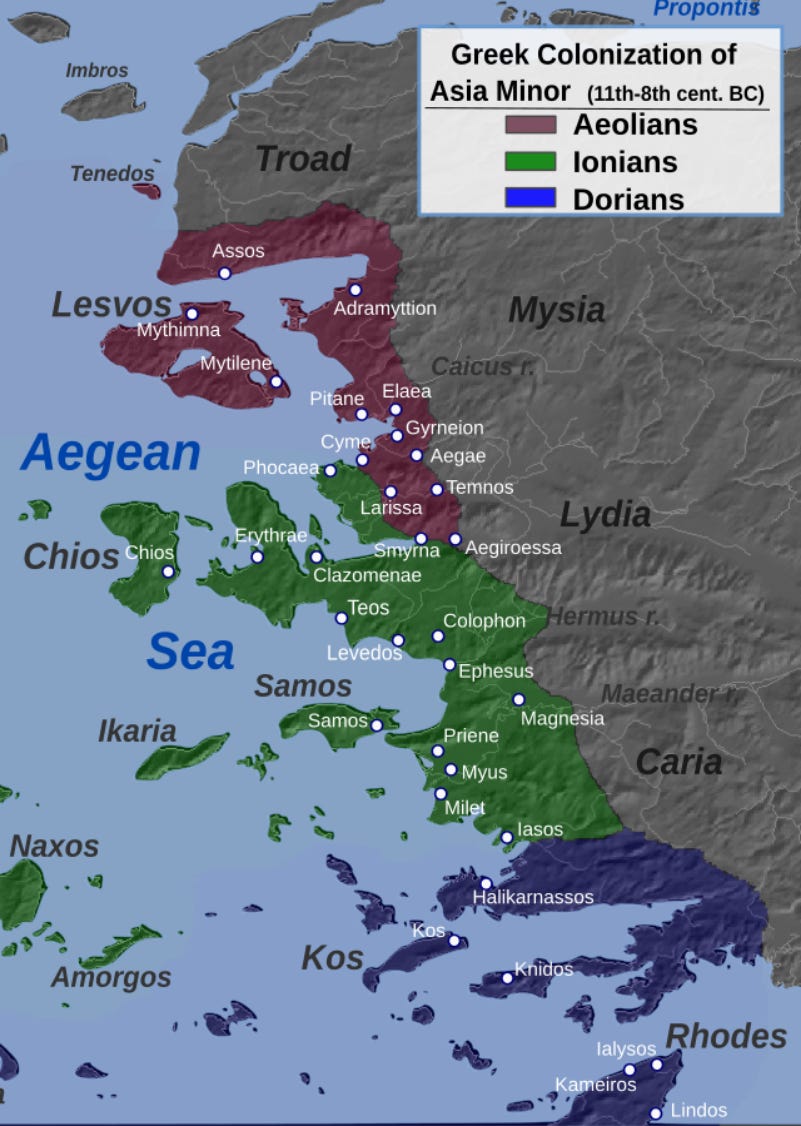
But why should we stop at the evidence?
Since philosophy is so closely associated with the spoken and written world — in short, language — it is no surprise that the evidence of philosophy is very young compared to the evidence of other human practices like dance.
But what about the deep history of philosophy?
Is it really true that no one thought philosophical thoughts prior to Thales?
There is a simple and complex version of this.
The simple version holds that it is obviously true that people thought philosophically before Thales, they just didn’t write it down and we have no evidence of it.
The complex version says that what happened before Thales doesn’t count as philosophy proper, because it was missing something.
But what was it missing?
One of the key distinctions that will I will hang my hat upon many times throughout this article is the difference between doing something poorly and not doing it at all.
It may be the case that prior to Thales, people were crude and impoverished philosophers, unable to formulate the kinds of thoughts that we would recognize or consider philosophical, but does this mean that it shouldn’t count as philosophy?
If we think of philosophy as a kind of thinking in which we rationally reflect on life’s ultimate questions, and try to develop answers, then the bar for whether someone counts as thinking philosophically is quite low.
It is not required that one do these things within the walls of a university, or in response to a published text.
We use our ability to reason in the same way that we use our bodies to dance.
Another important point is that it is critically important for one’s view of what philosophy requires that it recognizes much of what children think and say as philosophical.
Children are capable of asking “Why?” questions — and they are not simply mimicking us.
They really want to know.
If we can look at children and infer backwards through history to what is innately human or fundamentally human, then we can conclude that philosophical thinking is just as deeply embedded in our nature as dance.
We can imagine a child sitting beneath the night sky next to their parent asking why there is something rather than nothing, or where the stars came from. We can imagine a child engaging in ethical or moral reasoning prior to the invention of philosophy.
Philosophy is very likely the oldest form of human inquiry.
When did it begin?
Perhaps philosophy began when homo sapiens first evolved from their early ancestors (homo sapiens literally means “thinking human”). Although we will never know the exact details, one answer to the question “when did philosophy begin?” is that philosophy began when the first homo sapien asked the first philosophical question.
Well, human philosophy at least.
Is it reasonable to think that in the entire 13.7 billion years that the universe has existed, the first philosophical question was asked by a human being?
Personally, I don’t think that this is likely.
Even if we assume that our universe is the only universe that ever was and will be, it seems unlikely that reason made its first appearance with homo sapiens roughly 300,000 years ago. If there are, or were, any rational beings other than us, then philosophy did not begin with us (this assumes, of course, that if a being has the faculty of reason, then it can or will use this faculty to ask philosophical questions).
Question 2: What Does It Mean To Live Philosophically?
Throughout this essay I have been working my way towards an answer to the question of what it means to live philosophically.
One reason why I have went into such detail regarding the definition of a “philosopher”, the deep history of human dancing, the deep history of philosophy, and the human form of life, is in order to add some context to what will appear to be a trivial answer to the question posed here, which is:
What it means to live philosophically is to live.
I believe that everyone is already living philosophically, whether they realize it or not, and whether they are doing it well or poorly.
Is it really possible for someone to be a human being and to be unphilosophical?
What would such a life even look like?
It may be the case that most people are living philosophically by my definition, but are not doing a good job—they make mistakes in reasoning, they don’t ask the right questions, and fail to articulate and defend their own beliefs with good arguments or evidence.
But they are living philosophically nonetheless.
The reason it was essential for me to argue that philosophy is embedded in the human form of life is to be able to justify the thesis that philosophy is an inescapable aspect of being human and that no one can cease to be philosophical by doing it poorly.
For activities that are not part of the human form of life, it does not seem to be the case that people who are incredibly bad at them should count as doing the thing. For example, consider the sport of Golf.
Golf is hard.
Many people do not play golf and never will.
Out of the millions who do play, most of them play it poorly.
It makes sense for someone who plays golf poorly to call themselves a golfer, but it doesn’t make sense for someone who is so bad at golf that they cannot even play golf to call themselves a golfer (or even a bad golfer).
For certain activities, being good enough is constitutive of doing the thing at all.
While philosophy is, as I am arguing, constitutive of being human, Golf is not part of the human form of life — it is not something we do simply as a result of being human.
Philosophy is.
We can’t but help asking philosophical questions throughout our lives and trying to pose our own answers.
We can’t but help to debate and discuss our philosophical beliefs, and criticize the arguments and reasoning of others.
The easiest way to make my case is by considering Ethics.
Ethics is the branch of philosophy about what is right, wrong, good, bad, valuable, and disvaluable.
It asks questions about how we should live and what we should do.
The activities of judging, evaluating, questioning, and criticizing ourselves and others from the perspective of Ethics are fundamental to who we are.
Insofar as we are ethical beings, we are philosophers.
This points to one of the reasons that a philosophical education can be important.
Philosophical training and education in ethical reasoning can be incredibly beneficial for helping people understand what it means to think clearly and reasonably about matters of moral importance (whether it is with respect to their own lives or others).
It can help people make better choices, develop sensitivities to conceptual distinctions, question their own and other’s beliefs, and achieve deeper self-knowledge.
In short, it can help us live well.
Philosophy As Inclusive, Natural, And Deeply Human
For the past several months, I have been seriously researching the idea that philosophy can be understood as a way of life, or as the “art of living” (in fact, that was the original name of this publication — shoutout to those who were here first Pablo Naboso).
I have come to realize is that there is very little interest within academic philosophy in the topic of philosophy as a way of life and also what I would call “personal philosophy”.
One of the main reasons I have been thinking about this is because of Substack.
The primary aim of the Micro-Philosopher is to teach people how to build their own philosophy for living.
In pursuing this aim, I have been drawn to writing and reading more and more about the connections between philosophy and living, philosophy and humanity, and personal philosophy. This research has shed light on the limitations of philosophy as an academic discipline and how it is failing to serve and actively exclude ordinary people.
The primary motivation for writing this essay is that I have become very interested in articulating and defending a conception of philosophy that is widely accessible, deeply human, and natural.
It is a sad fact that very few academic philosophers seem to be interested in philosophy understood as a way of life, or philosophy as it exists in the wild — that is, in the lives of real people who are untrained and simply living.
(I highly recommend Jessica Böhme, PhD and her writings about philosophy in the wild if this is a topic you would like to explore further. She even runs what she calls “philosophy gyms” which are places to exercise your philosophical nature).
In fact, if you spend enough time around academic philosophers, you will find that one common joke amongst philosophers are stories about instances when those untrained in philosophy ask a philosophy professor some version of the question “what’s your philosophy?”.
What’s the joke?
I’m not quite sure, but I think it is supposed to be funny to academics because it demonstrates the level of ignorance or misunderstanding in ordinary perceptions of philosophy and philosophy professors.
It is supposed to be funny that ordinary people mistakenly think that a philosophy professor “has a philosophy” in the same way that the Buddha had a philosophy, or some ancient guru.
The joke seems to consist in the absurdity of an outdated idea of philosophy — the idea that a philosopher has some kind of pet theory of everything — being applied to a modern researcher who takes themselves to be more like a scientist working on a very narrow set of questions.
The humorous nature of the “what your philosophy?” questions turns on a tension between what academics think it means to be a philosopher today, and what ordinary people think a philosopher is.
I think that both ideas of what a philosopher is are wrong.
As I have argued above, I don’t think that the title “philosopher” should only be reserved for those with special academic training such as a B.A., M.A., or Ph.D. Likewise, I don’t think that in order to be a philosopher you have to be some kind of gifted genius who has developed a “theory of everything” and acquired a following.
Everyone is a philosopher.
Not everyone is a good philosopher, but that isn’t as important as understanding the fact that everyone is a philosopher.
One reason this matters to me is that it is a way to make philosophy more inclusive.
It is a known fact that philosophy has a history of being highly exclusive.
If philosophy has any value to offer human beings, then its history of exclusion is a real shame, and we should feel compelled to search for visions of philosophy and its role in human life that can correct this.
I firmly believe that philosophy has the potential to change nearly all human lives for the better.
Philosophy taught me how to think, write, talk, empathize, question, research, and be able to see the world as an infinitely interesting place to be.
Although the benefits of my study are paying dividends today, I was a first-generation low-income college student.
I had to pay $80,000 to major in philosophy at my local state university.
But I did it because I believed in its value.
I did it because I was confident that it would repay itself by teaching me how to think for myself.
And after 17 years, I believe in its value today more than ever, given how the world has changed.
Things are much different now than when I started.
When I started studying philosophy, many of the resources available today didn’t exist.
But what exists now is not enough.
The future of the humanities and humanities education depends upon the creator economy and a grassroots movement of passionate and thoughtful individuals who will continue to build on what has been started.
No one should have to pay $80,000 to benefit from what philosophy has to offer.
I am here to change that as much as I can, but I can’t do it alone.
I need you to push me with your comments.
I need other creators, like Adam Walker and Jared Henderson , to write insightful articles, and develop courses and communities that open up new paths for online humanities education.
The goal is, ultimately, to help people get more in touch with themselves and their humanity at a time when we are all feeling that the world is missing something.
The goal is to help people learn how to argue, question, inquire, theorize, debate, write, read, and, ultimately, to dance through life with intellectual joy.
The goal is to help people live better through philosophy.
The goal is to get you to believe that you don’t need a degree to identify as a philosopher.
You already are a philosopher.
At the Sight of a Learned Book. We do not belong to those who only get their thoughts from books, or at the prompting of books —it is our custom to think in the open air, walking, leaping, climbing, or dancing on lonesome mountains by preference, or close to the sea, where even the paths become thoughtful. Our first question concerning the value of a book, a man, or a piece of music is: Can it walk? or still better: Can it dance?
Nietzsche, The Gay Science
Danièle Moyal-Sharrock, “Wittgenstein on Forms of Life, Patterns of Life, and Ways of Living” (2015).
Gertrude D. Conway, Wittgenstein On Foundations, 1989.
Excellent and so thoughtful. It is so interesting that while asking and exploring the question on the nature of philosophy, you compare it to dance. This comparison is striking to me.
I am a dancer, I dance a lot in many styles and observe people dancing in various cultural and social contexts, including very ancient traditions. And yet, if we ask the same question about dance (what is dance?) we don’t know. We don’t really know what dance is, and why people dance - why, across cultures and continents, the act of dancing, always connected to music, remains ubiquitous, natural and intuitive.
Yet, there are some clues. Maybe, just maybe, our language is like thin egg shell, able to describe the thin surface but not the vast depth of the reality in which we live. Maybe the reality is much deeper than we think. Maybe we, the humans strive to touch, experience and express this vast depth of reality, and approach its abbyss, which we can never do with words, so we turn to things like art, music and dance. Maybe philosophy is just another attempt to reach those vast hidden dimensions. Yes, we are all philosophers, dancers, travelers - truth seekers.
Thank you, Paul Musso.
An enjoyable essay, Paul.
I’m always drawn to the line that Plato attributes to Socrates: “Wonder is the beginning of all philosophy,” and I think this applies to science, too. After all, until recently, science (or “natural philosophy”) was a branch of philosophy.
But in the classic sense, this sense of wonder leads to questions, which makes philosophy into an inquiry.
Here’s something I’ve been thinking about lately:
The “philosophy as a way of life” approach often involves following rules and precepts that others arrived at in the past. (For example, most people who follow Stoicism today don’t make original contributions to philosophy. They are following a system arrived at in the past.)
So is there a minimal qualification that doing philosophy requires besides being human? Does it require inquiry? At the least, I suppose a real philosophy of life at least requires self reflection?