


The Phenomenology of Spirit is the bildungsroman of human consciousness itself and the most important philosophical book of the 19th century.
On the night of October 13, 1806, a little-known philosophy lecturer sat at his desk in the university town of Jena, racing to finish a book before a publisher’s deadline five days away. He was 36 years old at the time, and yet to really make a name for himself in the highly competitive world of 19th century German philosophy.
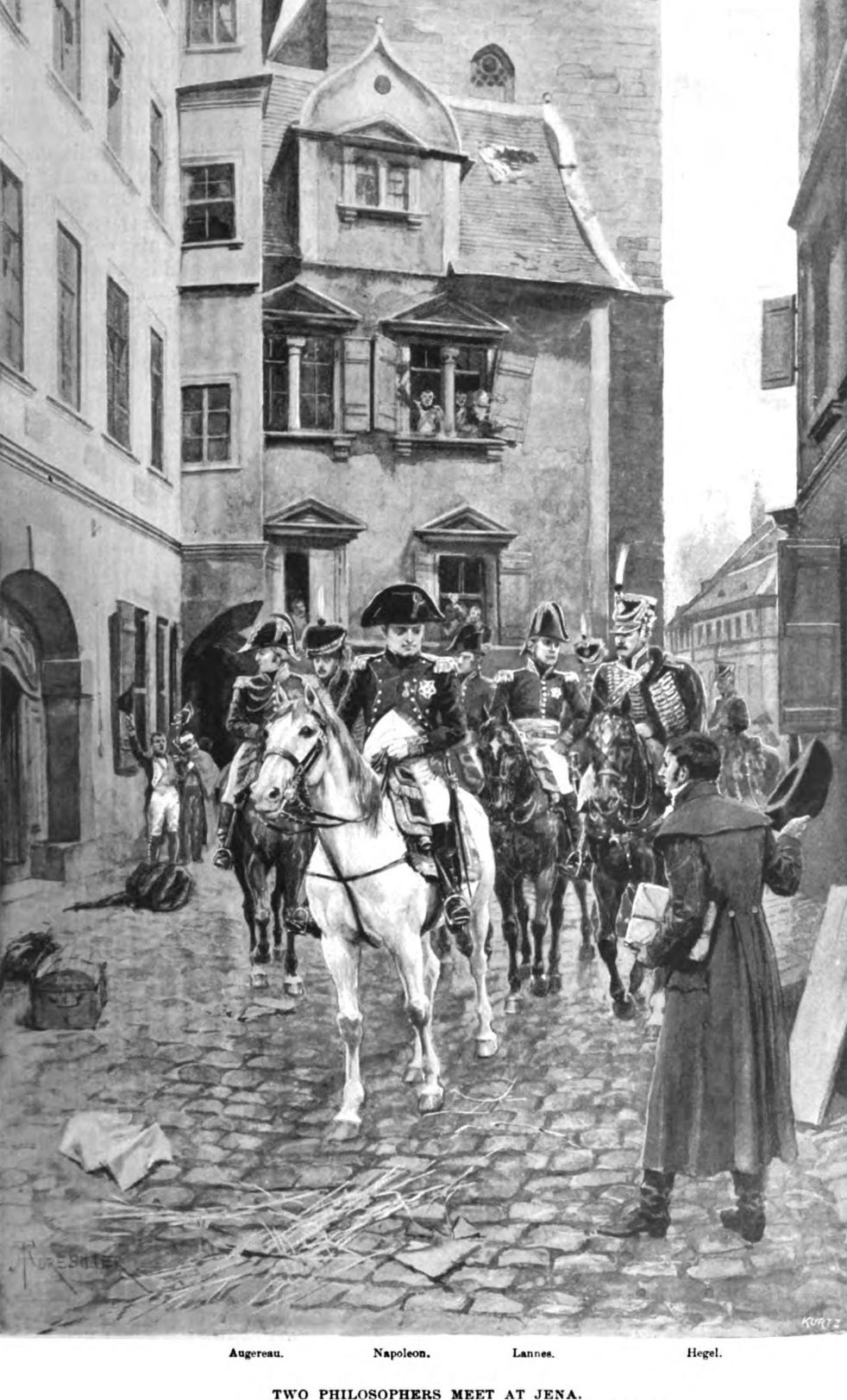
Finishing a great philosophical book is hard under any circumstances, but in this case it was especially difficult because Napoleon’s army was camped on the hills above Jena ready to capture the town at any moment. To make matters worse, the publisher was located in Bamberg, another town already captured by the French army and deep behind enemy lines. If the French army descended on Jena before the deadline, it would be incredibly difficult to deliver the manuscript
That afternoon the author watched Napoleon ride through the streets of Jena, and wrote to a friend:
“I saw the Emperor — this world-soul — riding out of the city on reconnaissance”
The philosopher was Georg Wilhelm Friedrich Hegel (“Hegel” for short) and although he didn’t know it at the time, the manuscript he was writing would go on to become one of the most significant works of philosophy ever written.
It was called The Phenomenology of Spirit.
The praise for Hegel from significant thinkers such as Marx, Merleau-Ponty, Habermas, Derrida, Martin Luther King Jr., and several others, is staggering.
Alexandre Kojève is quoted as saying:
“It may well be that the future of the world … will depend in the last analysis on contemporary interpretations of Hegel’s work”
And Maurice Merleau-Ponty, the great 20th century phenomenologist wrote:
“All the great philosophical ideas of the past century — the philosophies of Marx and Nietzsche, phenomenology, German existentialism, and psychoanalysis — had their beginnings in Hegel”
“Interpreting Hegel means taking a stand on all the philosophical, political, and religious problems of our century”
— Merleau-Ponty, “Hegel’s Existentialism” (1946)
Regarding the Phenomenology in particular, Walter Kaufmann writes that it was:
“A wild, bold, unprecedented book that invites comparison with some great literary masterpieces”
— Walter Kaufmann, Hegel: A Reinterpretation (1965)
Karl Marx called it:
“The true point of origin and the secret of the Hegelian philosophy”
— Karl Marx on the Phenomenology, Economic and Philosophic Manuscripts (1844)
The great Existentialist Simone De Beauvoir, who read Hegel while living in Nazi occupied Paris, wrote that:
“The richness of his thought overwhelmed me”
— Simone de Beauvoir, diary, 1940
Reverend Martin Luther King Jr., who took a seminar on Hegel in the 50’s, wrote that:
“His analysis of the dialectical process, in spite of its shortcomings, helped me to see that growth comes through struggle”
The great American Pragmatist Charles Sanders Peirce wrote that:
“Hegel, is in some respects the greatest philosopher that ever lived”
— Charles Sanders Peirce, Lowell Lectures (1903)
And last but not least, Nietzsche:
“Without Hegel there would have been no Darwin”
Friedrich Nietzsche, The Gay Science §357
At the time of his death in 1831, Hegel was the most powerful philosopher in Germany whose challenging and original ideas directly altered the course of world history.
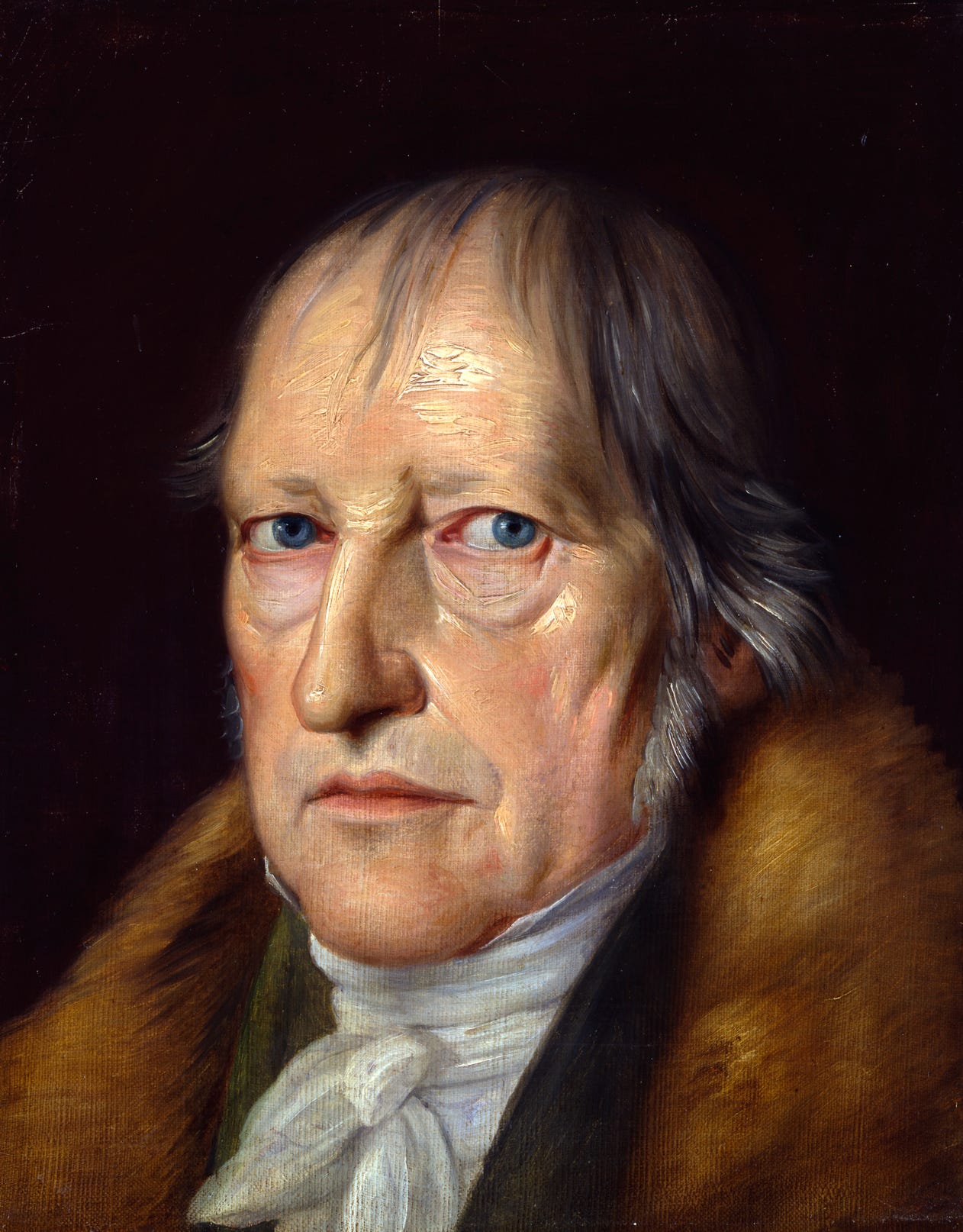
Hegel’s influence was so significant after his death that the government in Berlin wanted to reduce his philosophical and political influence on younger generations of students. The philosopher Friedrich Wilhelm Joseph Schelling (“Schelling” for short), who was Hegel’s old roommate and estranged friend, was appointed chair at the University of Berlin in order to deliver lectures directly aimed at dismantling Hegel’s philosophy.
In the audience for these lectures say Friedrich Engels, Marx’s future collaborator, and a 28-year-old Dane named Søren Kierkegaard (the grandfather of existentialism).
Kierkegaard came away convinced that Hegel’s grand system explained everything except the one thing that mattered most — the individual human being who has to choose for themselves, suffer and die.
“Existence itself is a system — for God,” Kierkegaard wrote, “but it cannot be a system for any existing spirit”.
A century later in Paris, Sartre and Beauvoir took Hegel’s ideas and applied them to their analysis of everyday human life.
Most significantly, Hegel’s philosophy was the main source of inspiration for a young Karl Marx. Marx famously took some of Hegel’s biggest ideas and “inverted them” by bringing them down from the world of ideas into the material world of labor and political economy.
It would be hard to name any author who has had more impact on the course of world history than Karl Marx. Depending on your philosophy of history, it is not totally unreasonable to believe that, without Marx, events such as the Vietnam War never would have happened.
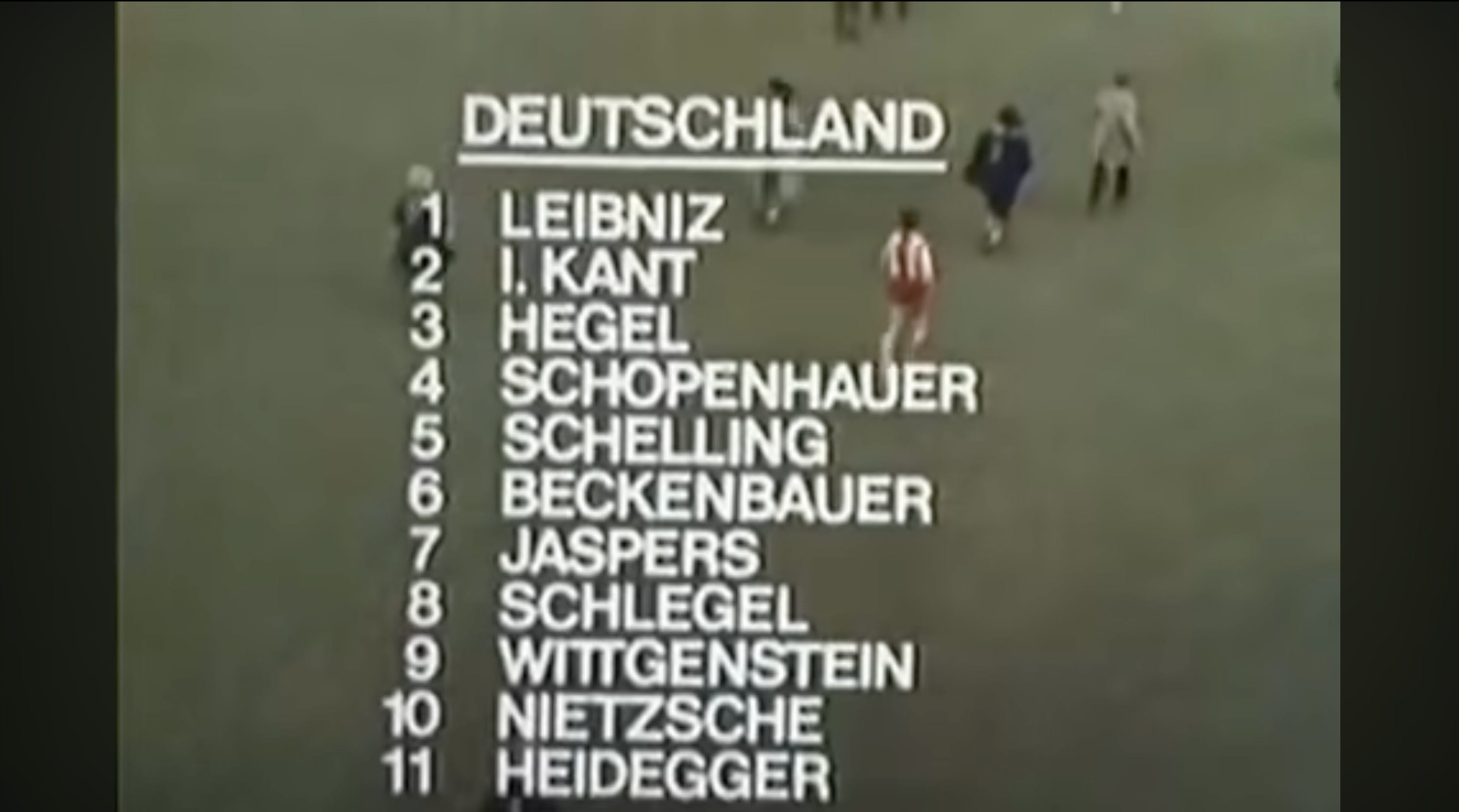
(They would also end up playing on the same side in football — although Marx came off the bench and did not make the starting XI).
Hegel is now widely considered the most difficult philosopher of all-time and, for some, the most significant thinker in the last several centuries. It is always possible to nitpick with these kinds of claims, but what’s important is that he was a monumental thinker whose ideas continue to exert their influence on the human spirit.
The Phenomenology is thus the initial step in the intellectual journey that was to take Hegel from the obscurity of his early career in Jena and Bamberg, where he struggled to make any kind of mark, to the eventual triumph of his period in Berlin, where ‘what does Hegel think about it?’ was the first question of the chattering classes”
— Robert Stern, The Routledge Guidebook To Hegel’s Phenomenology of Spirit
Why Hegel? Why Now?
The list of people Hegel influenced is a good reason to be curious about him.
For some, being in a position to understand the Enlightenment, Marxism, and Existentialism is reason enough to commit to reading Hegel.
But there are deeper reasons why Hegel’s ideas matter today.
The real reason to read Hegel is what the book does to the person reading it.
First, the Phenomenology shows you the lenses that have shaped the modern world and that all of us are already living through.
You may not think of yourself as having a philosophy, but you have one. We all do.
You carry assumptions about what counts as real, what counts as knowledge, what a self is, and what freedom means. You did not choose most of them initially, but that doesn’t mean you can’t come to understand them and reshape them on your own terms.
Hegel warns us that “the familiar, just because it is familiar,” is not thereby understood.
The Phenomenology drags these assumptions into the light one at a time and makes each of them answer for itself. You come out the other side able to see your own thinking, which is a different thing from simply having more thoughts or acquiring more knowledge.
Second, it teaches you how to think through a position instead of merely attacking it.
We live in a world of instant verdicts and pre-determined judgments. The result is that genuine thinking is disappearing rapidly.
Everything is sorted into easy categories.
Hegel’s philosophy teaches us how to demand more from ourselves.
He takes each way of understanding the world, walks you through it from the inside, and holds it to its own standard until it breaks by its own logic. After that he keeps what was true in it and carries that forward into a higher synthesis.
After learning how to think more critically with Hegel, you will find it hard to dismiss an idea you have not first understood from the inside.
I know of no better training for a philosophical mind than this sort of exercise.
Third, the Phenomenology frees us from either/or thinking.
Most of our deepest arguments are stuck between two poles. It can feel like nothing will ever get solved. This leads to skepticism and the belief that what’s true is just “what feels right for me”. Our world is defined by rigid binaries:
The individual or the community.
Freedom or order.
Reason or faith.
Science or meaning.
We are forced to pick a side and defend it against the other forever.
Hegel’s tries to show that when an argument cannot be settled, the fault usually lies in the opposition itself. Each side is holding half of something and mistaking it for the whole. Learning to see that is what “dialectic” means, and once you have learned how to think dialectically, all debates will look permanently different.
Fourth, Hegel cannot be simplified or summarized.
We live in a world that continuously tries to shrink big ideas into “mental models” or “tips”. But genuinely difficult ideas cannot be summarized or reduced. They are like poetry.
How can summarize a poem? You can’t.
You have to read it. That’s the point.
Reading Hegel is an act of resistance against the dominant trends of our time and a commitment to real thinking and learning.
The difficulty is what makes it worthwhile.
The ultimate goal of Hegel’s philosophy is to solve the problem of modernity, which is alienation.
The feeling of being lost in the world — not at home.
The modern condition, as Hegel saw it, is one in which we are surrounded by institutions, ideas, and histories we did not make and do not understand. To comprehend how they came to be, and how we came to be through them, is to be at home.
Hegel was trying to repair what has been fragmented and return the human spirit to its proper home by helping us understand ourselves.
In the rest of this essay, I want to provide a general introduction to Hegel’s philosophy as well as to his incredible book The Phenomenology of Spirit. Most of the ideas below come from my reading of Robert Stern’s excellent Routledge Guidebook To Hegel’s Phenomenology of Spirit, which I highly recommend as an introduction to Hegel.
We will be doing a slow read of the entire book through my online philosophy school called The Micro-University. If you want to join, we start on November 21st. You can read more about the live seminar here.
Hegel and German Idealism
It is not possible to understand Hegel without having a general sense of how he fits into the incredibly rich philosophical movement known as German Idealism.
The movement or period of German Idealism is generally taken to span from the publication of the first edition of Immanuel Kant’s Critique of Pure Reason in 1781, to the decline of Hegelianism in the 1840s.
Some historians of philosophy believe that German Idealism rivaled classical Greek philosophy for originality and significance.
German Idealism was inaugurated by Kant’s “critical philosophy” which attempted to set metaphysics on “the secure path of a science” and to balance the competing perspectives of determinism in natural science and freedom in morality.
Kant

If there is a serious competitor for Aristotle’s title of “The Philosopher” in the Greek/European tradition, it would be the German philosopher Immanuel Kant.
Although Kant was aiming to show how metaphysics is possible, especially in response to David Hume’s skeptical arguments, many people interpreted Kant’s critical philosophy to demonstrate the limitations of human knowledge.
Kant’s incredible arguments were taken at the time to prove that human knowledge and rationality is, in fact, incredibly limited.
Kant’s successors therefore sought to go beyond his philosophy and find another philosophical system that would achieve what he had set out to do. The ambitious hope was to build a philosophical system that could support the natural sciences, the arts, history, as well as epistemology, metaphysics, ethics, political philosophy, and philosophy of religion.
Clearly, this was an age of grand philosophical ambition.
It is at this point in history that many of the paradigms of modern thinking were formed.
Hegel’s Phenomenology was his first major contribution to shaping them.
The Phenomenology Of Spirit
The publication of the Phenomenology in 1807 marks the beginning of Hegel’s “mature” philosophy and is treated by Hegel as a “ladder” to his final position.
The Phenomenology is the first work in which Hegel began to lay out his own distinctive approach to the problems that had concerned his predecessors and to construct a position that is recognizably “Hegelian”.
The Phenomenology provides the initial step in the intellectual journey that was to take Hegel from the obscurity of his early career in Jena and Bamberg, where he struggled to make any kind of mark, to the eventual triumph of his period in Berlin, where ‘what does Hegel think about it?’ was the first question of the chattering classes.
Hegel was a systematic philosopher through and through.
What this means is that he was not content to write about particular topics or issues, but sought to provide total explanations and solutions to philosophy’s deepest issues. He writes that:
‘[a]part from their interdependence and organic union, the truths of philosophy are valueless, and must then be treated as baseless hypotheses, or personal convictions’ -Hegel, Encyclopedia Logic
In other words, what matters in the complete whole of our thinking, not individual claims and ideas taken on their own.
The first published version of Hegel’s system as a whole, with its division into Logic, Philosophy of Nature, and Philosophy of Spirit (Geist), is the edition of the Encyclopedia of the Philosophical Sciences that appeared in 1817.
Hegel believed that his complete system needed a proper introduction, which is why he started writing the work that would come to be called Phenomenology of Spirit (His first title for this work was a ‘Science of the Experience of Consciousness’ which was the title originally envisaged for a shorter introduction to his system).
“It is this coming-to-be of Science as such or of knowledge, that is described in this Phenomenology of Spirit”
-Hegel, Phenomenology of Spirit, 8
The Phenomenology was considered to be a ‘ladder’ designed to take us towards the standpoint of Hegel’s complete philosophical system.
It is a preparatory journey of consciousness that will allow us to see things from a higher perspective.
According to Robert Stern, Hegel’s comments on the rationality of the world “may stand as an epigraph for Hegel’s philosophy as a whole” (Stern, 2002). For example, Hegel wrties:
“In everything that is supposed to be scientific, reason must be awake and reflection applied. To him who looks at the world rationally the world looks rationally back; the two exist in a reciprocal relationship”
-Hegel, Lectures on the Philosophy of World History
The ultimate aspiration of Hegel’s philosophy was to reconcile human rationality with the rationality of the world.
If we can get ourselves to see the world the right way, we will see that the world is rational. The goal of human inquiry is to “bring this rationality to consciousness” —in other words, to become aware of this rationality and achieve a fully adequate comprehension or understanding of reality.
In claiming that the world is rational in this respect, one thing Hegel means is that there is nothing fundamentally flawed in the human intellect or the order of the universe. The world is not unknowable, incomprehensible, or irrational. The human mind is capable of understanding and knowing the nature of the world. We are not doomed to folly or misunderstanding.
As the world itself is rational in this way, once we can see that this is the case, the world will then show itself to us in the right way.
The result?
What Hegel called absolute knowledge — the highest form of intellectual satisfaction.
Until that point is reached, Hegel calls our knowledge “finite” or “conditioned”.
Now, as Hegel also makes clear in this comment, whether we attain this state of absolute knowledge depends on us and how we look at the world.
If we are unable to view the world correctly, it will not appear satisfactory to our reason.
The world will appear to contain elements that are incomprehensible, contradictory, and alien.
The cost of this is that we will fall into “despair”.
You might have reason to believe this is what is currently happening with “the meaning crisis”.
Hegel aims to give us a way of resolving those difficulties by finding a new way of looking at things, to show us the world as it intrinsically is when these difficulties are removed.
Hegel thus believes that the greatest contribution philosophy can make is to help us overcome our despair, by providing us with fresh ways of thinking about reality, thereby bringing us back to our sense that the world is a rational place, one in which we can truly feel ‘at home’ (the opposite of alienation).
‘“I” is at home in the world when it knows it, and even more so when it has comprehended it’”
Hegel, Philosophy of Right, 36
And…
“‘The aim of knowledge is to divest the objective world that stands opposed to us of its strangeness, and, as the phrase is, to find ourselves at home in it: which means no more than to trace the objective world back to the notion – to our innermost self.’)”
Hegel, Encyclopedia of Logic, 261
In order to achieve this goal, Hegel says that “reason must be awake and reflection applied”.
Philosophy must take a reflective stance.
It does this by identifying and guarding against those forms of thought that lead us to adopt an intellectual or practical conception of the world that prevents it from appearing rational to us in the way it should (when viewed properly).
Philosophy must therefore set out to correct those outlooks which create the puzzles that stop us from seeing reason in the world. It can show us how these outlooks arise and can be overcome. Philosophy doesn’t give us the single answer about what is true, it dissolves the puzzles presented to us so that we can see clearly.
If philosophy fails, then the prospects of despair, skepticism, and irrationalism are all but unavoidable. What’s worse, the world becomes unheimlich — a place in which we are “not at home”.
Our spirits become restless and confused.
Once philosophy is used to help humanity overcome its estrangement from the world, our consciousness can achieve its freedom and find its home.
What caused the conflicts that have alienated us from ourselves and the world?
Us.
We are responsible because of “one-sided” thinking which has fragmented our ability to understand reality and our place in it: binaries, dualisms, and irresolvable disagreements.
For example, the Enlightenment disrupted traditional forms of knowing and failed to fully replace them.
Reason, which was the primary weapon used by Enlightenment thinkers against old dogmas, was therefore seen as leading to skepticism. Science was seen as leading to mechanistic materialism. Social and political reforms to bloody revolution and instability. And humanism to immorality, individualism, and hedonism.
In Hegel’s time, there was a felt need to find a way out of this uncomfortable situation.
For Hegel, the new direction should not involve the simple repudiation of reason, science, social reform, and so on, after realizing what they lead to. Instead, he argued that the conceptual assumptions underlying the way these ideas had been developed required investigation, to show how they could be taken forward in a less limited and one-sided way.
The way forward was reconciliatory, rather subtractive.
As Stern writes:
“Hegel’s position is therefore distinctive in continuing to give philosophy the exalted role of restoring our sense of intellectual and spiritual well-being, albeit a philosophy that thinks in a new, non-dualistic, way”
Stern, The Routldege Guide to Hegel’s Phenomenology of Spirit
The Phenomenology As Conceptual Therapy
Hegel takes it that in order for his system to succeed in showing how we can find rational satisfaction in the world, we must enter into a process of conceptual therapy.
But there are two preliminary difficulties which must be overcome.
The first is that we may feel no need for this therapy.
This can happen for a variety of reasons. We may not see the problem for which this therapy is the solution, we may not see that non-dialectical thinking is the source of the problem, or because we may think the problem is intrinsically unsolvable.
These are all reasons people may avoid therapy in their personal lives.
The second difficulty is that we just may not know how to go about making the kind of dialectical revisions that Hegel believes are required to follow through the transitions of the Logic.
As an introduction to the system, the Phenomenology therefore has two fundamental tasks, one motivational and the other pedagogic.
The motivational task is to make us see why we are required to undertake the kind of reflective examination of our categories that takes place in the Logic.
Hegel points out that though we use categories all the time (such as cause and effect) we do not usually recognize that the categories we adopt in this way have a vital influence on how we view and act in the world.
Therefore, we do not see the importance of critically reflecting on them. We just use categories, like being, without realizing it or questioning it.
Hegel writes:
“All our knowledge and ideas are entwined with metaphysics like this and governed by it; it is the net which holds together all the concrete material which occupies us in our action and endeavour. But this net and its knots are sunk in our ordinary consciousness beneath numerous layers of stuff. This stuff comprises our known interests and the objects that are before our minds, while the universal threads of the net remain out of sight and are not explicitly made the subject of our reflection”
Hegel, Lectures on the History of Philosophy
This is actually one of the main ideas behind my concept of a birthview.
Your birthview is the worldview or worldviews you were born into that have provided you with the metaphysical categories you use to make sense of your life. These are very often so deep in the background of our lives that we are completely unaware of them.
Another reason ordinary thinking may resist the work proposed by Hegel is not merely because it finds no need for it (the motivational problem), but it may find Hegel’s philosophy too counter-intuitive and intellectually demanding.
Hegel seeks to overturn our conceptual certainties and this can be disorienting and uncomfortable as we may have no idea how to proceed without them.
‘The mind, denied the use of its familiar ideas, feels the ground where it once stood firm and at home taken away from beneath it, and, when transported into the region of pure thought, cannot tell where in the world it is’
(EL: §3, p. 7).
The Phenomenology helps consciousness to gradually question the conceptual certainties it takes for granted and thus to move to a position where it can see what it might mean to give them up. Thus, as consciousness proceeds through the Phenomenology, it comes to set aside some of its ‘familiar ideas’, so that by the end it is prepared for the kind of explicit examination of those ideas that is achieved in Hegel’s book called Logic.
The Phenomenology is therefore written in a distinctive style, in so far as it has a story to tell from two points of view.
First, there is the point of view of ordinary consciousness, which is undergoing this experience of moving from confident ‘certainty’ to despair, to renewed certainty as it revises its position and sees things in a different way.
Second, there is the point of view of Hegel (and us) as observers of this consciousness, who already occupy the speculative standpoint, and who can therefore see, in a way that consciousness itself cannot, what is going wrong for it and why.
This can be a strange reading experience in some ways because we are both reading about the journey of consciousness while undergoing the transformation ourselves. Additionally, Hegel will often break the fourth wall and describe what’s happening to the experience of consciousness and speak to us about what’s really going on.
In other words, it is important to keep track of which point of view is really speaking and seeing.
Ultiamtes, Hegel’s goal is to get us to see that the development of consciousness in the book is inevitable given the internal logic of the one-sided positions he considers.
Robert Stern writes:
“It is certainly the case that perhaps the greatest challenge to any reading of the Phenomenology is to show how it can be understood as a coherent and well-ordered work, and to fit its bewildering range of topics into a satisfactory and unified philosophical conception”
Stern, The Routledge Guidebook To The Phenomenology of Spirit
Despite this difficulty, Stern believes that there is an “underlying unity of purpose and method”.
The only catch is this.
You can’t fully grasp it at the outset. You need to begin your journey through the stages of consciousness and see for yourself where it leads.
The Phenomenology of Spirit is the bildungsroman of human consciousness itself and the most important philosophical book of the 19th century.
I’m unable to signup for the seminar without it redirecting to sign up for the Substack, which I’m already subscribed.
Thanks for sharing 😄 Hegel racing a publisher's deadline with Napoleon's army on the hills above Jena. What an opening.