


If there is a serious competitor for Aristotle’s title of “The Philosopher” in the Greek/European tradition, it would be the German philosopher Immanuel Kant.
Kant’s philosophy is nothing short of revolutionary, fundamental, and wide-ranging.
Significant portions of philosophy as it is practiced today are directly shaped by Kant’s thought.
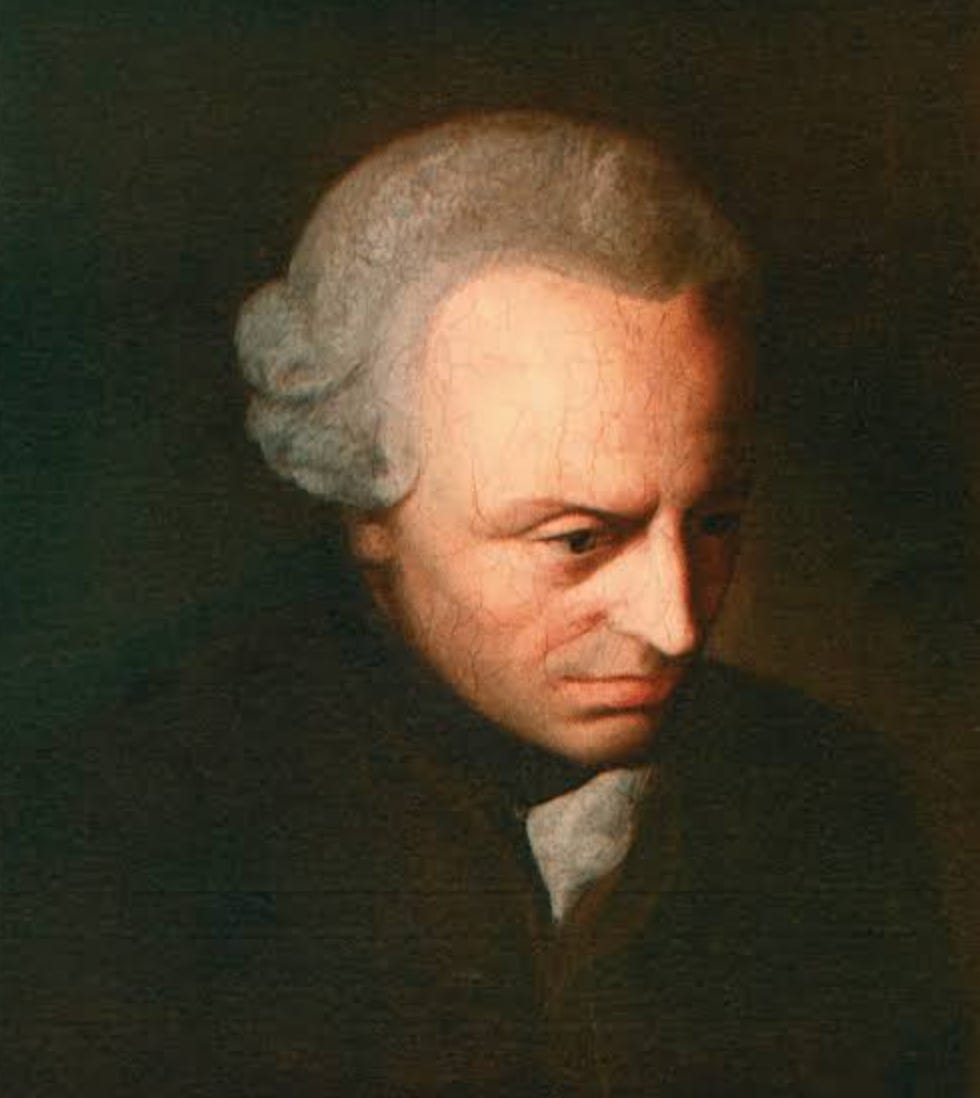
Like many philosophers before and since, Kant tried to rebuild philosophy from the ground up. While there is good reason to question whether such a project is ever really possible, if there was ever anyone who approached actually doing it, it would be Kant (the list of western philosophers who have a reasonable claim to have “rebuilt” philosophy is very short in my book: Plato, Aristotle, Descartes, Kant, Heidegger).
Kant wanted to show that philosophers and natural scientists would never be able to give final answers to questions about the nature of the physical world and of the human mind or soul, and about the existence and attributes of a supreme being.
Why?
Not because he was some kind of skeptic.
But because there were fundamental and important limitations on human reason that we must be aware of and respect.
Kant’s work changed philosophy’s conception of what can be known, and how it can be known.
After Descartes, “modern” philosophy really came to be centrally concerned with questions of knowledge and the relationship between mind and world.
As such, Kant’s philosophy forms the very core of modern philosophy.
As Gary Hatfield writes:
His criticism of previous work in metaphysics and the theory of knowledge, propounded in the Critique of Pure Reason and summarized in the Prolegomena, provided a comprehensive response to early modern philosophy and a starting point for subsequent work.
Kant rejected previous philosophical explanations of cognition (thinking), and was critical of his predecessors’s (Descartes) use of reason or “pure intellect” as the basis for making claims about God and the essences of mind and matter.
The big questions was this:
What can we really know through the pure use of human reason?
Kant famously argued that these philosophers could not possibly know what they claimed to know about such things, because direct knowledge of a mind independent reality exceeds the capacity of the human intellect.
This is why Kant is considered, to some extent, an “Idealist”.
Idealism is a general family of philosophical views which have different meanings, but for our purposes here, Kant is an idealist in the sense that what we can really know is limited to important truths about our own minds rather that “objective” reality.
Kant was therefore sympathetic to Empiricism and the work of philosopher such as Locke and Hume, who prescribed real limits to human understanding as a result of the limitations of human experience to contact ultimate reality.
Kant was not merely an empiricist, however.
He contended that because these philosophers did not also analyze human cognition properly, they lacked knowledge of the principles by which the boundaries of human knowledge might be outlined. Kant thought that, as a result, they did not understand how it metaphysics could be possible within the boundaries placed on human knowing. In other words, Kant believed that there were important truths we could know through pure thinking and rational argument, even if those truths were fundamentally limited.
In fact, Kant maintained that without a proper understanding of reason and its limitations, even the empiricist attitude to knowledge would inevitably lead human beings to making claims that go beyond its own domain in the world of nature, and therefore produce unjustified assertions about such topics as free will, the existence of God, and the nature of objective morality.
Kant was especially interested in the philosophical implications of Newton’s physics in relation to both metaphysics and morals, for he was concerned that the deterministic picture of the world in physics posed a threat to the idea of moral freedom. Without moral freedom, Kant thought, objective moral requirements are impossible.
Life And Work
Immanuel Kant was born in Konigsberg on April 22, 1724.
He went on to study at the University in Konigsberg from 1740 to 1746, supporting himself with the help of his uncle, by tutoring, and through his skill at billiards and card games.
During this period Kant came to admire the work of Isaac Newton as a provided a paradigm for what natural science should look like.
Kant finished his doctoral dissertation in 1755 and served as a private lecturer paid directly by the students. He was a popular lecturer and covered a broad curriculum, which included logic, mathematics, morals, physics, metaphysics, and physical geography.
As his reputation grew Kant turned down opportunities for appointment elsewhere, having his heart set on a professorship in Konigsberg. At the age of 45, Kant finally received an permanent appointment as Professor of Logic and Metaphysics.
He continued to lecture on the topics already mentioned, and during the 1770s added anthropology, education, natural theology, and natural law to his repertoire.
His “Inaugural Dissertation” for the new appointment was titled On the Form and Principles of the Sensible and the Intelligible World. In this work, he distinguished between sensible and intelligible “worlds,” the first being known via sensory cognition of things as they appear (i.e., phenomena), the second via intellectual cognition of things as they are in themselves (i.e., noumena) (this distinction between the phenomenal and noumenal realm would prove to be important for his later theoretical work).
After the publication of the Inaugural Dissertation, Kant entered his “silent decade,” which produced no major publications but which famously ended in 1781 with the publication of his most significant work of all — the Critique of Pure Reason.
Having reflected on previous efforts in theoretical philosophy (including his own), Kant saw the need to pose a new question, which contained the “key” to metaphysics:
“I asked myself: What is the ground of the relation to the object of that in us which is called representation?”
Kant’s Critique of Pure Reason appeared nine years after he first proposed the work.
It was followed by another major work about every two years until 1790.
These included the Prolegomena, the Metaphysics of Morals, the Metaphysical Foundations of Natural Science, and the second and third of his major “critical” works, the Critique of Practical Reason and the Critique of the Power of Judgment.
The second and third Critiques, referenced above, respectively explained the possibility of moral judgment and examined the conditions for judgments of beauty and of natural purpose (teleology). These critiques continued Kant’s exploration of the function of reason itself, as a faculty that seeks unity between the understanding’s cognition of nature and natural laws, and its own grasp of the moral law and of the harmony, systematicity, beauty, and organization of nature.
Kant’s vision of reason as seeking unity between the natural and moral worlds remains of interest today, as philosophers reflect on the natural scientific picture of the world and seek to determine the relation between that picture and the moral, political, historical, legal, and aesthetic visions inherent in the social and cultural world of humankind.
In many ways, how to square our scientific and moral commitments remains one of the most difficult and interesting areas of philosophical research.
Kant was not a great writer in terms of style, but on the hundredth anniversary of his death a monument was erected to him containing a famous line from the concluding section of the Critique of Practical Reason.
It was the best sentence he ever wrote:
“Two things fill the mind with always fresh and growing wonder and veneration, the more often and the more continuously they are reflected upon: the starry heaven above me, and the moral law within me”
Kant’s “Copernican Revolution”
Kant described his own work as revolutionary, and drew an analogy between his “critical project” (meaning critique of reason) and the Copernican revolution in astronomy.
According to Kant, Copernicus was better able to account for the phenomena of astronomy by assuming that the motion attributed to the stars actually results from the motion of the observer as stationed on the earth.
Kant held that he could account for the human ability to know the basic properties of objects only on the assumption that the knower contributes certain features to those objects as known. In answer to his querstion above, he therefore held that the fundamental characteristics of objects as experienced — characteristics described by mathematics (especially geometry) and also by metaphysical concepts such as cause and substance — result from something that the knowing subject brings to such experience.
This idea, that we ourselves contribute or produce our own understanding of reality, but it’s not the case that “everything is subjective,” certainly was revolutionary.
Kant was not a pure Idealist.
He did not think it was all in our heads.
