

The Micro-University
What if you could receive a complete philosophy education for less than 1% of the cost of a bachelor’s degree? The Micro-University is a completely new online school of philosophy designed to provide exactly this.
Universities have become educational buffets.
Their expenses are out of control — which means their students end up paying $50,000+.
They offer everything to everyone in order to lure in aimless youths— meaning that students eventually end up paying for things they don’t actually want or use.
They don’t specialize in doing one thing excellently — meaning that the educational quality fluctuates from class to class.
Many universities have forgotten that their main purpose and priority should be education, not research.
I am convinced that it is now possible for individuals to receive a similar or in some cases better education online and for less than 1% of the cost of a traditional degree.
How is this possible?
It is possible because platforms like Substack have helped highly qualified content creators and writers identify the exact needs and interests of their audience and design courses that are specifically tailored to give them what they want.
What’s more is that these courses can be offered without needing to build any buildings, pay for utilities, security guards, or administrative staff.
This means that they cost virtually nothing when compared to their university counterparts.
Critics will argue that the in-person element and community aspect of universities is irreplaceable.
Maybe.
But is it worth an extra $5,000 per course? Or $25,000 per year?
Entire companies are run through Zoom and Google Meet.
I created The Micro-University to serve as a platform that allows me to teach the exact same or better content that I teach at elite universities, but without the absurd paywall and gatekeeping practices of the modern university.
My goal is to offer a lean and high-quality education experience that cuts out all of the middleman and unnecessary costs and deliver real learning directly to the student.
If that is something you are intersted in, you can learn more about it below.
Modern technology has made it possible for a single individual to reach thousands of students around the world interested in studying philosophy and deliver a high-quality education without incurring massive costs (buildings, employee benefits, marketing, etc.).
Over the past few years, I have secretly been training myself to be in a position to do this by developing a broad knowledge of philosophy across multiple sub-fields in order to see the macro-patterns.
I quietly became a philosophical generalist.
By forcing myself to teach new subjects every semester, I had to develop a special ability to learn new things through relying on pattern recognition and frameworks that allowed me to contextualize new information based on what I previously studied.
Here is a list of complete courses I have taught since starting my PhD:
PHIL 001: Intro To Philosophy
PHIL 127: Existentialism
PHIL 298: Philosophy As The Art Of Living
PHIL 1380: Aesthetics
PHIL 1110: Ancient Greek Philosophy
PHIL 2221: Philosophy: East and West
PHIL 1330: Intro To Ethics
PHIL 1433: Social Contract
PHIL 1342: Bioethics
PHIL 2450: Justice, Law, and Morality
ETHC 2000: Ethics and Society
SPRO 1000: Scientific Reasoning
PHIL 1450: Philosophy of Law
PHIL 1343: Environmental Ethics
PHIL 25: Philosophy of Science
VLST 1010: Eye, Mind, Image
ISP 0001: The Self in Transformation (Grader)
PHIL 26: Philosophy of Space and Time
I have never forgotten the struggle it took to get to this point.
The struggle to read, the struggle to write, and the struggle to understand and enjoy philosophy.
I am creating this school to help people in the same way I remember that I needed help.
To get rid of the stupid roadblocks and questions that people are too afraid to ask, but that actually prevent them from progressing.
I want to explain everything that holds people back.
The title of the book. That random French word that makes you anxious. Whatever little thing it is that is “getting in the way”.
I also want to teach philosophy in a way that avoids turning it into a passive consumption machine.
Everything will be framed and presents as being direct towards using or integrating what you learn with your own life.
The general frame behind the whole university is philosophy for living (a return to the ancient philosophical schools of Athens).
That will add a unique twist to all of my courses.
Even the most abstract.
Everyone needs a good teacher, someone they can struggle with and grow with. I may or may not be able to be that for you. Honestly, a lot of that depends on the right fit and personalities coming together. But I am going to try. And I am not going to charge you tens of thousands of dollars to roll the dice for each class.
If you want to give it a shot, I would love to have you on board.
Information and knowledge have become commodities.
The future of humanity will reward perspective and creativity.
The aims and incentives are mass education are not your own, they are social, political, and economic.
The system wasn’t made for you!
No one is willing to go slow enough.
To do it the right way.
To take intellectual risks, to feel the tension of personal growth, and to transform.
We have replaced spiritual transformation with information consumption.
Mainstream education has been captured by the pursuit of wealth which forces it to become a new form of job training in order to justify it’s absurd costs.
When education becomes economic training, intellectual and spiritual development become secondary.
Some course and concepts are better suited for a self-paced experience, whereas other more advanced courses require a hands-on interactive learning experience akin to a college seminar.
My idea is to eventually have an entire curriculum in place where students can learn everything they would learn at a university if they were to study philosophy. At the beginning of the curriculum would be introductory self-paced courses. As students progress they would “unlock” advanced seminars.
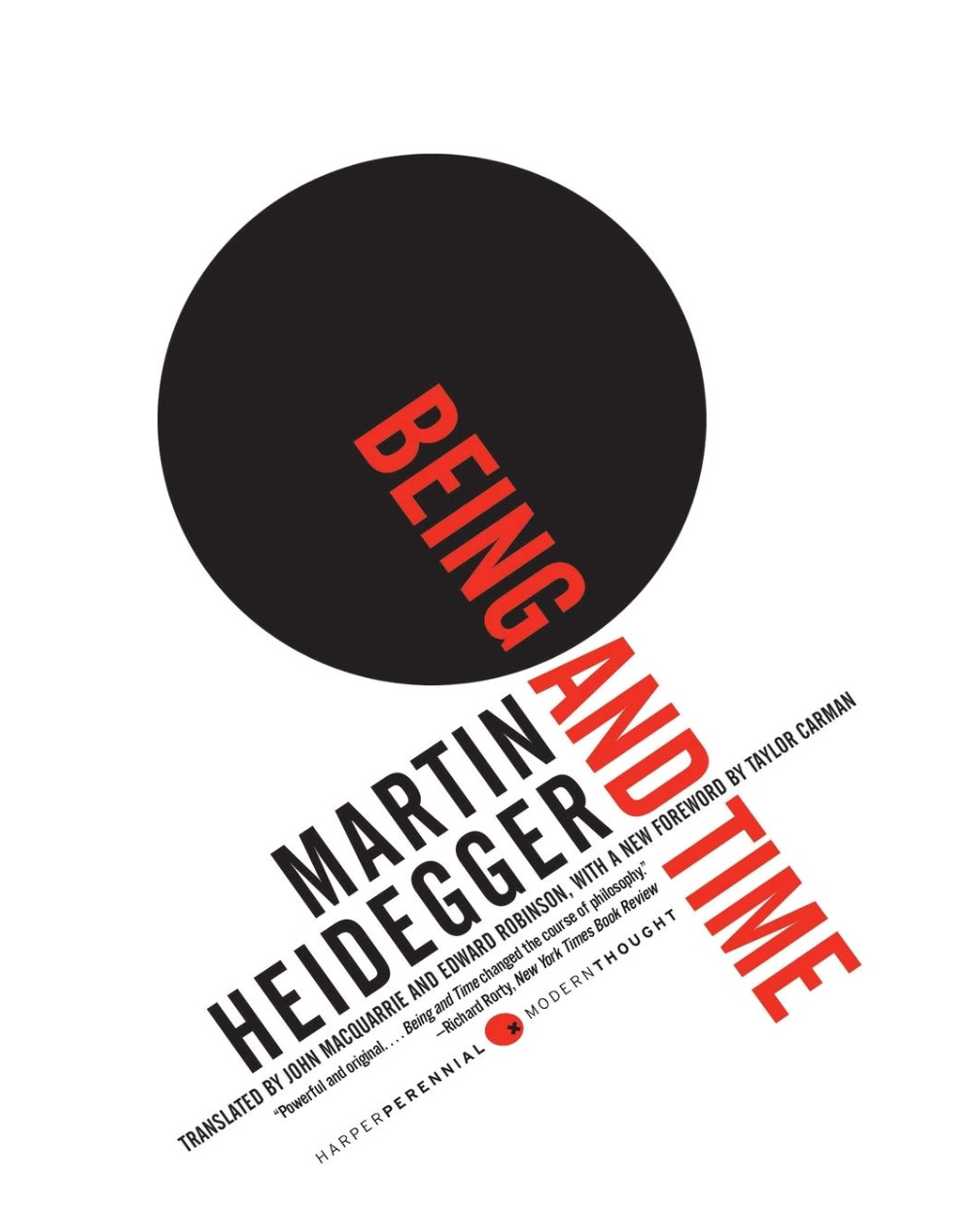
As a way to get this crazy journey started, I am proud to announce a new course on Heidegger’s Being and Time.
Current Course Offerings
Live Course #1: Heidegger’s Being And Time: A Complete Beginner’s (Starting March 15th, 2026)
The most important philosophical work of the 20th century is also one of the most difficult — Being and Time.
(You can access the course syllabus here)
Being and Time is a work perfectly suited for modern life.
It helps us think about our relationship to existence itself, the technological world, anxiety, death, authenticity and, most importantly, other people.
The internet craves depth, genuine thinking, and intellectual community. Unfortunately, there are fewer and fewer places someone interested in these things can go (not even most universities). This course is somewhere you can to go to challenge yourself intellectually, learn real philosophy (straight to the source), learn how to read philosophy in a hands-on way, discuss the text with others, and learn together.
I want this course to address those very real spiritual and intellectual needs and help beginners actually finish one of the truly great works in the history of philosophy.
Who Is This Course For?
I want to be clear that this course is for beginners.
This is not a space for someone to show off how much philosophy they have read and make others feel behind.
At the same time, this is also not a space for people who want to sit back and have me explain everything to them so that they don’t have to do any real thinking for themselves.
This is an intensive and interactive learning experience — not a series of lectures or videos.
We will be going through Being and Time together, line-by-line.
We will be interacting with each other. Asking questions. Sharing interpretations. Making exciting intellectual connections. Forming an intellectual mastermind.
This course is for anyone looking for one of the greatest intellectual challenges of their life — something that they will remember forever.
There is so much philosophy online today that tries to make things so incredibly simple and easy that people are left yearning for the real deal.
This is the real deal.
You are not going to understand everything. In fact, I am not going to understand everything.
But we are going to make serious progress together.
How Do You Join The Course?
The course is available through a subscription to The Micro-University here on Substack. You can subscribe to The Micro-University by upgrading to a paid subscription to The Micro-Philosopher Substack.
Membership to The Micro-University will give you access to the following:
Weekly live classes
Class recordings
Exclusive learning resources (handouts, guides, book reccomendations)
Private course chat (ask questions, learn together, build community)
(You can access the course syllabus here)
The Micro-University membership will also give you access to every other course (such as the Nietzsche course starting on April 18th).
Pricing
The per class rate for Being And Time: A Complete Beginner’s Course is $20 USD.
The course subscription is what makes it possible for me to dedicate significant time out of my work week to create and run the course at a high-level.
Since there will be one class per week, the subscription to The Micro-University will be $80/month (you can cancel anytime).
This gives people an opportunity to start taking the class and see if they find it valuable rather than making a huge commitment to a course that might not be for them.
Micro-University Spectator Program
Can’t afford the tuition, or too busy to make the live calls?
Consider being an auditor for a discounted rate (50% off). Being an auditor gives you access to everything but the live calls. This is a good option if you want to follow what’s happening and learn at your own pace for a discounted rate.
You can following this special link to access the Spectator Program and get 50% off your subscription:
https://themicrophilosopher.com/audit
When Does It Start/End? When Are The Meetings?
Over 70 people already expressed interest in the course from various time-zones.
After reviewing the wait-list (link below), I have decided to offer 2 sections of the course (limited to 15 seats in each in order to guarantee quality and depth). The majority of people are either in EST or PST, so I decided to schedule the meetings for the following day/time:
Section 1: Sundays at 12pm EST.
Section 2: Sundays at 2pm EST.
(If you live in Australia or Asia and have trouble joining, let me know and I will see if there is anything I can do to make it more accessible)
If you already signed up for the waitlist, the way to officially guarantee your seat is by subscribing to my Substack monthly or yearly plan which gives you access to The Micro-University.
Once you subscribe, you’re in.
There are already 12 people who officially subscribed, which means that there are 18 seats remaining for this version of the course.
Seats are first come first serve for the course, so once it fills up, I will have to close sign-ups to maintain a small class size.
If you subscribe before March 1st, you can guarantee your spot early without risking it by waiting.
The course will end when we finish section 66 of Being and Time (roughly 380 pages).
This could take a while because we are going to go at the pace necessary to actually understand and learn the material, not simplify and skip over it. Even if you don’t make it to the end, each lesson will be valuable on its own because you will be practicing and improving your philosophical reading, thinking, and discussion skills in a very real way with me as your guide.
(You can access the course syllabus here).
Free Resources
I have prepared some resources already for you to consult as we begin the book.
I have created two sets of lecture notes titled “Heidegger’s Philosophical Project In Being And Time”. These notes provide a very high level introduction to Heidegger, the history of the book, and why his philosophical project is interesting and important.
The first video is available here:
Heidegger’s Philosophical Project In Being and Time Part I
The second video will be available either today or tomorrow.
The lecture notes for each video are available here:
Finally, I have also created this living google sheet where I will share book, article, podcast, and video recommendations with some notes about each and a difficulty rating.
Live Course #2: Nietzsche, “Beyond Good & Evil: Prelude To A Philosophy Of The Future” (Starts April 18th)
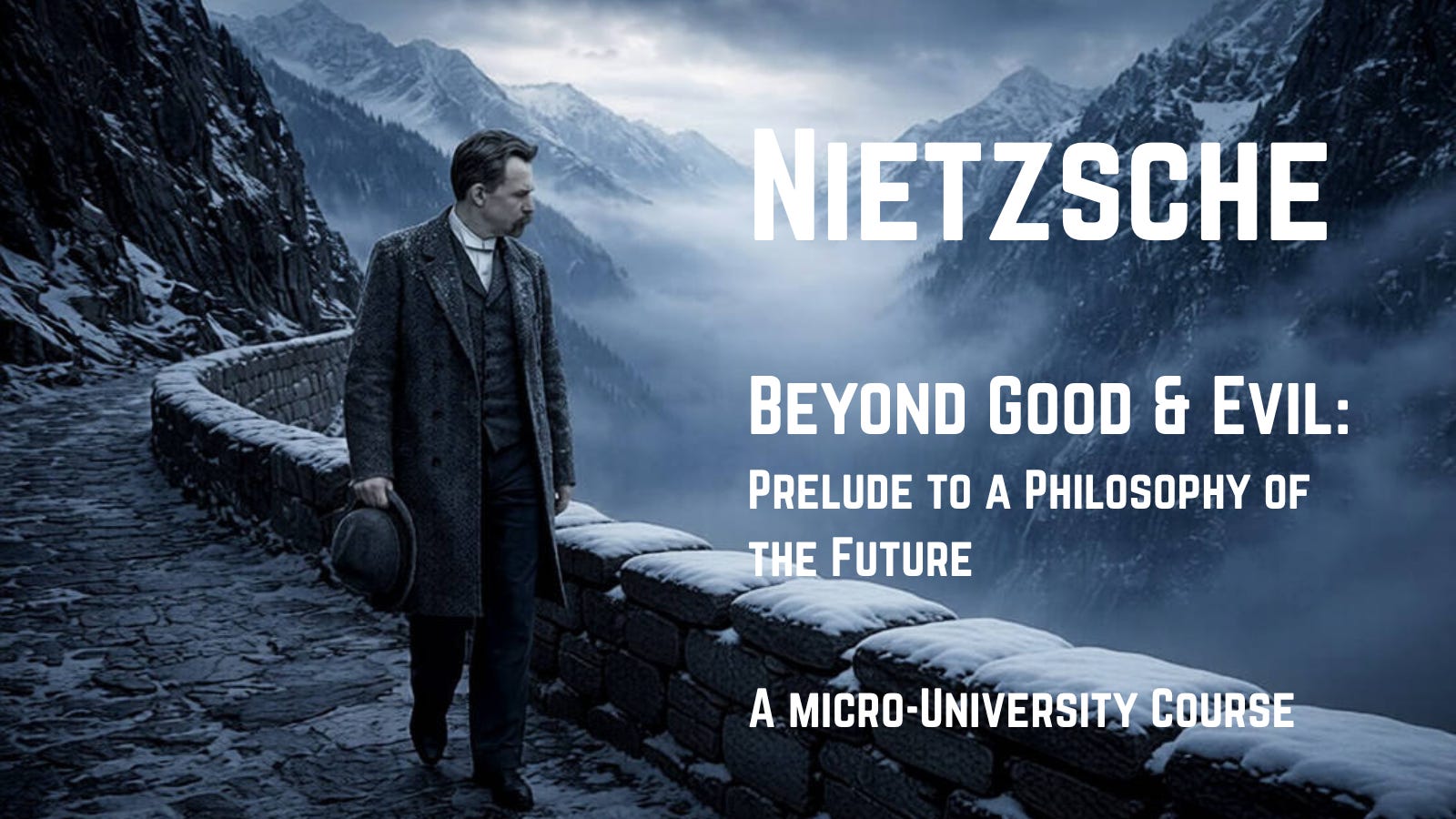
This course will be an in-depth, chapter by chapter reading of Nietzsche’s groundbreaking book.
Nietzsche writes that:
“This book is in every essential a critique of modernity; modern sciences, modern arts, even modern politics are not excluded. Besides this, it is an indication of an opposing type, which is as un-modern as possible, a noble, yes-saying type”
How To Join
The course is run through The Micro-University right here on Substack.
It will begin on April 18th at 11AM EST and meet regularly at that time.
You can join with a paid subscription to my Substack, which offers you two options:
Full membership gives you access to live calls where we discuss the text together every week, recordings, course videos, handouts, and other helpful resources (like book lists). These calls are capped at 15 seats to guarantee a deeper conversation and allow for everyone to participate meaningfully.
Alternatively for a 50% discount, you can join as an “spectator”. This gives you access to everything in the course except the live calls
(You can following this special link to access the Spectator Program and get 50% off your subscription:
Course Syllabus
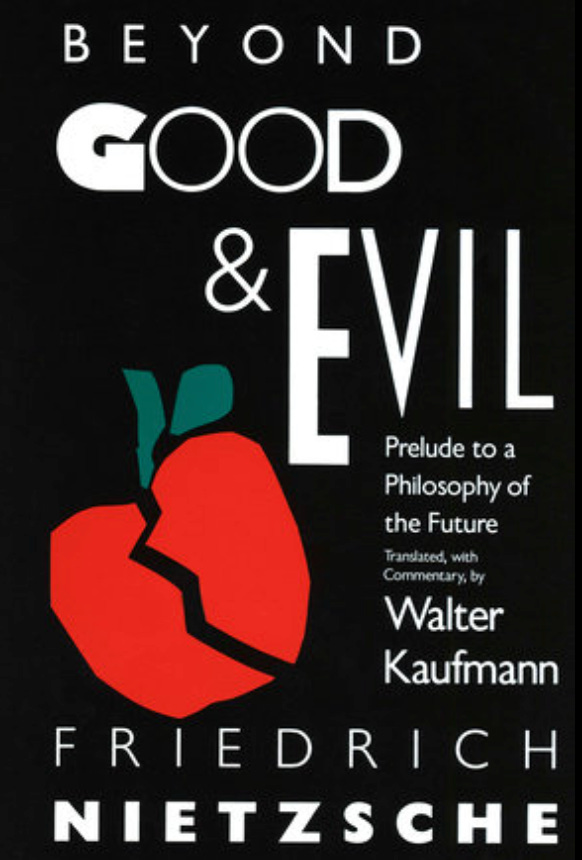
We will be using the Walter Kaufmann translation of Beyond Good & Evil.
Reading/Meeting Schedule
Week 1: Introduction To Nietzsche and Beyond Good & Evil
Week 2: On The Prejudices Of Philosophers (Part I)
Week 3: On The Prejudices Of Philosophers (Part II)
Week 4: The Free Spirit
Week 5: What Is Religious
Week 6: Natural History Of Morals
Week 7: We Scholars
Week 8: Our Virtues
Week 9: Peoples and Fatherlands
Week 10: What Is Noble
Planned Course Offerings
The Micro-University will be structured around two tiers of courses.
The first-tier are self-paced courses that are introductory and will cover the basic curriculum of a philosophy bachelor’s degree.
The second-tier are small seminar-style courses that are more advanced and focused on specific books, philosophers, or niche topics.
Introductory Courses
Below is a list of courses that I plan to develop over the next two years and anticipated release dates.
Introduction to philosophy (expected: May 2026)
Introduction to ethics (expected: May 2026)
Introduction to greek philosophy (expected: May 2026)
Introduction to logic (expected: June 2026)
Introduction to meta-philosophy (expected: August 2026)
Introduction to stoicism (expected: June 2026)
Introduction to existentialism (expected: August 2026)
Introduction to buddhism (expected: December 2026)
Introduction to political philosophy (expected: February 2027)
Introduction to aesthetics (tbd)
Introduction to philosophy of mind (tbd)
Introduction to philosophy of religion (tbd)
Philosophy of Physics: Space & Time (tbd)
Philosophy of Physics: Quantum Mechanics (tbd)
Advanced Courses
Heidegger’s Being and Time (happening now)
Marx and Marxism
Philosophy of Economics (expected December 2026)
Philosophy of Technology (expected December 2026)
Nietzsche (starts on April 18th)
Hegel (tbd)
Adam Smith
Philosophy of Life & Death (expected May 2026)
Late Wittgenstein (tbd)
Kierkegaard (tbd)
Dostoevsky (tbd)
Nihilism and the “Death of God” (tbd)
The philosophy of pain (tbd)
The philosophy of pleasure (tbd)
Meta-philosophy (expected August 2026)
Special Events
Workshops
Future one-off workshops that try to cover a lot of ground in a short period of time.
For example, a 4 part workshop that covers the entire history of western philosophy from the Pre-Socratics to the 20th century in four 1-hour chunks.
Heidegger’s Philosophical Project In Being & Time: An Introduction For Complete Beginners
In anticipation of the upcoming Micro-University course on Being & Time, I will be hosting a live webinar that introduces complete beginners to Heidegger’s radical philosophical project in Being & Time.
If you always felt like there was something “off” about Western philosophy, then this webinar is for you.
In his magnum opus Being & Time, Martin Heidegger argues that the entire history of Western philosophy is founded upon a fundamental error — an implicit dualism and misunderstanding of the nature of “Being” which has infected nearly every philosopher’s thinking.
Before you comment that non-Western thinkers have already known this for forever, it’s important to understand that the value of Heidegger’s critique is that it emerges from within the Western tradition, not outside of it.
This insider threat that Heidegger poses to Western philosophy opens up new pathways for bridging Western and Eastern thought and flirts with the possible construction of a “meta-language” that allows distant thinkers to understand each other.
Through Heidegger, you will also engage with the central ideas of previous philosophers like Husserl, Kant, Descartes, and Aristotle.
Heidegger's Philosophical Project In Being and Time (Part I)
The History Of Western Philosophy (In 4 Hours)
Want to learn about the history of western philosophy at a high-level?
In this one day special workshop, I will cover every major figure in the history of western philosophy so that you can gain exposure to the big picture.
This workshop will allow you to see the macro-patterns across the entire tradition and figure out where you want to invest your time and energy for future study.
Date: TBD
Build Your Own Philosophy (In 4 Hours) Workshop
Build your own philosophy from scratch in this 4-hour intensive workshop.
What!? How!?
I will give you the frameworks and concepts you need to develop a minimum viable philosophy on the spot and figure out how to organize your core beliefs and values.
Date: TBD
The Micro-Philosopher Incorporated, Founded 2025