


This guide is part of my Introduction To Philosophy Class offered through The Micro-University right here on Substack. I provide an introduction to Socrates through Plato’s famous depiction of his trial in Apology. If you are interested in learning more about the course, you can follow this link.
Introduction
The work by Plato titled “Apology” gets its name from the greek word apologia which means a defense speech in a legal proceeding. The word “apology” has also come to acquire the general meaning of an impassioned defense (e.g., “Christian apologetics”).
Apology is a philosophical masterpiece and unlike any text in the history of thought.
It is a moving depiction of a philosophical hero making his last stand against the judgment of the masses.
In my judgment, it captures the essence of what it means to be a philosopher and live a philosophical life (even if one doesn’t fully identify with some of Socrates’ ideas). I think it is fair to say that if someone gives Apology a careful read and does not enjoy it or find value in it, then philosophy is most likely not for them.
The dialogue depicts Socrates delivering a speech before a jury of his peers which consists of 501 male Athenians. Socrates was indicted, at the age of seventy, for breaking the law. The primary charge against him was called “impiety”, or offending the Olympian gods.
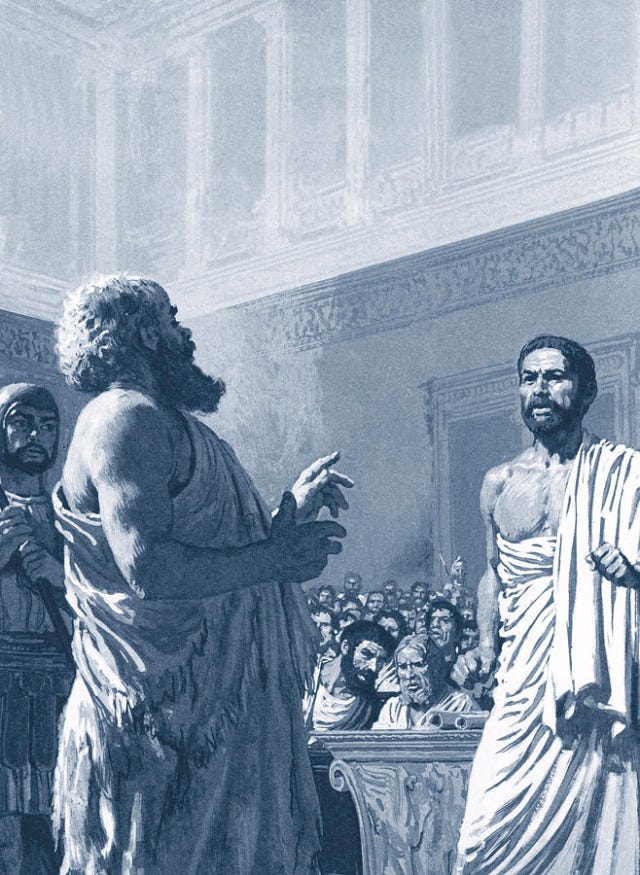
Socrates treats his defense as occasion for him to both explain and demonstrate the importance of philosophy for human beings, as well as his own devotion to the examined life.
The examined life for Socrates largely consisted of dialogos, or dialogue, about philosophical questions with others. It is for this reason that Plato wrote works in the genre of dialogue (although his later works become more like the modern philosophical treatise.
Socrates goes on to argue, in his own defense, that not only are the charges against him false, but that he is in fact more pious than his fellow Athenians insofar as his pursuit of philosophy was in service of Apollo (the god associated with the Oracle at Delphi).
He believed that the gods want, more than anything else, for us to be good and that goodness depends principally upon our ability to understand what’s worth caring about and how to act accordingly.
Socrates believed that philosophy, as practiced through dialogue, was what made this understanding and practice possible.
One of the great questions is whether Socrates was, in fact, guilty as charged. I encourage readers to think carefully about this question and its implications as they follow Socrates’ arguments.
Does Socrates really think that we should follow the gods on the basis of divine authority? Or does he set up human reason as the final arbiter of what is right and wrong? Does that violate the law?
Commentary
Unlike most philosophers throughout history, Plato was a great stylist. The list of philosophers that were able to use style and form to enhance their philosophical arguments and the clarity and power of their ideas is quite short and Plato is, arguably, at the top. Some other names might be Marcus Aurelius, Kierkegaard, Nietzsche, Sartre, and Camus, to name a few.
One incredible aspect of Plato’s style in particular is that it comes through even when translated into English.
The Apology is a perfect example.
While there are plenty of texts in the history of philosophy that reward careful reading and re-reading, Apology is one of those rare texts that is both charming and pleasurable no matter how many times one has read it. It is not just entertaining and moving, but also intellectually rich. This is not merely due to its overabundance of famous quotes and quips, but also the dramatic structure of the dialogue as a whole. Plato chooses to begin and conclude his famous depiction of Socrates with the idea that he is most known for — that he does not possess knowledge. At first, that he does not possess knowledge of other people’s feelings (”I do not know, men of Athens, how my accusers affected you”), and at the end that he does not possess knowledge about whether death is ultimately a good or bad thing for a human being.
“Now the hour to part has come. I go to die, you go to live. Which of us goes to the better lot is known to no one, except the god”
“ἀλλὰ γὰρ ἤδη ὥρα ἀπιέναι, ἐμοὶ μὲν ἀποθανουμένῳ, ὑμῖν δὲ βιωσομένοις· ὁπότεροι δὲ ἡμῶν ἔρχονται ἐπὶ ἄμεινον πρᾶγμα, ἄδηλον παντὶ πλὴν ἢ τῷ θεῷ”
Apology, 42a
There is so much to say about the Apology.
If I’m being honest, it was really tough to write this guide. I found myself spending over two hours working on the first few sentences and realized that I must make some difficult choices about what to focus on. What I decided to do was read through it carefully on my own and pick out a handful of things that I personally find to be the most interesting or important. I did not try to represent the state of present scholarship on the text, or to provide an overarching framework through which a reader could tie everything together into a complete “reading” or “interpretation” of the significance of the dialogue as a whole.
Hopefully this approach can make the text come alive for you. Although it doesn’t need my help!
17b-
The opening paragraph begins with Socrates in mid-speech.
We should immediately realize that Apology is not meant to be an accurate historical record, like a courtroom transcript, but an interpretation constructed by Plato. Part of what makes the text so fascinating is the interplay between what actually happened, what we know about Greek culture, politics, and history, the thought and philosophy of Socrates, and Plato’s relationship to all of these things. This complex and multi-layered web makes reading and thinking about what’s happening on the page endlessly interesting.
We find Socrates opening his speech by drawing important contrasts and careful distinctions—one of the things philosophers are infamous for. The first distinction is between people and their feelings. Socrates begins by carefully distinguishing between how he was affected by the speech of his accusers and how others may have been affected. In other words, he is saying, “I can only speak for myself”. This establishes, in my judgment, a level of respect for his audience.
How was Socrates affected?
He claims that he was:
“almost carried away in spite of myself, so persuasively did they speak”.
The importance of this line is hard to see if one is unfamiliar with the lore of Socrates.
Socrates was famous for many things, but one thing he was especially famous for (and we have multiple sources that attest to this) was his self-control. For example, he was reported to be able to drink anyone under the table without himself getting too drunk. In Plato’s dialogue Symposium, Plato provides an account of when Socrates stood on watch for an entire evening in the freezing cold while barefoot (many people don’t realize that Socrates was a veteran). So when Socrates says that he was almost carried away by his accusers speech, he is actually making an incredible statement. In order for this to be possible, his accusers would have had to say something so profound or revelatory that even Socrates couldn’t resist being persuaded (persuasion is a key word here and is contrast with truth in the next sentence). But this immediately leads us into what is, perhaps, the most important lesson that Plato has to teach us about Socrates. The lesson is that Socrates was a deeply ironic figure. He may have been the greatest ironist in human history.
In just three lines, Plato introduces a text and also captures essence of Socrates both as a person and as a philosopher (although in his case, these are the same thing).
Pure.
Genius.
In the following sentence (”And yet, hardly anything of what they said is true”), Socrates sets up a classic contrast between truth and persuasion.
This contrast is as old as philosophy itself.
It was clearly expressed by famous “pre-Socratic” philosophers such as Heraclitus and Parmenides. For example, in Parmenides famous poem, published over 100 ears before Socrates, he writes:
It is right that you learn all things—
both the unshaken heart of well-persuasive Truth
and the beliefs of mortals, in which there is no true trust.
But nevertheless you will learn these too—how it were
right that the things that seem
be reliably, being indeed, the whole of things.
The contrast here between truth and persuasion is also intertwined with the contrast between truth and feeling.
Again, within just three lines, we find ourselves having to think about the complex relationships between thought, feeling, speech, and truth.
Plato writes in a way that forces us to become philosophical.
Socrates makes it plain that there was something powerful about his accusers speech despite “hardly anything” of what they said being true. As we will see throughout the dialogue, the reason Socrates was affected was not the reason that the “men of Athens” who vote to sentence him to death were affected. Socrates was affected by what he took to be the falsehood and inconsistency of the accusations made against him. In short, the reason that Socrates was almost carried away was that he simply couldn’t believe his accusers could be so off the mark (whether they were actually so wildly off the mark, or Socrates is using this as a rhetorical strategy is an interesting question).
Although we could spend hours discussing just the first few lines, it’s best to move on at this point with the following takeaway: despite what he will say in the rest of this opening section, Socrates is an incredibly tricky figure who speech can be quite complex to interpret (even if the language is direct).
The opening section of the dialogue spans from 17a-18a.
The rest of the dialogue can be divided up, at a high-level, along these lines:1
Statement of the Case: Two Sets of Accusers (18a-19a)
Refutations
Refutation of Old Accusers (19a-20c)
Narration of Socrates’ Divine Mission (20c-24b)
Refutation of Present Accusers (24b-28b)
Digression On Socrates’ Divine Mission
Reply to First Objection (28b-31c)
Reply to Second Objection (31c-34b)
Conclusion of First Speech (34b-35d)
Second Speech
Proposed Counter Penalty (35e-38b)
Third Speech
To Jurors Who Voted To Condemn (38c-39d)
To Jurors Who Voted To Acquit (39e-42a)
Let’s jump to one of the most important (and puzzling) parts of the dialogue — Socrates’ account of how he became a philosopher.
