


What if you could receive a complete philosophy education for less than 1% of the cost of a bachelor’s degree? The Micro-University is an online school of philosophy dedicated to doing exactly this.
Ivy-League instruction, guided learning, and a genuine community.
It’s all here.
If you want to see what courses are currently available, as well as past courses that you can access for a self-guided learning experience, scroll about halfway down this page.
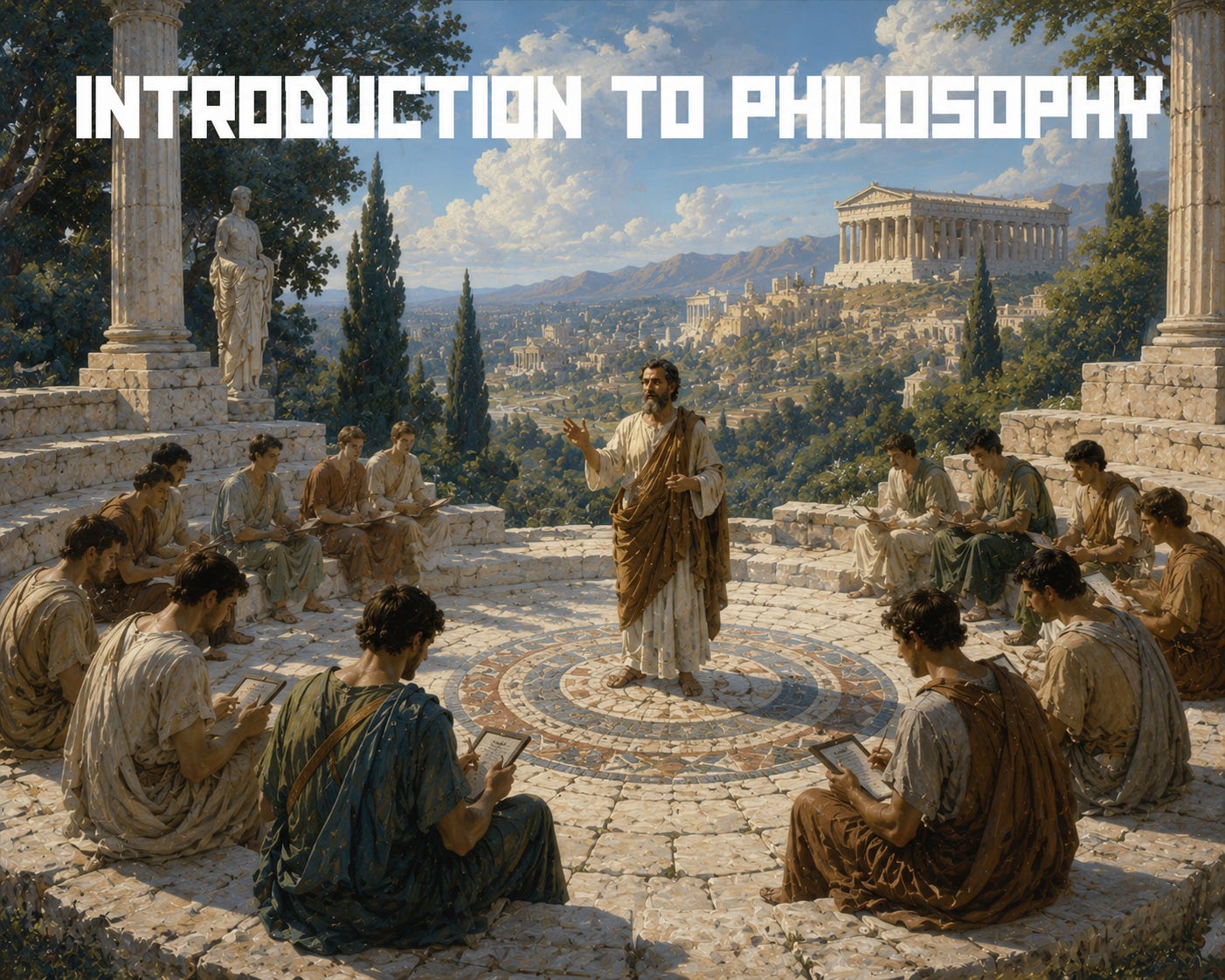
On July 25, 2026, we are starting PHIL 1: Introduction To Philosophy. This is a course meant for beginners who want a scintillating introduction to the tradition of Western philosophy where they can learn the basics with a group of likeminded individuals.
The Problem With Universities
Universities have become educational buffets.
Their expenses are out of control — which means their students end up paying $50,000+.
They offer everything to everyone in order to lure in aimless youths— meaning that students eventually end up paying for things they don’t actually want or use.
They don’t specialize in doing one thing excellently — meaning that the educational quality fluctuates from class to class.
Many universities have forgotten that their main purpose and priority should be education, not research.
I am convinced that it is now possible for individuals to receive a similar or in some cases better education online and for less than 1% of the cost of a traditional degree.
How is this possible?
It is possible because platforms like Substack have helped highly qualified content creators and writers identify the exact needs and interests of their audience and design courses that are specifically tailored to give them what they want.
What’s more is that these courses can be offered without needing to build any buildings, pay for utilities, security guards, or administrative staff.
This means that they cost virtually nothing when compared to their university counterparts.
Critics will argue that the in-person element and community aspect of universities is irreplaceable.
Maybe.
But is it worth an extra $5,000 per course? Or $25,000 per year?
Entire companies are run through Zoom and Google Meet.
I created The Micro-University to serve as a platform that allows me to teach the exact same or better content that I teach at elite universities, but without the absurd paywall and gatekeeping practices of the modern university.
My goal is to offer a lean and high-quality education experience that cuts out all of the middleman and unnecessary costs and deliver real learning directly to the student.
If that is something you are intersted in, you can learn more about it below.
Modern technology has made it possible for a single individual to reach thousands of students around the world interested in studying philosophy and deliver a high-quality education without incurring massive costs (buildings, employee benefits, marketing, etc.).
Over the past few years, I have secretly been training myself to be in a position to do this by developing a broad knowledge of philosophy across multiple sub-fields in order to see the macro-patterns.
I became a philosophical generalist.
By forcing myself to teach new subjects every semester, I had to develop a special ability to learn new things through relying on pattern recognition and frameworks that allowed me to contextualize new information based on what I previously studied.
Here is a list of complete courses I have taught since starting my PhD:
Intro To Philosophy, Existentialism, Philosophy As The Art Of Living, Aesthetics, Ancient Greek Philosophy, Philosophy: East and West, Intro To Ethics, Social Contract, Bioethics, Justice, Law, and Morality, Ethics and Society, Scientific Reasoning, Philosophy of Law, Environmental Ethics, Philosophy of Science, Philosophy of Space and Time.
I have never forgotten the struggle it took to get to this point.
The struggle to read, the struggle to write, and the struggle to understand and enjoy philosophy.
I am creating this school to help people in the same way I remember that I needed help.
To get rid of the stupid roadblocks and questions that people are too afraid to ask, but that actually prevent them from progressing.
I want to explain everything that holds people back.
The title of the book. That random French word that makes you anxious. Whatever little thing it is that is “getting in the way”.
I also want to teach philosophy in a way that avoids turning it into a passive consumption machine.
Everything will be framed and presents as being direct towards using or integrating what you learn with your own life.
The general frame behind the whole university is philosophy for living (a return to the ancient philosophical schools of Athens).
That will add a unique twist to all of my courses.
Even the most abstract.
Everyone needs a good teacher, someone they can struggle with and grow with. I may or may not be able to be that for you. Honestly, a lot of that depends on the right fit and personalities coming together. But I am going to try. And I am not going to charge you tens of thousands of dollars to roll the dice for each class.
If you want to give it a shot, I would love to have you on board.
Information and knowledge have become commodities.
The future of humanity will reward perspective and creativity.
The aims and incentives are mass education are not your own, they are social, political, and economic.
The system wasn’t made for you!
No one is willing to go slow enough.
To do it the right way.
To take intellectual risks, to feel the tension of personal growth, and to transform.
We have replaced spiritual transformation with information consumption.
Mainstream education has been captured by the pursuit of wealth which forces it to become a new form of job training in order to justify it’s absurd costs.
When education becomes economic training, intellectual and spiritual development become secondary.
Some course and concepts are better suited for a self-paced experience, whereas other more advanced courses require a hands-on interactive learning experience akin to a college seminar.
My idea is to eventually have an entire curriculum in place where students can learn everything they would learn at a university if they were to study philosophy. At the beginning of the curriculum would be introductory self-paced courses. As students progress they would “unlock” advanced seminars. Over the course of a year or two, you will have received the equivalent of a B.A. in philosophy.
How To Access The Micro-University
You can gain complete access to The Micro-University by upgrading to a paid subscription to The Micro-Philosopher Substack.
Membership to The Micro-University will give you access to the following:
Weekly live classes
Class recordings (including a complete course on Nietzsche and Heidegger)
Exclusive learning resources (handouts, guides, book recommendations)
Private course chat (ask questions, learn together, join a community)
Current Live Courses
Introduction To Philosophy: July 25-Sept. 12
“All human beings by nature desire to know”
-Aristotle, Metaphysics
This 8-Week introduction to philosophy is the exact same content that I will be teaching to my Ivy-League students over the summer, but offered to you for a 1% of the cost.
This course is ideal for students seeking a rigorous introduction to philosophy in a short period of time without needing to commitment thousands of dollars or hundreds of hours to understanding these great ideas.
For 8 weeks, we will dive deep into the greatest philosophical minds of the Western tradition and work through their texts together.
If you want to join the course waitlist for free, you can sign-up with this link.
You can also access the course syllabus here.
I will post video lectures to cover the basics, and then we will go deep in our weekly calls.
We start with Parmenides, who stunned the ancient world by arguing that change itself is an illusion and that reality is far stranger than it appears. Next is Plato, who asked whether the world you see is real or merely a shadow of something deeper. Aristotle, Plato’s most famous student, brought philosophy back down to earth to ask what it actually means to live well and flourish. Marcus Aurelius turns philosophy inward, showing how a Roman emperor used Stoic discipline to stay grounded amid power, grief, and the certainty of death.
From there we cross into modernity with Descartes, who tore everything down to a single unshakable certainty—I think, therefore I am—and rebuilt knowledge from the ground up. Kant revealed that the mind isn’t a passive mirror of the world but actively shapes everything we experience. Nietzsche took a hammer to our most cherished beliefs and famously declared that God is dead and challenged posterity to create your own values in a universe that hands you none. Finally, Heidegger confronts what he takes to be the most fundamental question of all — what does it mean to be?
Course Details
When: 8 Weeks (July 27- September 12), Saturday mornings 12pm (EDT/EST)
Where: Online
How To Join: You can join the waitlist here to reserve your spot before July 27.
8 Week Syllabus
In this course, you will read: Parmenides, Plato, Aristotle, Marcus Aurelius, Descartes, Kant, Nietzsche, and Heidegger.
Eight monumental thinkers in the Western tradition.
Here is the complete schedule:
Week 1 — Parmenides: Is Change an Illusion? Reading: The fragments of On Nature (the surviving lines of the poem, especially “The Way of Truth”).
Focus: Being vs. becoming, the claim that “what is” cannot change, and the birth of metaphysics as rigorous argument.
Week 2 — Plato: The World Behind the World Reading: Republic, Book VII (the Allegory of the Cave); selections from Book VI (the Divided Line).
Focus: Appearance vs. reality, the Forms, and what it means to be “freed” into knowledge.
Week 3 — Aristotle: How to Live Well Reading: Nicomachean Ethics, Books I and II.
Focus: Eudaimonia (flourishing), virtue as a mean, and habit as the path to character.
Week 4 — Marcus Aurelius: Philosophy as Practice Reading: Meditations, Books II, IV, and V (selections).
Focus: Stoic discipline, control vs. acceptance, mortality, and living according to nature.
Week 5 — Descartes: Tearing It All Down Reading: Meditations on First Philosophy, Meditations I and II.
Focus: Radical doubt, the cogito (”I think, therefore I am”), and rebuilding knowledge from certainty.
Week 6 — Kant: The Mind That Shapes the World Reading: Prolegomena to Any Future Metaphysics (selections); Groundwork of the Metaphysics of Morals, Section I.
Focus: How the mind structures experience, and the categorical imperative as the foundation of morality.
Week 7 — Nietzsche: Creating Your Own Values Reading: The Gay Science §§108–125 (including “The Madman”); Thus Spoke Zarathustra, Prologue.
Focus: The death of God, nihilism, and the task of creating meaning for yourself.
Week 8 — Heidegger: What Does It Mean to Be? Reading: Being and Time, Introduction (§§1–8) and the sections on Being-toward-death (§§46–53).
Focus: The question of Being, authenticity, and how mortality gives life its weight.
Private Community
When you enroll in The Micro-University, you will be pleased to know that you are entering an already thriving community of serious intellectuals who are willing to not just show up every week, but to have actually read the material.
For the past several months, we have been working through some of the most challenging texts in the history of philosophy — Heidegger’s Being and Time and Nietzsche’s Beyond Good & Evil.
All of that work has built a real intellectual community that is here to stay.
We would love for you to be a part of it.
Past Courses
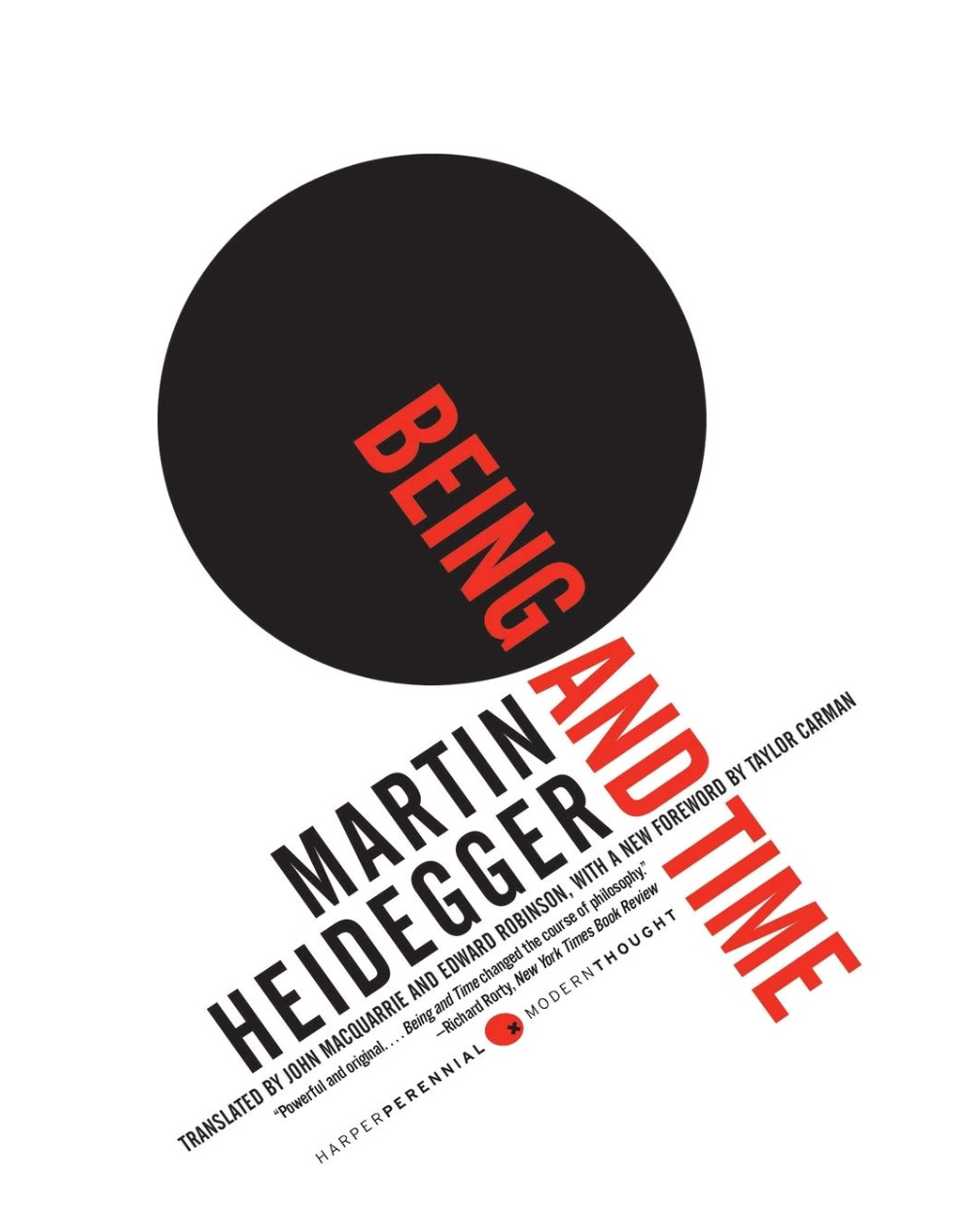
Heidegger’s Being And Time
The most important philosophical work of the 20th century is also one of the most difficult — Being and Time.
(You can access the course syllabus here)
Being and Time is a work perfectly suited for modern life.
It helps us think about our relationship to existence itself, the technological world, anxiety, death, authenticity and, most importantly, other people.
The internet craves depth, genuine thinking, and intellectual community. Unfortunately, there are fewer and fewer places someone interested in these things can go (not even most universities). This course is somewhere you can to go to challenge yourself intellectually, learn real philosophy (straight to the source), learn how to read philosophy in a hands-on way, discuss the text with others, and learn together.
I want this course to address those very real spiritual and intellectual needs and help beginners actually finish one of the truly great works in the history of philosophy.
Who Is This Course For?
I want to be clear that this course is for beginners.
This is not a space for someone to show off how much philosophy they have read and make others feel behind.
At the same time, this is also not a space for people who want to sit back and have me explain everything to them so that they don’t have to do any real thinking for themselves.
This is an intensive and interactive learning experience — not a series of lectures or videos.
We will be going through Being and Time together, line-by-line.
We will be interacting with each other. Asking questions. Sharing interpretations. Making exciting intellectual connections. Forming an intellectual mastermind.
This course is for anyone looking for one of the greatest intellectual challenges of their life — something that they will remember forever.
There is so much philosophy online today that tries to make things so incredibly simple and easy that people are left yearning for the real deal.
This is the real deal.
You are not going to understand everything. In fact, I am not going to understand everything.
But we are going to make serious progress together.
(You can access the course syllabus here)
The course will end when we finish section 66 of Being and Time (roughly 380 pages).
This could take a while because we are going to go at the pace necessary to actually understand and learn the material, not simplify and skip over it. Even if you don’t make it to the end, each lesson will be valuable on its own because you will be practicing and improving your philosophical reading, thinking, and discussion skills in a very real way with me as your guide.
(You can access the course syllabus here).
Friedrich Nietzsche, “Beyond Good & Evil: Prelude To A Philosophy Of The Future”
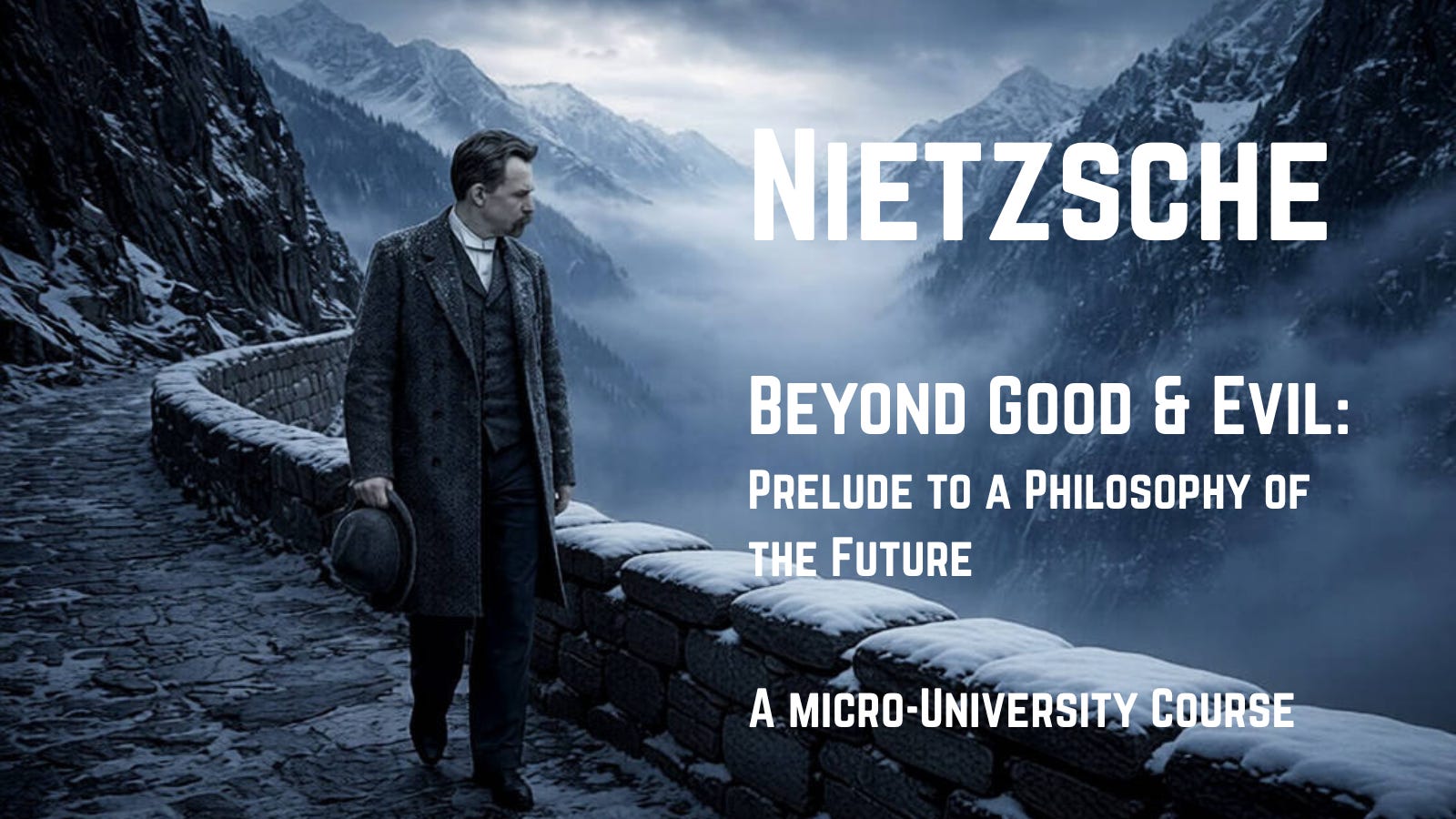
This course is an in-depth, chapter by chapter reading of Nietzsche’s groundbreaking book.
Nietzsche writes that:
“This book is in every essential a critique of modernity; modern sciences, modern arts, even modern politics are not excluded. Besides this, it is an indication of an opposing type, which is as un-modern as possible, a noble, yes-saying type”
Future Courses
The Micro-University will be structured around two tiers of courses.
The first-tier are self-paced courses that are introductory and will cover the basic curriculum of a philosophy bachelor’s degree.
The second-tier are small seminar-style courses that are more advanced and focused on specific books, philosophers, or niche topics.
Introductory Courses
PHIL 1: Introduction To Philosophy
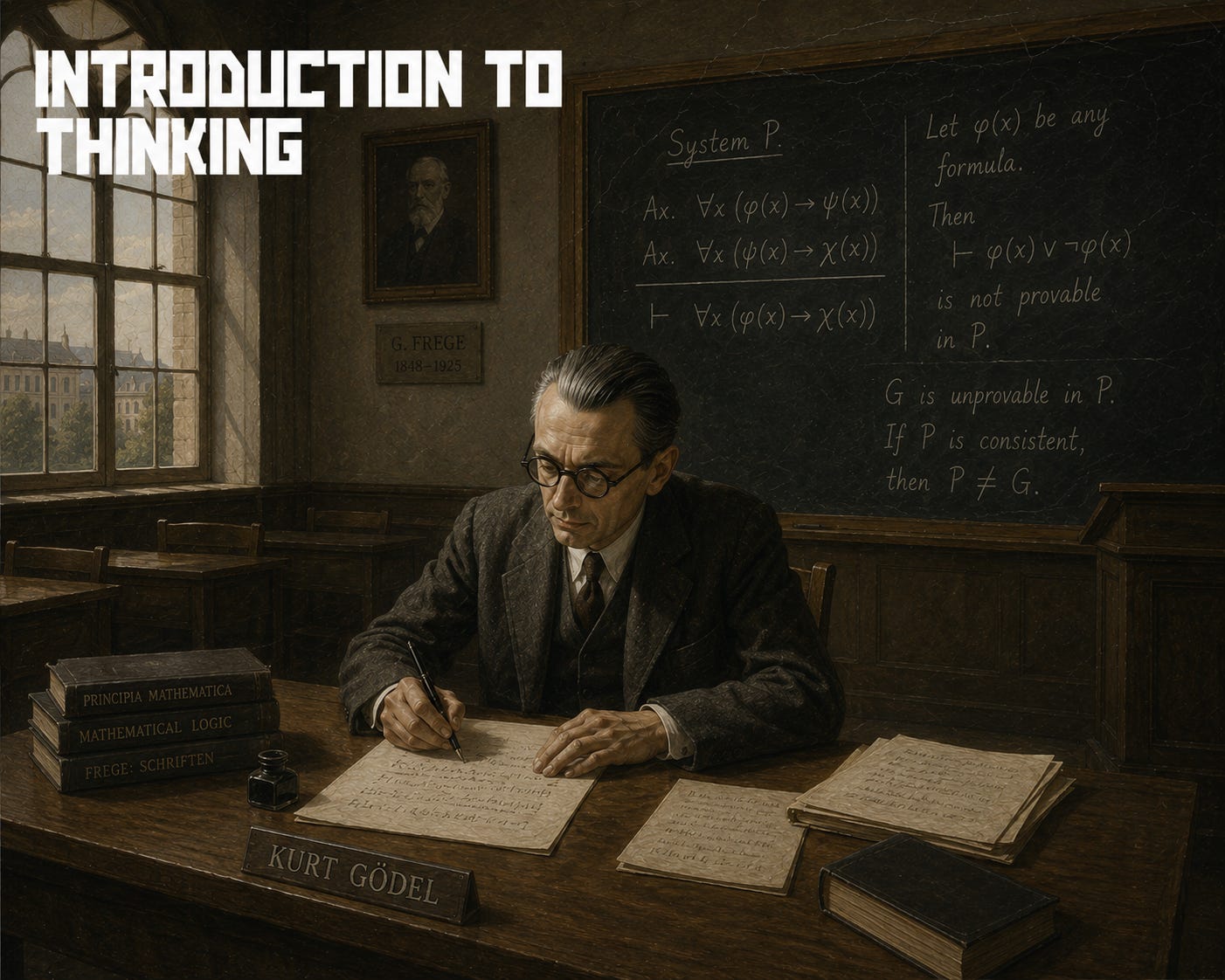
PHIL 2: Introduction To Thinking
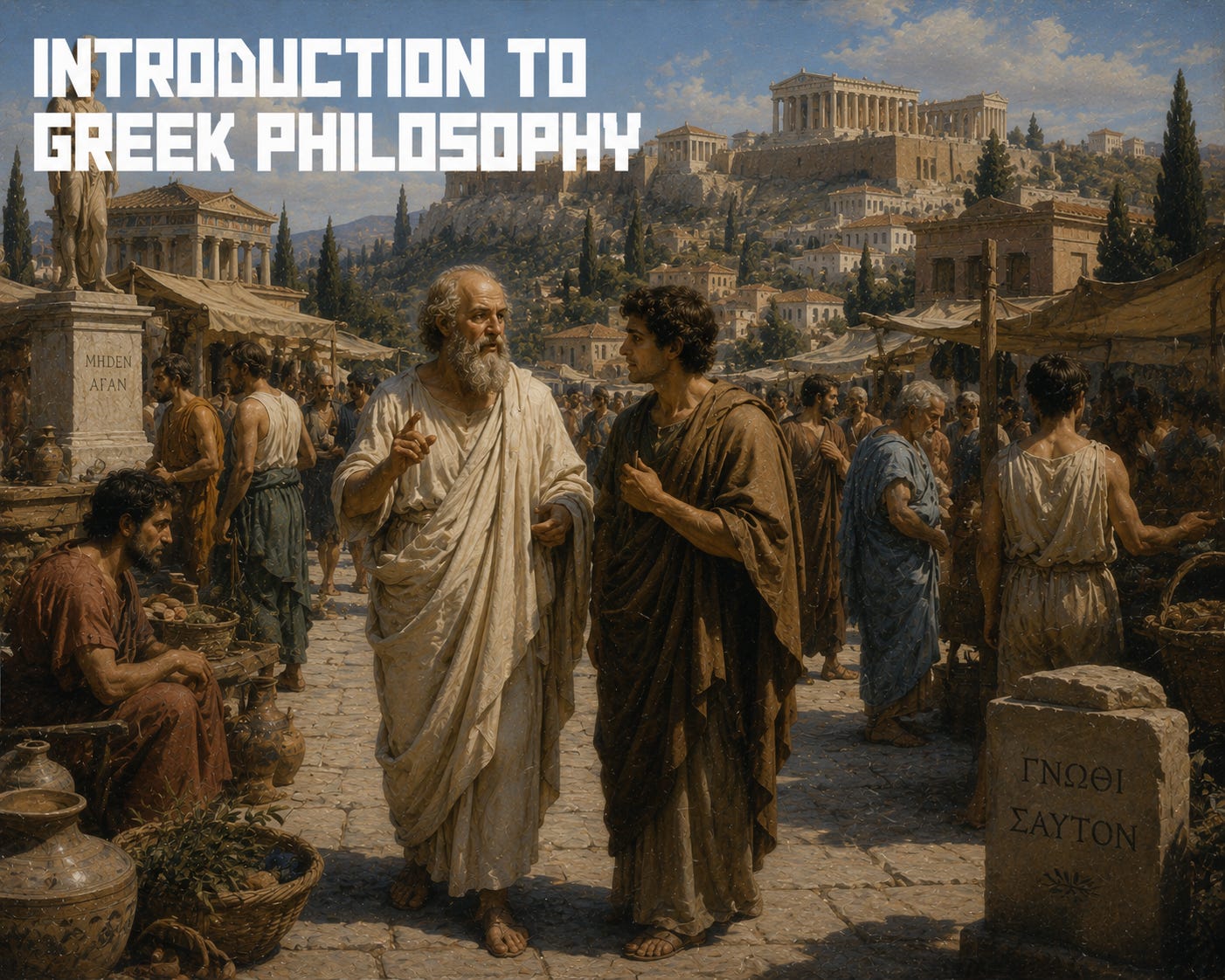
PHIL 3: Introduction To Greek Philosophy
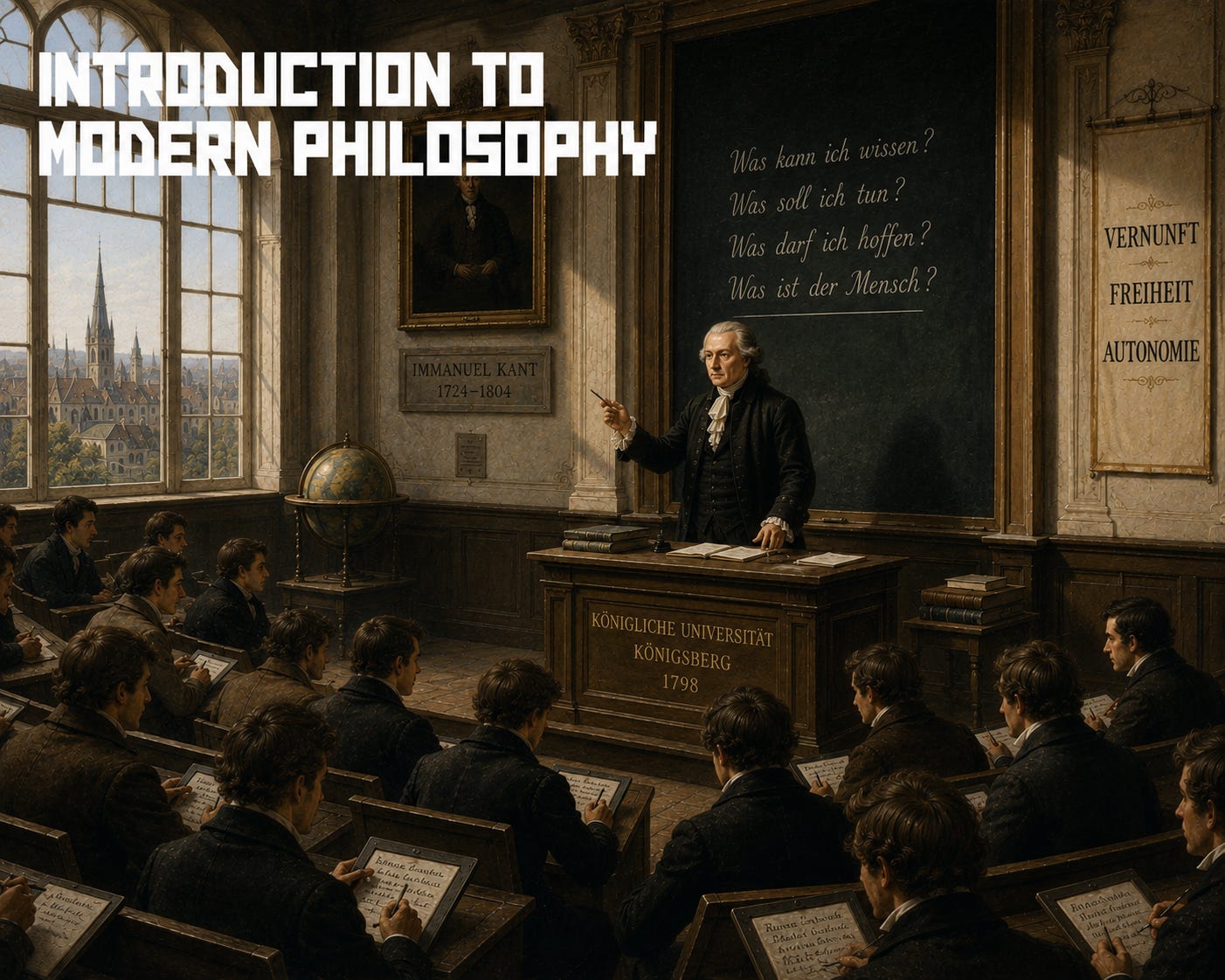
PHIL 4: Introduction To Modern Philosophy
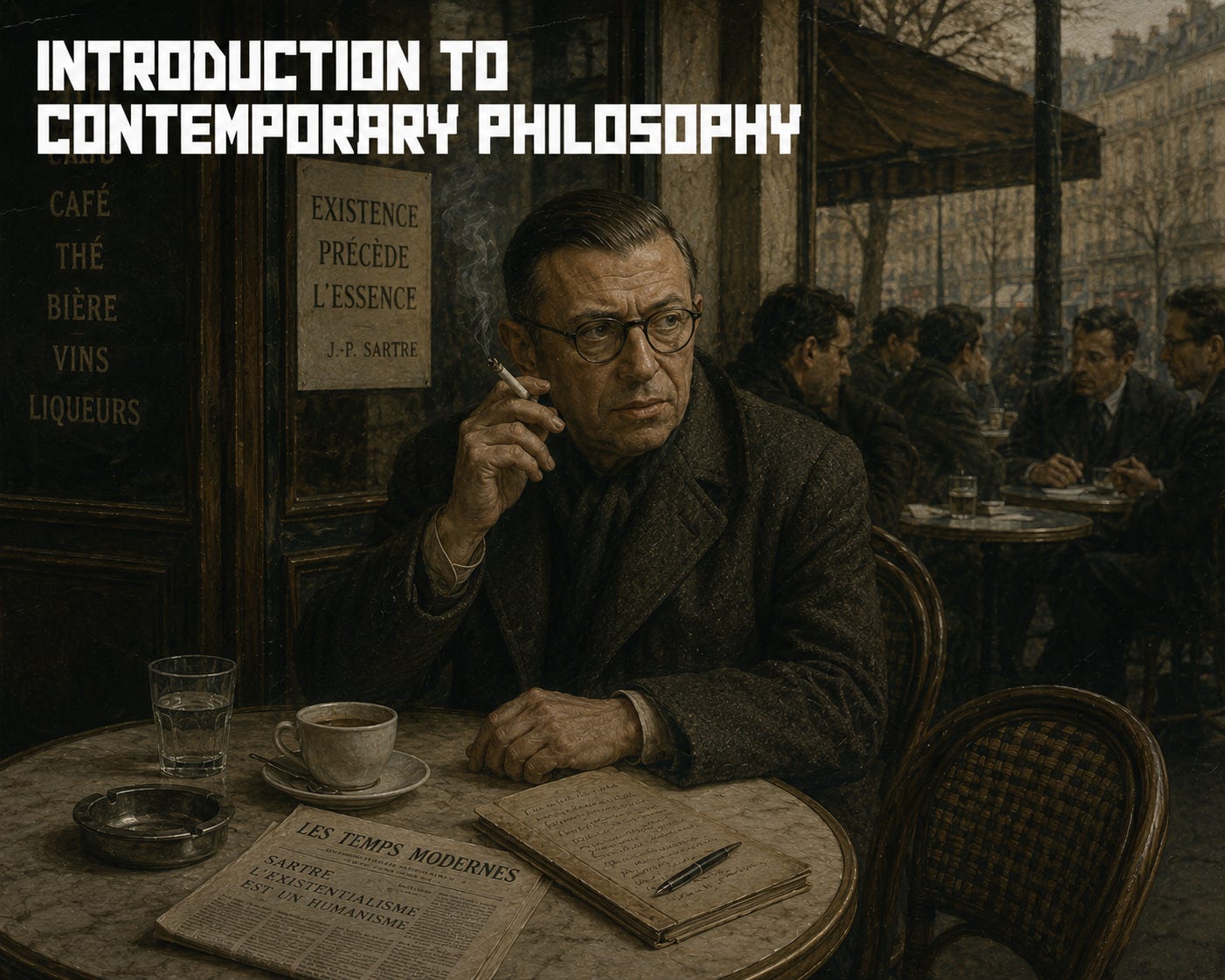
PHIL 5: Introduction To Contemporary Philosophy
Advanced Courses
Heidegger’s Being and Time (Currently Live) ✅
Marx and Marxism ⏩️
Philosophy of Economics (expected December 2026) ⏩️
Philosophy of Technology (expected December 2026) ⏩️
Nietzsche (Completed; Recordings Available) ✅
Hegel ⏩️
Adam Smith ⏩️
Late Wittgenstein ⏩️
Kierkegaard ⏩️
Dostoevsky ⏩️
Nihilism and the “Death of God” ⏩️
The Philosophy of Pain ⏩️
The Philosophy of Pleasure ⏩️
Meta-philosophy ⏩️
The Micro-Philosopher Incorporated, Founded 2025