


The real reason that so many people fail to read hard books isn’t because they are dumb, it’s because they don’t know what to do when they get stuck.
Most reading advice online is focused on what to read or the benefits of reading rather than how to actually read.
This is because book lists and recommendations grab more attention than actual reading advice.
If you are tired of constantly trying and failing to read great books like The Brother’s Karamazov or Meditations by Marcus Aurelius, then you are in the right place.
We now live in a world where people spend 10-100x more time watching videos or listening to podcasts about books rather than reading the actual books themselves.
Functional illiteracy = having the ability to read complex texts but never doing so
I have nothing against online educational resources that help people understand difficult idea, or even just intellectual entertainment in the form of people engaging in a passionate conversation about something they find interesting.
The problem is when the consumption of “edutainment” content replaces the actual development of an individual’s own skills, experiences, sensibility, taste, and perspective.
There is simply no substitute for reading or thinking through something on your own.
This is one of the very few ways that human beings can develop their ability to think independently instead of just repeat what everyone else is saying.
Being able to think independently and develop one’s own perspective is quickly becoming a rare and valuable skill in the age of artificial intelligence where knowledge has become a commodity.
People used to view readers as “smart” because they knew a lot of facts or information that others didn’t.
But facts and information on their own are basically worthless in the modern world.
What matters is perspective.
In this essay, I am going to share with you the personal framework that I developed to go from absolutely hating reading to becoming obsessed with reading, thinking, writing, and developing my own perspective.
Reading has been the greatest joy in my life, and there are few things I get more excited about than helping people experience that for themselves.
My hope is that by the end of this essay, you will have a general framework you can use to avoid getting stuck the next time you encounter a difficult page.
How To Actually Read Hard Books
So much reading advice online is pitched at the wrong level.
People get caught up on what to read, which translations are best, and what order to read books in.
But all of this doesn’t matter if you are unable to sit down and get through a single difficult page on your own.
If you think about it, almost every “great” author in history had to figure out how to read books completely on their own.
They did not have the internet.
What they would do is intensely read and master whatever books they were fortunate enough to stumble upon in their local library or book shop.
Friedrich Nietzsche himself claims to have discovered Arthur Schopenhauer’s masterpiece The World As Will And Representation while browsing in a second-hand bookshop in Leipzig, writing:
“I cannot say what demon whispered to me: ‘Take this book home with you’ … At home I threw myself into the sofa corner with the treasure I had acquired, and began to allow that energetic, sombre genius to work upon me.”
By the way, on April 18th I am launching a 10-Week Live Course on Nietzsche’s Beyond Good and Evil. If you have struggled to read Nietzsche, this is an opportunity to make sure you not only finish the entire book, but understand it as well.

If you’re interested, you can read more about it here: The Micro-University
Okay, so let’s assume that you have found a life-changing, consciousness expanding, masterpiece of a book that you desperately want to not only finish but deeply understand.
How do you actually go about doing that?
How do you avoid the all-too-familiar scenario in which you brew a cup of coffee, sit down in a comfy chair, and crack open some hefty tome, only to fall asleep within 10 minutes?
Here is my approach.
Reading Is Like Music
I like to approach reading in the same way that I approach learning music.
Like playing an instrument, reading is a skill.
If you want to learn how to play guitar, you have to learn the individual notes, and then how those three notes together form a chord, and then how the chord creates a chord-progression, etc.
I took Jazz Guitar lessons for several years and the only way that we would make any progress was by breaking a complex piece of music down into it’s individual components.
I approach reading the same exact way.
Notes → Words
Chords/Melodies → Sentences
Chord Progressions → Paragraphs
Songs → Chapters
Albums → Books
Just as every song is a collection of notes that are arranged to produce complex and interesting passages, every text is a collection of words, sentences, and paragraphs that are being used in interesting but sometimes challenging ways.
When you really think about it, what makes reading challenging is often the exact same thing that makes music challenging.
Time.
When it comes to playing music, most people don’t struggle to play the correct notes in a song, they struggle to play the correct notes in time.
Anyone who has played an instrument knows the stress of time rushing by while you are trying to prepare for the next chord change, or sequence of individual notes.
But if you were to take a complex musical piece, like Beethoven’s Piano Sonata No. 14 in C♯ minor, popularly known as “Moonlight Sonata”, and slow it down to half-speed, it would actually be quite playable.
What’s amazing about this example is that it not only seems pretty playable for the average person, but it actually sounds like beautiful music.
Underlying every difficult text is a collection of micro-challenges that most readers can overcome with a bit of perspective, skill, and patience.
The trick is to learn how to overcome enough of these micro-challenges within a reasonable time-frame so that you can start making real progress.
In order to help you do this, I took everything I have learned over the past 15+ years of struggling with challenging books and transformed it into an analytical system that anyone can use to break down challenging texts into manageable micro-challenges.
I call it The Micro-Reading System.
If you can overcome enough of micro-challenges using this system, then you will be able to not only finish hard books but also enjoy them.
The Micro-Reading System
In this section, I present a general overview of The Micro-Reading System and walk you through an example of how it can be applied to a difficult passage.
The goal of using the system is to become skillful micro-readers.
A micro-reader is someone who can skillfully break down complex texts into more manageable micro-challenges and avoid getting stuck.
Let’s take a look a high-level overview of The Micro-Reading System.
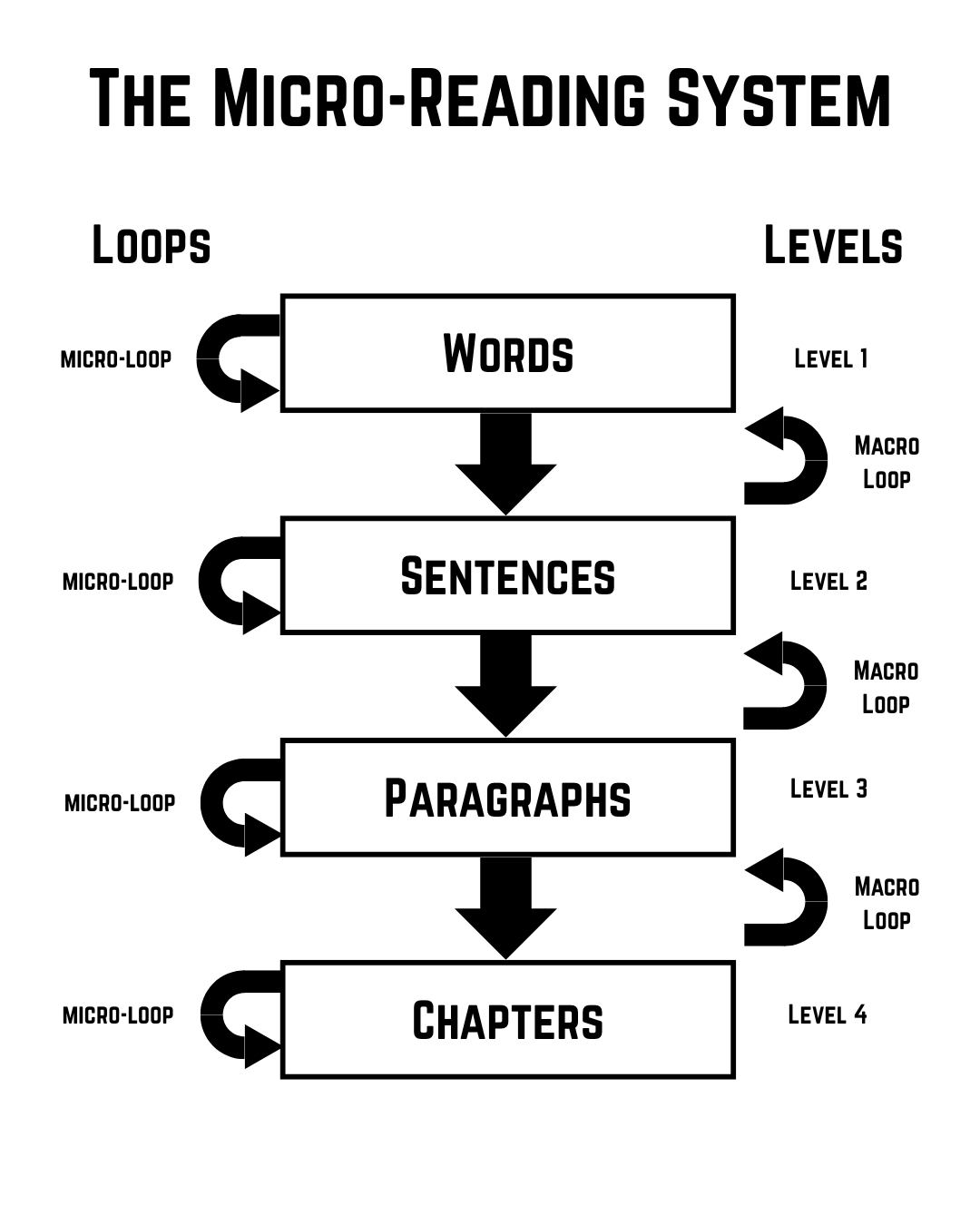
The Micro-Reading System is built around two general concepts:
“Loops”
“Levels”
You may have heard about “reading levels” in school, but I am using the word “levels” in my own way.
In The Micro-Reading System, a “level” refers to the scale at which reading occurs—from the smallest units of meaning (words) up to entire books.
Reading hard texts requires being able to fluidly synthesize and integrate information on different levels of scale in order to achieve understanding.
Let’s walk through two examples of “levels” before introducing the concept of “loops”.
Level 0: Letters/Symbols/Syllables
The smallest level at which reading occurs is the level of letters, symbols, and syllables.
For fluent readers, this level is usually automatic.
You don’t consciously think about how words are constructed out of letters or how syllables are formed—you simply recognize them.
However, this level becomes relevant again when:
reading in a foreign language
encountering unfamiliar scripts (e.g. Arabic)
dealing with unusually dense or difficult text
In most cases, though, this is not where reading breaks down.
That brings us to what I take to be the most important level: the word-level.
Level 1: Words
The word-level is where most reading problems begin — and end.
Resolving these word-level issues goes a long way toward improving comprehension and enjoyment.
It’s important to point out that, even in extremely difficult texts, readers typically understand the vast majority of the words.
It’s actually very surprising just how many words native speakers know.
I would estimate around 90% on average.
The word-level challenges come from the small number of words readers do not understand—or think they understand but actually don’t.
Understanding words alone is not sufficient for understanding an
That said, understanding every word is not always sufficient for understanding a text.
For challenging texts, readers will struggle with how words they know are structured into sentences, arguments, and larger conceptual systems.
Poetry provides a perfect example of familiar words being used to convey deep and challenging meaning.
Still, in my experience, if you fix what’s happening at the word-level, you eliminate a huge percentage of the confusion and anxiety people experience when reading.
Alright, that is the concept of “levels”.
Let’s take a look at “loops”.
Loops
What is a Loop?
In general, a loop is a reliable and repeatable process that a reader go through whenever they get stuck or want to deepen their understanding.
Loops are meant to help you diagnose the source of confusion, resolve it, and return to the text with clarity. Additionally, loops can be used to add layers of meaning and depth of understanding to prior knowledge.
At each level of The Micro-Reading System there are micro-loops that a reader can perform.
There are also macro-loops that a reader can perform between levels.
For example, after reading an entire chapter you can return to a difficult word from earlier in the chapter and rethink it’s deeper layers of meaning based on what you learned.
The entire system as a whole also forms one big macro-loop that a reader can run through as well by feeding each level back into it’s previous level.
Let’s look at a detailed example of how a micro-loop would work on the word-level.
Micro-Loops: Heidegger Example
Let’s look at a particularly challenging excerpt from one of the most difficult philosophical texts of all time — Martin Heidegger’s Being and Time.
These are the first few lines of Being and Time.
I. The Necessity for Explicitly Restating the Question of Being
THIS question has today been forgotten. Even though in our time we deem it progressive to give our approval to ‘metaphysics’ again, it is held that we have been exempted from the exertions of a newly rekindled “Γιγαντομαχία περὶ τῆς οὐσίας”. Yet the question we are touching upon is not just any question. It is one which provided a stimulus for the researches of Plato and Aristotle, only to subside from then on as a theme for actual investigation.
What’s interesting about this excerpt is that most of the words are familiar. In fact, I would say about 90% of the words in this particular excerpt are familiar.
When applying The Micro-Reading System to the word-level, then, the goal is to hyper-focus on the words that are problematic.
In this case, there are a handful of words that might trip people up:
“Being”
“metaphysics”
“Γιγαντομαχία περὶ τῆς οὐσίας”
Perhaps one or two other words present a challenge for you in this particular passage, but I just want to point out again that we have just looked at the opening lines of what is often considered one of the most difficult philosophical texts of all time and realized that there are only a handful of words which we don’t know.
This example suggests an incredibly important principle.
Let’s call it The Familiarity Principle:
For most people, if they are reading in their native language, they will know the majority of words in any given book, no matter how hard. The challenges of reading on the word-level are the result of a small minority of words they do not know but can learn in a reasonable timeframe.
Let’s put this principle to work by going through the “small minority” of words I picked out from the passage and seeing if it’s true that we can “learn them in a reasonable timeframe”.
“Being”
This one is tough because Heidegger’s entire book is actually an investigation into the meaning of “Being”. But we can learn an important lesson from this word.
We shouldn’t expect the meaning of every word to always be available to us within a reasonable timeframe, even though most words will be.
Sometimes we need to “bracket” or “suspend” words as we investigate their meaning.
I take this to be an “exception that proves the rule”.
“metaphysics”
This word presents a challenge because it is a technical philosophical term (“jargon” as they say). If you have never studied philosophy before, you may have never heard of “metaphysics”, or may have an inaccurate understanding of what it means.
In this context, “metaphysics” refers to an area of philosophy in which philosophers theorize about the ultimate nature of reality, existence, and related abstract questions.
The meaning of “metaphysics” can be complex and vary by philosopher, but the basic idea is easily searchable and can be grasped within a few minutes.
“Γιγαντομαχία περὶ τῆς οὐσίας”
This collection of words would likely trip up 99.9% of readers because it is a quote written in a foreign language that very few people can read — Ancient Greek. Heidegger is quoting Plato’s famous dialogue Sophist in Ancient Greek here. Foreign words are always going to present challenges to readers and should be expected to appear in any work that is originally written in another language.
In philosophy, readers should expect to encounter foreign words and quotes in Ancient Greek, Latin, French, German, and Sanskrit.
In fact, “metaphysics”, which we saw above, originally comes from Aristotle’s Greek expression:
των μετὰ τὰ φυσικά
This expression just means “those after the Physics” and refers to the books Aristotle wrote after Physics which address fundamental and abstract philosophical issues such as substance, form, causality, and so on.
What I have just done is provide an example of how to break down a passage on the word-level.
I now want to share with you a more systematic “micro-loop” that you can use when reading difficult texts.
After reading a sentence or paragraph, stop and perform the following micro-loop:
Step 1: Word Check
“Do I know every word?” → Yes/No
If No, then…
Step 2: Isolate Words
“Which words do I not know?” → Make a list or circle them
Step 3: Categorize Each Word
“What type of word is it?” → Jargon, Foreign (untranslated/translated), Redefined, Common, Undefined
Jargon = Technical term used in special ways by experts
Foreign= Translated or untranslated foreign word
Tip: When reading philosophy, keep an eye out for words that are both foreign and jargon!
Redefined = The author is defining or using a familiar word in a way unique to them
Common = A normal word in your native tongue that you simply don’t know
Undefined = A word that is difficult to define and may require further reading
Step 4: Define Each Word
Take 3-5 minutes and look up each word.
Tip: There is a serious danger of falling into a rabbit-hole here. I recommend limiting yourself to a “good enough” definition and moving on unless you really want to go deeply into something.
Write the word by hand in your book or pdf with a simple definition that seems to fit the context.
Tip: Some words have multiple definitions, so use context clues to see which one is in the right ballpark.
So this is a complete micro-loop you can run through on the word-level when you read a sentence that presents word-challenges.
Now, you might be thinking that this is a lot to think about and it will really slow you down if you were to do this for every word.
It will.
In general, that is a good thing!
Again, would you want to play a song faster than you actually can and miss a bunch of notes along the way?
If you never slow down to identify and overcome the micro-challenges posed by the words in a given text, you will actually end up slowing yourself down in the future because you will continue to read books and not understand them.
The more you do this when reading challenging books, the easier and easier it will get, since your vocabulary will grow and you will have more context and depth of knowledge to draw on in the future.
Consider this an investment that will not always pay off immediately.
Eventually this process becomes “internalized” to the point that you don’t even need to follow the steps explicitly.
Your mind becomes used to recognizing patterns and running through these micro-loops automatically.
When I read the Heidegger passage, for example, my brain immediately recognized that Heidegger was quoting something in Ancient Greek and instead of panicking, I calmly just looked it up and moved on.
Conclusion
Each level in The Micro-Reading System contains its own unique challenges and micro-loops that can be used to address them.
The demands placed on a reader by sentences differ from those placed on them by words. The demands placed on readers by chapters and macro-structures also differ radically from the demands of individual sentences.
Before I end up making this article 4x longer than it already is, I want to make sure that you actually find this framework helpful.
So let me know in the comments below if you found this helpful and would like to learn more about how to break down sentences and avoid getting stuck at Level 2.
There is a lot more to breakdown, but I want to make sure people would actually read it before I write thousands of words.
-Paul
This was an excellent article, Paul! It is subject that many consider too silly to elaborate. A guided demonstration of a particular hard text was a good call. I hope you can press this topic further, especially for those of us interested in learning philosophy.
Definitely interested in reading more of this. I already enjoy reading or I probably wouldn't have started this article, but from what you have written I think this can increase my enjoyment and depth.