


On January 4th, 1960, a Facel Vega coupe was approaching it’s destination just outside of Paris when it’s driver suddenly lost control of the car and slammed into a tree.
Albert Camus, Nobel Prize winning author, was killed instantly. On his body was found an unused train ticket, and an unfinished autobiography he was writing titled Le Premier homme (The First Man).
This is the end
Beautiful friend
This is the end
My only friend, the end
Of our elaborate plans, the end
Of everything that stands, the end
No safety or surprise, the end
I’ll never look into your eyes again
-Jim Morrison, “The End”
The death of Albert Camus was absurd.
His life was vibrant, complex, and colored by creativity, original ideas, and meaningful relationships. It was overflowing with plans to produce incredible literary works which will forever remain unknown to us (and which no one else could ever possibly write). And yet, the entire momentum of his existence came to an end in an event so instantaneous that we cannot even measure it.
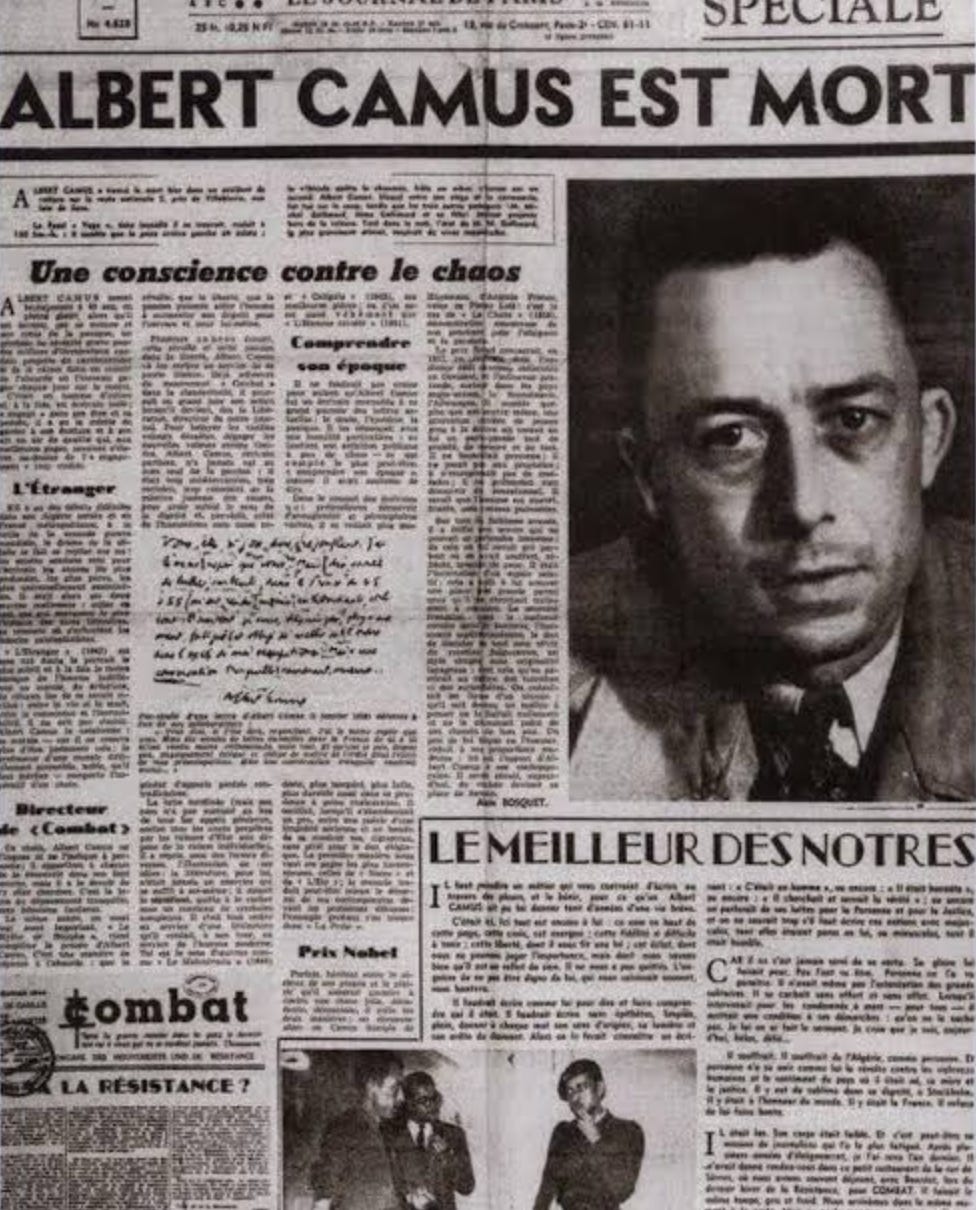
How long does it take to die?
This question really doesn’t make any sense.
Perhaps this is part of the reason death is so mysterious to us. We have no experience of it, and we never will. When As Epicurus famously wrote in the 4th century BCE, when death is present, we are not:
“Death, the most dreaded of evils, is therefore of no concern to us; for while we exist death is not present, and when death is present we no longer exist”
Epicurus, Letter to Menoeceus
The death of a human being, and this applies to all human beings, necessarily defies human reason. In death, the momentum of a human life, no matter how impressive or “simple”, is brought to a stop all at once. But how is that possible?
The instant deletion of subjectivity from the physical universe defies how we understand the rules of reality.
When the Facel Vega crashed into the tree that killed Camus, it ricocheted into another tree because of its kinetic energy. That the car kept going and changed its shape as it was crushed under the incredible physical forces of the event makes complete factual sense. It is high school physics.
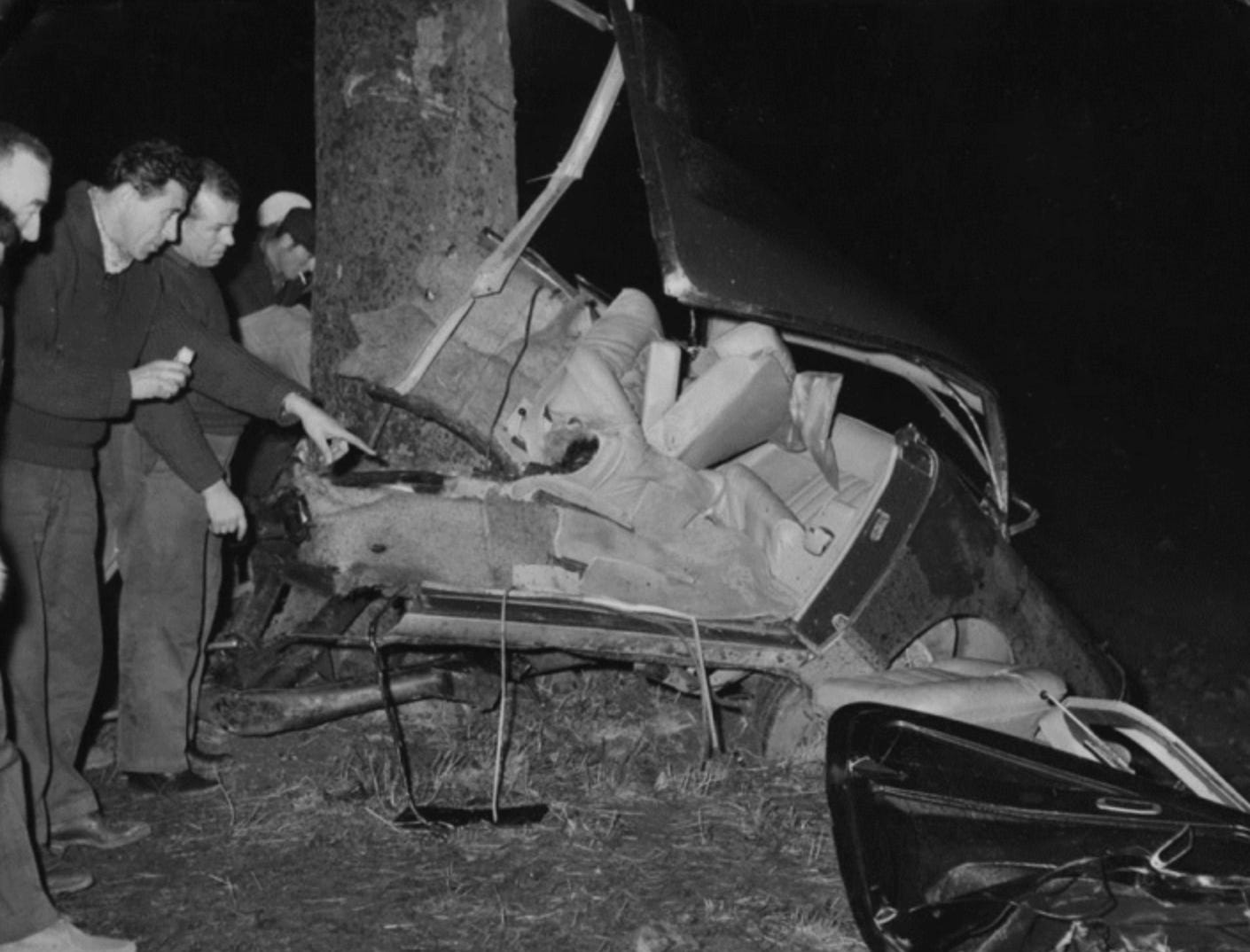
But what happens to the kinetic energy of a human life?
Everything that had happened and could happen inside of Camus’ mind, all of his subjective experiences, suddenly disappeared from the universe forever.
The subtraction of consciousness from reality simply cannot be comprehended.
Death is not a negation something that is, but a deletion.
While it is true that the kinetic energy of a conscious entity may ripple out and live on in its psychic effect on loved ones and other minds, there is still something internal to the subject which is lost forever and which no one could ever, in principle, know or understand — what it was like to be him.
All death is absurd.
In a famous tribute to Camus after his death, the great French existentialist philosopher Jean-Paul Sartre wrtoe:
“For all those that loved him, there is an unbearable absurdity in that death. But we shall have to learn to see that mutilated work as total work. Insofar as Camus’s humanism contains a human attitude toward death that was to take him by surprise, insofar as his proud and pure quest for happiness implied and called for the inhuman necessity of dying, we shall recognize in that work and in life that is inseparable from it the pure and victorious attempt of one man to snatch every instant of his existence from his future death”
Jean-Paul Sartre, 1960
Camus, The Man
Albert Camus (1913–1960) was a journalist, editor, playwright and director, novelist, author of short stories, political essayist and activist.
Despite endless debate he was, too, a philosopher.
He was a philosopher who dedicated his life first and foremost to living. He was not an academic by any means, but he was a serious thinker. Camus’ writings helped deepen humanity’s ability to think through and understand fundamental aspects of the human condition such as the meaning of human life, morality, oppression, and the absurdity of existence. He was a man trying to help human beings live and be happy in this world without the hope of any external salvation or justification, and without evading the cruel logic of existence.
“Believe me there is no such thing as great suffering, great regret, great memory … everything is forgotten, even a great love. That’s what’s sad about life, and also what’s wonderful about it. There is only a way of looking at things, a way that comes to you every once in a while. That’s why it’s good to have had love in your life after all, to have had an unhappy passion — it gives you an alibi for the vague despairs we all suffer from”
Albert Camus, A Happy Death
Camus did not believe that man could ever “solve” the problem of their absurd condition. Instead, he illuminated and embodied the human ability to create value and meaning from the quest for the “consciously realized unattainable”.
He was trying to teach us how to live asymptotically. That is, live fully without ever being able to overcome or eliminate fundamental existential problems or conditions. Living with a perpetual remainder, so to speak.
“We are dealing with a perpetual demand for unity … The rebel does not ask for life, but for reasons for living”
Camus, The Rebel
This, he thought, might allow us to transcend our challenging condition, or at least not let it destroy us.
He tried to do this through his art.
“In this universe, the work [of art] is then the unique occasion of maintaining [man’s] consciousness and of fixing its adventures. To create is to live twice”
Camus, The Myth of Sisyphus
There is a fundamental difference between being alive and living.
We are all alive in the minimal sense, but many of us can get stuck into long periods where we aren’t really living. What does that mean? It means not living our lives to the fullest. Not being fully present or immersed in the activites, relationships, and experiences that make life deeply meaningful and interesting.
This difference is especially acute in the modern world.
We “live” in a world designed to destroy us. Camus was aware of this in the 1940’s (because…Nazis), but it is perhaps even more true today.
Camus characterized the “madness” of modernity in terms of its central “fanatical” ambition to achieve immortality and indulge in every excess in service of this mission. Ronald Srigley writes in his book on Camus and modernity that:
“By the time of The Rebel, Camus had begun to identify modernity itself with the darkness and sophistry of the cave [Plato’s]. Confronted with this darkness, it was the rebel’s duty never to yield ‘to the impulse to allow himself to be engulfed in the shadows that surround him’ and ‘obstinately [to drag] the chains of evil, with which he is bound, to the light of good”
Ronald Srigley, Camus’ Critique of Modernity
The modern world is fundamentally incompatible with the world of the Greeks. Camus thought the Greeks had two dispositions which we have lost — “clairvoyant love of [our] human condition” and the “acceptance of death without hope” of an afterlife (Nietzsche also admired the Greeks for adopting a “tragic” view of human life which was able to turn our finitude and suffering into something beautiful and deeply meaningful).
The disposition towards death encourages us to consider the world around us carefully and to think deeply about its meaning (and also experience it deeply).
Srigley writes that:
“By the mid-1950s modernity and Christianity had become for Camus a single thing. The features that define these traditions are the reverse of those that characterize the Greeks: they are a desire to escape the world and the notion of an afterlife in which that desire will be satisfied. Christians and moderns attempt to secure meaning by placing it in the future and by appealing to human desire as guarantor of its existence. The practice has the consequence of diminishing life’s meaning in the present while also making it more exciting and increasing its emotional intensity in anticipation of a spectacular consummation”
Ronald Srigley, Camus’ Critique of Modernity
Despite Camus’ intense interest in the Greek attitude towards mortality and meaning, he was not a systematic philosopher like Plato or Aristotle. Camus had little faith in rationalism. In fact, he advocated strong forms of irrationalism (as will become obvious in The Myth of Sisyphus). Camus interested most of all with immediate personal experience and had the philosophical style of a novelist rather than an academic.
Camus’ Works
Camus explicitly spoke about his books as being organized according to different “stages” (étages) or “cycles” (cycles). See the table below for a general overview of his oeuvre (notice that The Myth of Sisyphus is to be read along with The Stranger. It also naturally pairs with The Rebel).
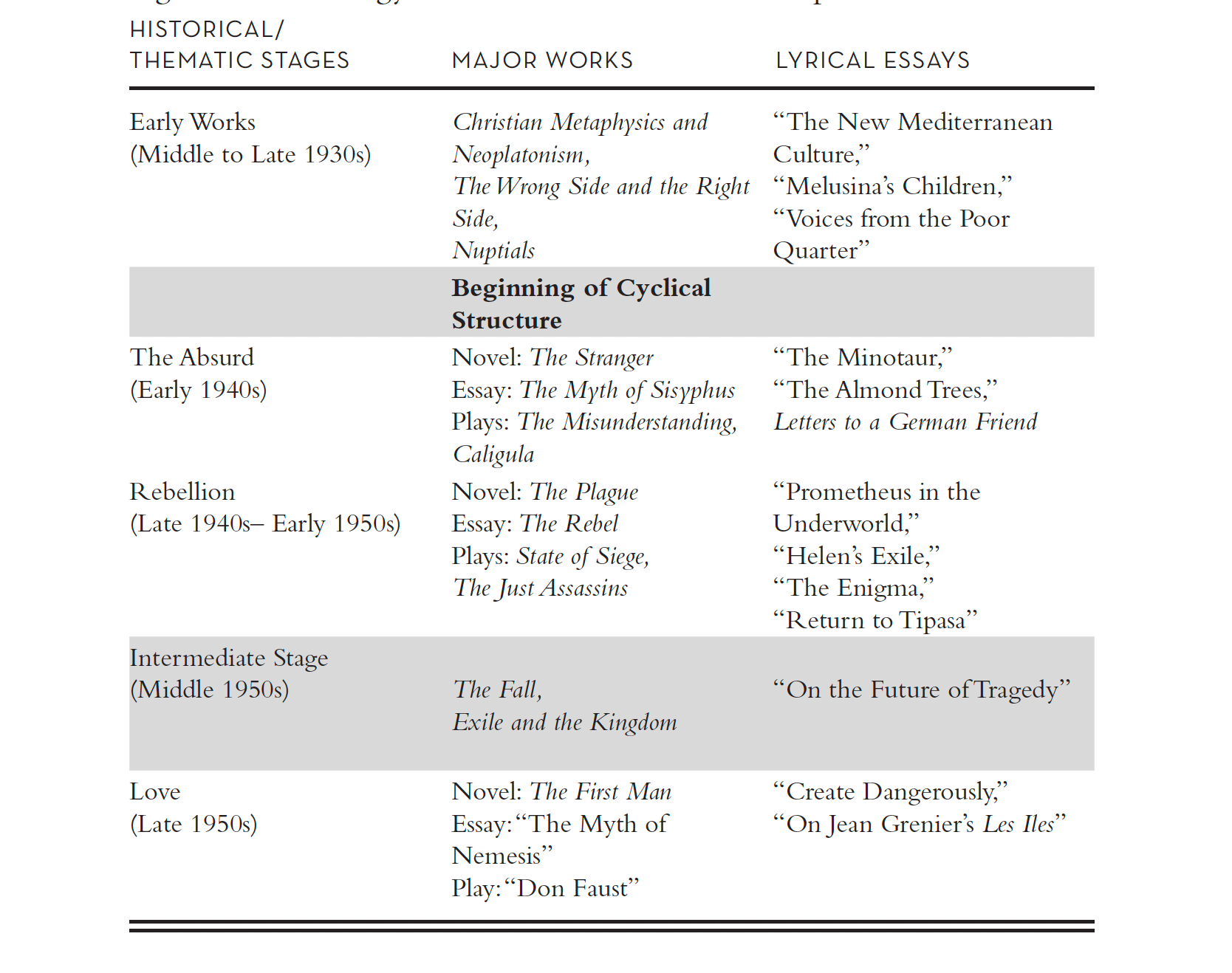
Across this diverse body of work, Camus investigated several major questions which I provide an overview of below to give you a sense of what gripped his mind.
Every philosopher has their questions.
For many, there is a single question that unifies their entire life and work. Socrates’ question was “How should one live?”, Heidegger’s question was “What is the meaning of Being?”, and Descartes’ question was “What can I know for sure?”. It is characteristic of the way Camus lived, wrote, and thought that he cannot be understood through a single question.
Instead, I have provided a list of questions from Matthew Sharpe’s book Camus, Philosophe, that are particularly helpful:
Can suicide ever be rationally justified, especially after the “death of God” (the loss in the West of shared faith in a transcendent, providential, salvific creator deity) diagnosed by Nietzsche in the late 19th century?
Can murder, for political or religious reasons (capital punishment, terrorism, targeted assassinations, drone strikes, etc.), ever be justified or should it always be opposed on principle?
Can ethical and political values be founded without recourse to a transcendent God, whose attributes and intentions seem beyond the scope of uncoerced, universal human agreement?
Is despair or “nihilism,” the view that there are no lasting epistemic or ethical limits or norms, inevitable for thoughtful non-believers?
Is a criticism of capitalism’s excesses and systematic injustices possible, which does not rely either on a return to theology (although it may), or the embrace of Marxist-Leninist principles which arguably secularize many motifs from Christian theodicy and eschatology, replacing the last judgment with utopian visions of an ‘end of history’?
What is the relationship between the West’s monotheistic (Jewish, then Christian) heritage, and its classical (Hellenic, then Roman) legacies, and what are the defining values and virtues of each which we might call upon in a modern world?
How can peoples of different cultural and religious backgrounds peaceably cohabit, in the absence of a single, universally agreed set of metaphysical or theological assumptions?
Sharpe argues that throughout Camus’ lifetime he develops a complex “master argument” which begins with The Myth of Sisyphus. I provide a condensed version of Sharpe’s very long and complex reconstruction of the master argument below.
Camus argues that we cannot, without making “leaps” of faith, claim to know either that there is a single, theological or rationalistic meaning explaining human life, or that there is no such absolute Meaning. He argues that suicidal despair would only be rationally justifiable if it could be definitively established that human life did have no meaning. But this is not so. Instead, Camus argues that philosophical “honesty” or “decency” demands a kind of chastened epistemic ethics: one of “living only with what we can know,” continually awake to, and animated to honestly confront, honor and preserve, the “absurd” divorce between the human longing for absolution and its unavailability, unless we philosophically “cheat”.
On the basis of this epistemic ethic, Camus argues in The Rebel that the murder of others can no more be justified than killing oneself, absent the sanction of an absolute theological or philosophical perspective. Thus, metaphysical skepticism does not necessitate moral nihilism. It points towards an unrelativizable primary value: that of solidarity with other human beings whom we know to exist, this side of all metaphysical disputes and confabulations:
Instead of continuing to aim for “all-or-nothing,” absolute perspectives, Camus contends that a consistently post-theological position must cultivate a perspective which would “exclude nothing” of what does inescapably present itself to human experience. No single truth or exigency (above all, the human longing for unity and order, or the final opacity of reality to total rational comprehension) can fully explain or comprehend all elements of the human condition.
The Myth of Sisyphus
We now turn to Camus’ famous philosophical essay, The Myth of Sisyphus.
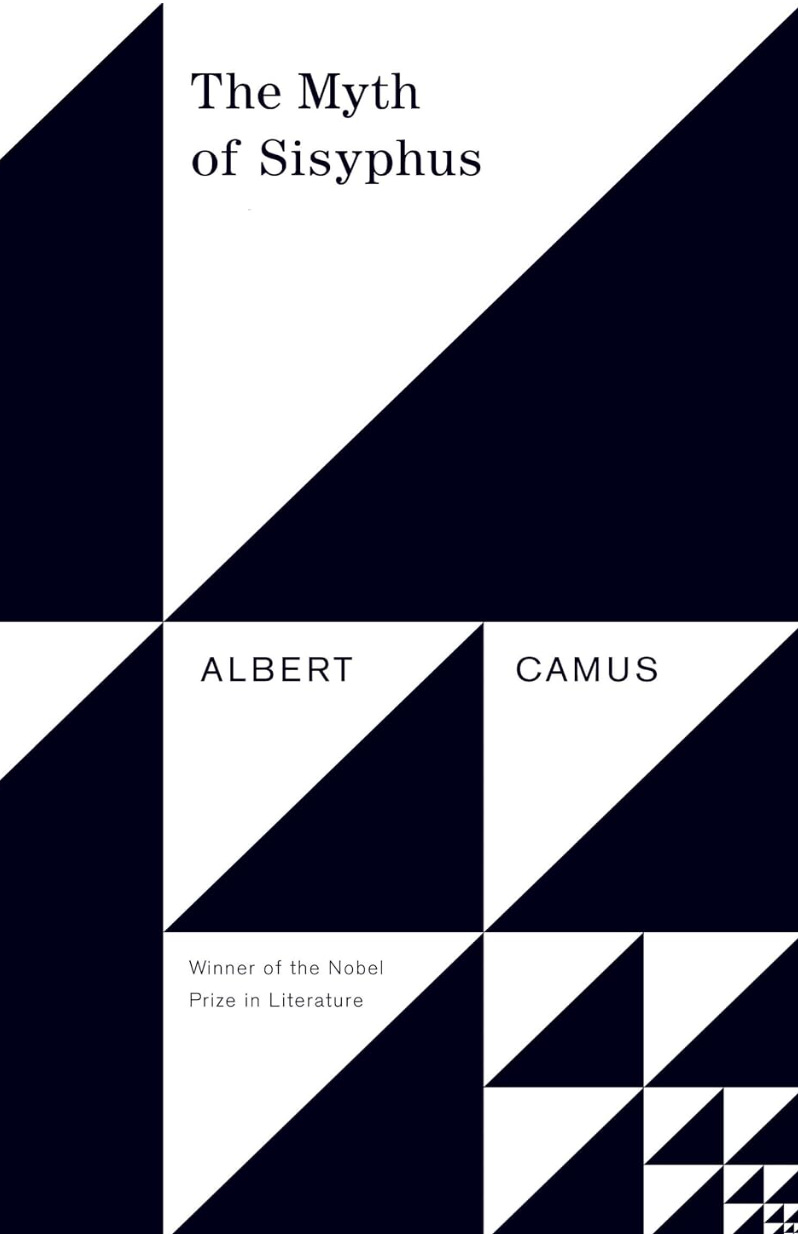
The rest of this newsletter provides an introduction to the text and the first two sections “An Absurd Reasoning” and “Absurd Walls”.
We will be discussing these sections and the rest of the book in my 4-week live seminar on Camus which starts on October 17th at 10am EST. Anyone who upgrades to a paid subscription to this Substack will receive access to all of the course materials, recordings, a private community, and live calls.
![The Myth Of Sisyphus [New Seminar]](https://substackcdn.com/image/fetch/$s_!HXNI!,w_140,h_140,c_fill,f_webp,q_auto:good,fl_progressive:steep,g_auto/https%3A%2F%2Fsubstack-post-media.s3.amazonaws.com%2Fpublic%2Fimages%2F765c0d8d-97a7-45f2-b9c1-61698c57629e_886x890.png)
In what is perhaps one of the greatest opening sections of any philosophical text, Camus asks:
“There is but one truly serious philosophical problem, and that is suicide. Judging whether life is or is not worth living amounts to answering the fundamental question of philosophy. All the rest — whether or not the world has three dimensions, whether the mind has nine or twelve categories — comes afterwards”
Camus, The Myth of Sisyphus, 3
The book is famous for introducing the concept of “the Absurd” to the world in a memorable way. But before we dig into what that concept means, it helps to know where the book came from.
Camus began writing The Myth of Sisyphus in 1940, during what he later called, in his 1955 preface to its American translation, “the French and European disaster”. France had just fallen to the Nazis. Millions of refugees were fleeing the advancing German armies. The mood was one of tragic hopelessness. The historian Robert Zaretsky argues that this experience of collapse is where Camus’ idea of the absurd was really born. Camus was also struggling with tuberculosis during this period and was so seriously ill he wasn’t sure he would survive at all.
The book was one panel of a planned triptych (a work of art divided into three section) on the absurd: a novel (The Stranger), a philosophical essay (The Myth of Sisyphus), and a play (Caligula). As Ronald Aronson recounts, Camus finished the manuscripts in Algeria and sent them off to his Paris publisher in September 1941. He wanted them published together, maybe even in a single volume. But between commercial concerns and the wartime paper shortage, The Stranger appeared in June 1942, Sisyphus followed in October, and Caligula didn’t appear in print until 1944.
(This is why I recommend reading The Stranger alongside or after this seminar. The novel shows the absurd in the main character Meursault. The essay thinks it through.)
Looking back on the book fifteen years later in that same preface, Camus said its central claim was that it is possible, even from inside nihilism, to find a way past it.
That is the goal of this seminar — to help us think through and past nihilism and return to life.
A major theme in Camus’ life and work was, according to David Carroll, a “will to resist”. In particular, a will to resist even when it appears hopeless or ridiculous to do so. Carroll reads The Myth of Sisyphus as describing the “preconditions for and limits of individual resistance to the human condition itself”. It is worth remembering that the man who wrote this book about resisting the human condition would soon be resisting the Nazis directly, as editor of the underground Resistance newspaper Combat (it is important not to underestimate how dangerous serving as the editor of Combat was for Camus).
A Philosophy That Questions Philosophy
The way Camus begins the work makes it clear that there is one thing that he is ultimately concerned with — human life.
In particular, whether this life, your life, is worth living.
Under what conditions (if any) is it not worth living? How should we live if life is absurd?
As Camus makes clear, philosophers have failed to address several important aspects of the human condition, with suicide being an obvious example. Part of the reason for this, we will learn, is that dealing with such issues adequately requires going beyond philosophy as it is normally understood and practiced (something Camus was happy to do).
The irony of Camus’ opening is that what he calls the “one truly serious philosophical problem” may just lie outside of the limits of philosophy itself.
A philosophical essay that begins by stating that the most important question is beyond the limits of philosophy itself.
Classic.
Socrates famously initiated the tradition of Greek/European rationalist philosophy by claiming in the Apology that:
“The unexamined life is not worth living for man”
Socrates, Apology
Camus’ book challenges the very foundation of this entire tradition by getting us to question the relationship between examination/reflection and the meaning of life. What happens if we realize, through the examined life, that life is absurd? Is life still, then, worth living? Was Socrates correct to think that such reflections make life good for us? It seems like they may make it worse!
What then?
The Myth of Sisyphus seeks to help you understand why life is absurd, but also why this shouldn’t lead to nihilism, despair, or suicide.
As Ronald Aronson points out, the book is full of paradoxes.
It is a philosophy that contests philosophy itself. It belongs squarely in the existentialist tradition, and yet Camus denied being an existentialist. It is skeptical of every conclusion about the meaning of life, and yet it gives confident answers about how to live.
That’s the world of Camus.
It is exhilarating.
Some of Camus’ contemporaries thought that an “absurdist philosophy” is a contradiction in terms. Not really a philosophy at all, but an anti-rational posture that can only end in silence.
Suppose that is true — what then?
An Absurd Reasoning
How do we reason about the absurd? Is that even possible?
That is what we read about in the opening pages of the book.
The first section of The Myth of Sisyphus is titled “An Absurd Reasoning” because Camus wants to do something unusual. He wants to take the absurd as a starting point and reason from it, honestly and rigorously, all the way to the end.
He wants to lead us into the philosophical desert.
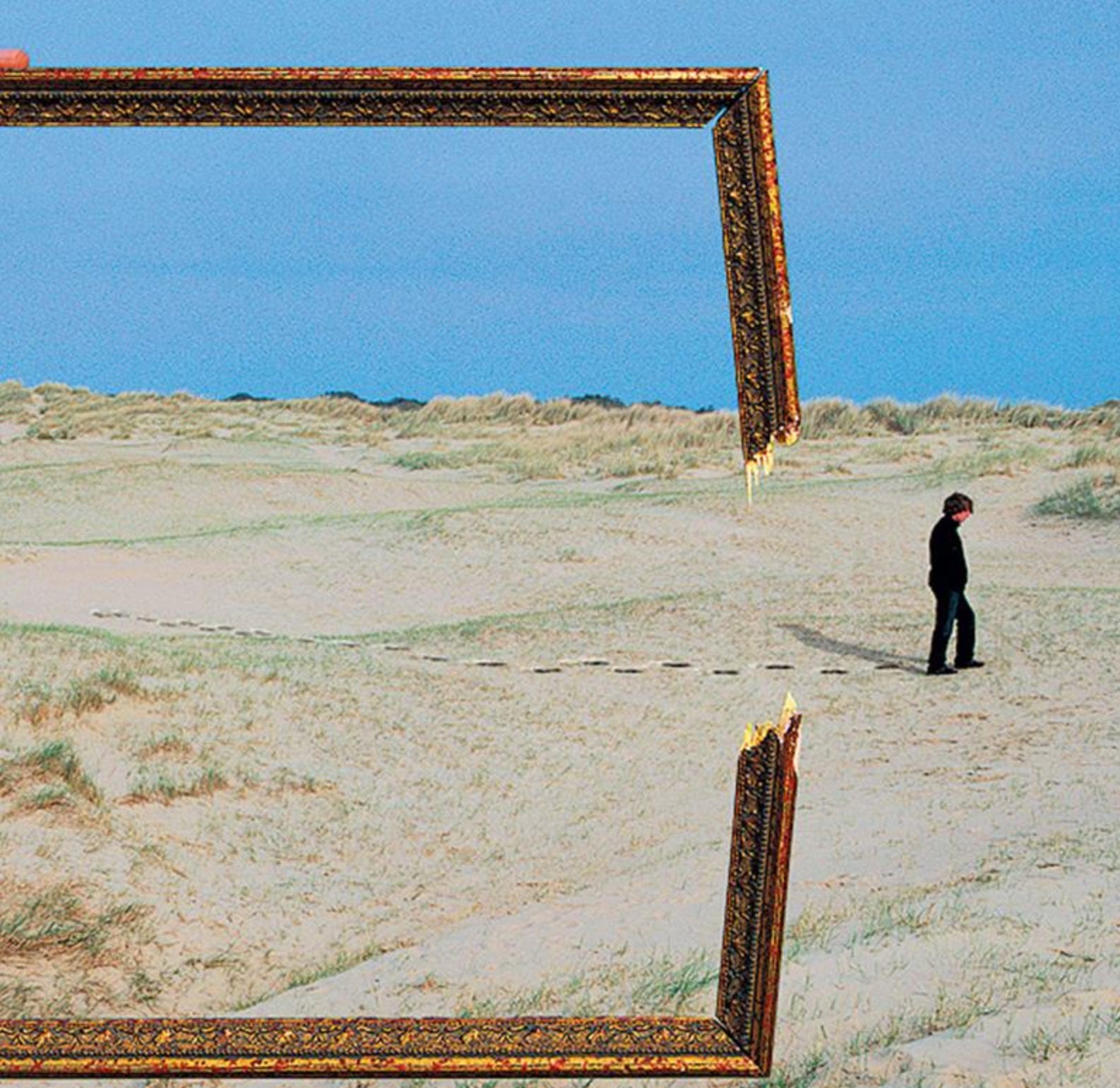
Notice what he is not doing. He is not trying to prove that life is absurd. Camus opens the book with a short note telling us that what follows describes an absurd sensibility that was widespread in his time, not an absurd philosophy (which, he says, his time never really had). He calls it a description of an intellectual sickness, and he insists it is provisional.
So the absurd is the premise, not the conclusion. Camus is interested in consequences. In seeing what follows from certain starting points.
Camus pushes the absurd reasoning as far as it will go, as a kind of methodical doubt akin to the method employed by Descartes in Meditations. David Carroll even suggests that the book replaces Descartes’ “I think, therefore I am” with something like “I experience the feeling of the Absurd, therefore I am”.
And so I go on living.
It always comes back to life at the end of everything. Life is always about actions and choices more than theories or ideas (although ignore these at your peril).
“An Absurd Reasoning” has four parts:
Absurdity and Suicide (pp. 3–10)
Absurd Walls (pp. 10–28)
Philosophical Suicide
Absurd Freedom
This week we work through the first two. They set the stage for the rest of the book.
Absurdity and Suicide
Let’s return to that famous opening line.
Camus combines it with a thought from Nietzsche that “a philosopher, to deserve our respect, must preach by example”. When these two thoughts are combined, then, Camus thinks we can appreciate the importance of the answer, “for it will precede the definitive act”.
Why should we believe this?
Camus supports his bold proclamation by reasoning that we can judge the urgency of a question by the actions it entails. Since the question of suicide, answered affirmatively, entails suicide, it is the most important question.
Camus points out that we are often not willing to die for theoretical truth.
“I have never seen anyone die for the ontological argument”
Camus, The Myth of Sisyphus
His example is Galileo. Galileo held a scientific truth of enormous importance, and he took it back the moment it put his life in danger. Camus’ verdict? In a certain sense, Galileo did the right thing. Whether the Earth revolves around the Sun or the Sun around the Earth is a question of “profound indifference” when compared to the question of whether life is worth living.
“I therefore conclude that the meaning of life is the most urgent of questions”
Camus, The Myth of Sisyphus
We can challenge Camus here, but the book hinges on this presupposition.
Again, start with a premise and see what its consequences are.
For Camus, the point of philosophy is not comprehension for its own sake.
It is action.
It is about whether, and how, to go on living.
Camus locates suicide in the individual heart. Suicide, he says, is prepared in silence, the way a great work of art is. And the danger begins with thinking or reflection itself (would someone living an unexamined life ever think of committing suicide?).
Once we start to reflect, something starts to erode.
To kill oneself, Camus suggests, is a kind of confession. It is a confession that life has become “too much”, or that we don’t understand it, or simply that it isn’t worth the trouble. It means having recognized, even instinctively, the reality of what Camus calls “the absurd”.
The Absurd
The subject of the essay, Camus writes, is the relationship between the absurd and suicide — “the exact degree to which suicide is a solution to the absurd”.
What is “the absurd”?
Not what we usually mean by the word. In everyday speech, “absurd” just means ridiculous or out of place.
Camus’ absurd comes from the collision of two things:
How we want the world to be and how the world actually is.
We want the world to make sense. We want it to be fair, with good rewarded and evil punished. We want to know why we’re here and where it’s all going. What we get is a world that doesn’t answer.
Silence.
Silence is absurd.
Imagine you are talking on the phone to someone and they go silent. You keep talking. Maybe after a minute you raise your voice, you get annoyed. Nothing. Are they dead? Are they upset with me? Has their phone been disconnected the entire time?
There are two basic senses in which Camus talks about “the absurd”.
What we can call a “metaphysical sense” and a “felt sense”. The metaphysical sense of the absurd is the sense in which the absurd is a kind of cosmic phenomenon — a fact or thesis about life itself or the universe and its meaning. The felt sense of the absurd is the subjectively experienced feeling of absurdity that many humans have experienced (even if they couldn’t quite articulate it).
Regarding the second sense, Camus writes:
“In a universe suddenly divested of illusions and lights, man feels an alien, a stranger. His exile is without remedy, since he is deprived of the memory of a lost homeland or the hope of a promised land. This divorce between man and his life, the actor and his setting, is properly the feeling of absurdity”
Camus, The Myth of Sisyphus, 6
Notice the image of exile. We are adrift between past and future, unable to lean on either, strangers to the world and to ourselves. That sounds like a recipe for despair, especially since Camus calls this exile “without remedy”. But as David Carroll points out, the book turns this around.
The very awareness that there is no remedy becomes the reason to live (and, eventually, the reason to resist).
Camus is intensely focused on the consequences of this feeling. In particular, he is interested in how the absurd should dictate our actions. He writes:
“The principle can be established that for a man who does not cheat, what he believes to be true must determine his action”
Camus, The Myth of Sisyphus, 6
In other words, if we are honest with ourselves and what we believe, then our actions should follow from those beliefs in theory. If the absurd requires suicide, then suicide it is.
“Belief in the absurdity of existence must then dictate his conduct”
Camus, The Myth of Sisyphus, 6
If someone believes that life is absurd and is therefore not worth living, and yet they continue to live, then they are living in contradiction with themselves (what is called a practical contradiction). Camus doesn’t say, yet, whether the truth of the absurd does dictate any particular response, but it is important to know ahead of time that he does not think it dictates suicide.
Exactly what the appropriate response is will be something we investigate throughout the book.
On this theme, Camus mocks the great German philosopher Arthur Schopenhauer, who denied that life has meaning, yet continued to live:
“Schopenhauer is often cited, as a fit subject for laughter, because he praised suicide while seated at a well-set table. This is no subject for joking. That way of not taking the tragic seriously is not so grievous, but it helps to judge a man”
Camus, The Myth of Sisyphus, 7
Camus thinks that it is important to investigate the relationship between our beliefs and our actions, but he also doesn’t think that figures like Schopenhauer should cause us to conclude that what we believe doesn’t matter. The case of Schopenhauer can be explained by the stubborn fact that:
“In a man’s attachment to life there is something stronger than all the ills in the world. The body’s judgment is as good as the mind’s and the body shrinks from annihilation. We get into the habit of living before acquiring the habit of thinking”
Camus, The Myth of Sisyphus, 8
The body is always a step ahead of the mind. That is part of why so few people who decide life is meaningless actually act on it.
But Camus also points out that many of us choose to avoid or escape the absurd rather than live in blatant contradiction.
We escape through hope.
Either the hope of another life that we must earn, or the more sophisticated trick of living not for life itself but for some grand idea that promises to give it meaning (and ends up betraying it). Camus calls hope the “fatal evasion”.
So there are two ways to get out of the absurd. Suicide ends it by ending life. Hope ends it by leaping beyond this life. Camus will argue that both are ways of running from the absurd rather than facing it.
The absurd needs two things, a human being and a world.
Take one away, and the absurd is destroyed.
Camus is trying to help us understand the confusing nest of contradictions and paradoxes on this topic.
The question now arises.
Should we take anything away?
Does the Absurd dictate death?
“One kills oneself because life is not worth living, that is certainly a truth — yet an unfruitful one because it is a truism. But does that insult to existence, that flat denial in which it is plunged come from the fact that it has no meaning? Does its absurdity require one to escape it through hope or suicide — this is what must be clarified, hunted down, and elucidated while brushing aside all the rest. Does the Absurd dictate death?”
Camus, The Myth of Sisyphus, 8–9
The Philosophical Desert
What is “absurd reasoning”?
It is being logical to the “bitter end”. Following logic to its ultimate conclusions. Camus wants to pursue the reasoning that follows from the absurd.
“This is what I call an absurd reasoning. Many have begun it. I do not yet know whether or not they kept to it”
Camus, The Myth of Sisyphus, 9
Camus wants us to enter into “those waterless deserts where thought reaches its confines”. Those existential and logical deserts that human beings seek to escape or destroy as soon as they find themselves lost in them.
“At that last crossroad where thought hesitates, many men have arrived and even some of the humblest. They then abdicated what was most precious to them, their life”
Camus, The Myth of Sisyphus, 9–10
Here is the problem. Most people who reach the desert don’t stay. Some give up their lives. Others (as we’ll see in the coming sections) give up their reason instead, and leap toward God, eternity, or some system that makes the desert disappear.
Either way, they get out.
Camus’ approach is the opposite:
“The real effort is to stay there, rather, in so far as that is possible, and to examine closely the odd vegetation of those distant regions. Tenacity and acumen are privileged spectators of this inhuman show in which absurdity, hope, and death carry on their dialogue”
Camus, The Myth of Sisyphus, 10
You need stubbornness to stay in the desert, and clear sight to see what is actually there once you do. As Carroll describes it, thought in this desert gets stripped of its phantoms, its comforting illusions, until it is reduced to almost nothing.
A skeleton of itself.
That is what absurd reasoning is. Not a proof. Not a system.
It is the discipline of holding the tension between what we want and what we get, and refusing to resolve it in either direction.
Absurd Walls
Why “walls”?
A wall is where you stop. You can’t walk through it, and you can’t see past it. Camus’ absurd walls are the limits we run into in both experience and in thought. The places where the world refuses to give way to our demand for meaning and clarity.
In the final scene of 2001: A Space Odyssey, the main character Dave finds himself in a walled room which has all of the familiar human comforts, but none of the meaning or coherence of human social life.
Viewers are left puzzled.
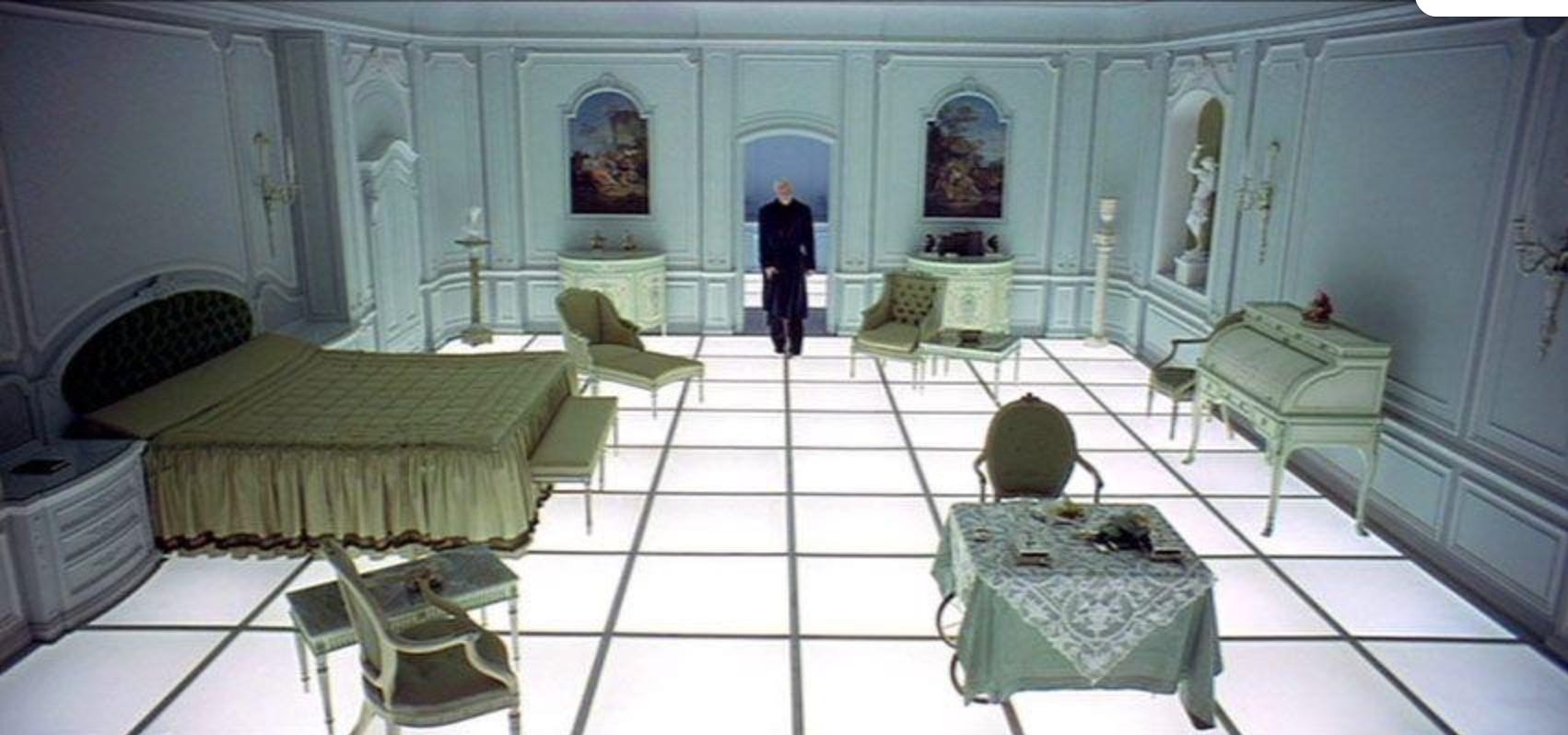
What is the place? What are its rules?
The very point is to break our rational minds. To force us to watch an ending that isn’t an ending. A scene that defies human comprehension, but contains everything which is needed to be meaningful.
An Inventory Off Absurd Feelings (pages 10-16)
Between pages 10 and 21, Camus takes himself to be providing what he calls an inventory of the absurd on two planes: that of feeling and that of thought. He ends with a survey of philosophers who have run into the walls of the absurd.
Human beings are capable of encountering the absurd at any place and time.
“At any streetcorner the feeling of absurdity can strike any man in the face”
Camus, The Myth of Sisyphus, 10–11
Why start with feelings? Because, Camus thinks:
“Like great works, deep feelings always mean more than they are conscious of saying”
Camus, The Myth of Sisyphus, 10
A feeling can’t prove anything. But it can point at something true before we are able to say it. The absurd almost always announces itself as a mood first.
Camus takes himself to be defining in this section a “method”, although not a typical philosophical method. It is a method which acknowledges:
“the feeling that all true knowledge is impossible. Solely appearances can be enumerated and the climate make itself felt”
Camus, The Myth of Sisyphus, 11
So Camus enumerates. And he wants us to notice how the absurd is born in the most ordinary and familiar places imaginable.
“the stage sets collapse. Rising, streetcar, four hours in the office or the factory, meal, streetcar, four hours of work, meal, sleep, and Monday Tuesday Wednesday Thursday Friday Saturday and Sunday according to the same rhythm”
Camus, The Myth of Sisyphus, 12–13
“But one day the ‘why’ arises and everything begins in that weariness tinged with amazement”
Camus, The Myth of Sisyphus, 13
Most of our lives are lived in routine. What Heidegger called our “they-Self”. The thoughts, speech, and behaviors of social life. The mundane. While we are immersed in this world, the stage set holds.
Then one day, often for no particular reason, things fall apart, and we ask ourselves a fatal question — why?
The weariness caused by routine is both sickening and what rouses us from sleepwalking through life. What follows is either a slow return to the routine or a transformative awakening.
An awakening that either to suicide, to recovery, or back into the dream.
“For everything begins with consciousness and nothing is worth anything except through it”
Camus, The Myth of Sisyphus, 13
The most absurd feelings we have are almost always direct towards death.
We all live as if we are not really going to do.
That is part of what allows for us to become immersed in the mundane.
No one actually experiences death, nor coudl they.
We only ever experience the deaths of others, from the outside, and that is no substitute. Our death is our own. It can only be experienced by us. But the cruel trick is that it cannot, really. This raises a puzzling question:
How are we to live in relation to something that is both inevitable and cannot be experienced?
What is truly horrifying about death, Camus says, is its mathematical character. It is a problem whose answer we already know, like 2+2=?
How long does it take to die? The question doesn’t make sense.
Maybe the answer is our entire lives.
That is a kind of truism, or empty response.
One moment there is an entire world of experience inside a person, and the next it is deleted.
It is incomprehensible.
Pages 16–21: Inventory of the Absurd on the Plane of Intelligence
In the next stretch of text, Camus takes a “rapid inventory” of the absurd on the intellectual plane.
He begins with a shocking observation about logical thinking — that it has what I would call a “cannibalistic quality”.
Camus writes:
“The mind’s first step is to distinguish what is true from what is false. However, as soon as thought reflects on itself, what it first discovers is a contradiction”
Camus, The Myth of Sisyphus, 16
Why?
“Because, as Aristotle has pointed out, ‘by asserting that all is true we assert the truth of the contrary assertion and consequently the falsity of our own thesis (for the contrary assertion does not admit that it can be true)’. And if one says that all is false, that assertion is itself false. If we declare that solely the assertion opposed to ours is false or else that solely ours is not false, we are nevertheless forced to admit an infinite number of true or false judgments. For the one who expresses a true assertion proclaims simultaneously that it is true, and so on ad infinitum”
Camus, The Myth of Sisyphus, 16
This is a “vicious circle”.
“The mind that studies itself gets lost in a giddy whirling”
Camus, The Myth of Sisyphus, 17
And yet, Camus asserts:
“the mind’s deepest desire, even in its most elaborate operations, parallels man’s unconscious feeling in the face of his universe: it is an insistence upon familiarity, an appetite for clarity. Understanding the world for a man is reducing it to the human, stamping it with his seal”
Camus, The Myth of Sisyphus, 17
This is the human dream. We want the world to be familiar, to feel like home. Camus suggests that if we discovered the universe could love and suffer the way we do, we would be reconciled to it.
To think, for us, is to unify. To make the many into one. But are unifications real? Are they true? Are they good for us?
“That nostalgia for unity, that appetite for the absolute illustrates the essential impulse of the human drama”
Camus, The Myth of Sisyphus, 17
These “truisms”, Camus thinks, are “not interesting in themselves” but only because of “the consequences that can be deduced from them”.
So what can we actually know?
Camus’ answer is that I can feel my own heart, so I judge that it exists. I can touch the world, so I judge that it exists too. And that is where my knowledge ends.
Everything else is a construction. A fantasy of reason.
What about science?
Camus admits that science can describe the world, classify it, and list its laws.
But if you want it to explain the world, and it tells you about an invisible solar system in which electrons orbit a nucleus, you will be left perpetually unsatisfied.
It explains the world with an image.
Science, which promised to teach us everything, ends in hypothesis and metaphor.
It is a form of poetry.
And it’s lines keep changing with every new theory.
Camus concludes that:
“intelligence, too, tells me in its way that this world is absurd”
Camus, The Myth of Sisyphus, 20
But wait, I thought the absurd was a relationship between man and world? That’s right. The world is not itself absurd. The world is just the world and that is all. We are not absurd either. We just creatures who want clarity and meaning.
The absurd lives in the relationship between the two— the confrontation.
“In this unintelligible and limited universe, man’s fate henceforth assumes its meaning. A horde of irrationals has sprung up and surrounds him until his ultimate end. In his recovered and now studied lucidity, the feeling of the absurd becomes clear and definite. I said that the world is absurd, but I was too hasty. This world in itself is not reasonable, that is all that can be said. But what is absurd is the confrontation of this irrational and the wild longing for clarity whose call echoes in the human heart. The absurd depends as much on man as on the world. For the moment it is all that links them together”
Camus, The Myth of Sisyphus, 21
Camus will give a vivid example of this later. A man armed only with a sword charging a nest of machine guns is absurd. Not because swords are absurd, and not because machine guns are absurd, but because of the disproportion between the two.
It is tempting to read Camus here as an enemy of reason. (Aronson, for one, says Camus pits himself against science and philosophy and dismisses rational analysis.) He certainly sounds like it:
“That universal reason, practical or ethical, that determinism, those categories that explain everything are enough to make a decent man laugh”
Camus, The Myth of Sisyphus, 21
But look closely at what makes him laugh. Not thinking. Systems that claim to explain everything. Camus’ target is reason’s claim to totality, not reason itself. And as we’ll see, he will be just as hard on those who give up on reason altogether.
“This is all I can discern clearly in this measureless universe where my adventure takes place. Let us pause here”
Camus, The Myth of Sisyphus, 21
The Philosophers
Camus ends this stretch of text by surveying a group of modern thinkers who, in his view, all ran into these same absurd walls.
Camus seeks to establish a “basic relationship” between these major thinkers.
What is it?
They are all responding to a historical moment in which “hope has no further place” and in which man wants:
“everything to be explained … or nothing. And the reason is impotent when it hears this cry from the heart. The mind aroused by this insistence seeks and finds nothing but contradictions and nonsense”
Camus, The Myth of Sisyphus, 27
Camus is sympathetic here. These thinkers saw the walls clearly. They described the same climate he is describing: a world of contradiction, anxiety, and powerlessness.
But Camus will argue that nearly all of them, at the last moment, tried to jump over the walls. They didn’t stay in the desert, but sought a way out.
That leap is what Camus calls “philosophical suicide”.
“The mind, when it reaches its limits, must make a judgment and choose its conclusions. This is where suicide and the reply stand”
Camus, The Myth of Sisyphus, 27
Reflection Questions
Camus measures the urgency of a question by the actions it entails. Do you agree? Is there a more serious philosophical question than whether life is worth living?
Have you ever had a “stage sets collapse” moment? What triggered it, and what did you do afterward: return to the routine, or something else?
Camus says the world isn’t absurd, only “not reasonable”, and that the absurd lives in the confrontation between us and the world. Why does it matter so much where the absurd is located?
Is Camus an enemy of reason, or of something more specific?
Camus treats hope as an evasion. What would it look like to live without hope in his sense? Is that even desirable?
Sources
Camus
Camus, Albert. Caligula and Three Other Plays. Translated by Stuart Gilbert. New York: Alfred A. Knopf, 1958.
Camus, Albert. The First Man. Translated by David Hapgood. New York: Alfred A. Knopf, 1995.
Camus, Albert. A Happy Death. Translated by Richard Howard. New York: Alfred A. Knopf, 1972.
Camus, Albert. The Myth of Sisyphus and Other Essays. Translated by Justin O’Brien. New York: Vintage International, 1991. Includes Camus’ 1955 preface to the American edition. Originally published as Le Mythe de Sisyphe (Paris: Gallimard, 1942).
Camus, Albert. The Rebel: An Essay on Man in Revolt. Translated by Anthony Bower. New York: Vintage International, 1991.
Camus, Albert. The Stranger. Translated by Matthew Ward. New York: Alfred A. Knopf, 1988.
Secondary Sources
Aronson, Ronald. “Albert Camus.” In The Stanford Encyclopedia of Philosophy. First published October 27, 2011; substantive revision December 13, 2021. https://plato.stanford.edu/entries/camus/.
Carroll, David. “Rethinking the Absurd: Le Mythe de Sisyphe.” In The Cambridge Companion to Camus, edited by Edward J. Hughes, 53–66. Cambridge: Cambridge University Press, 2007.
Sharpe, Matthew. Camus, Philosophe: To Return to Our Beginnings. Social and Critical Theory 18. Leiden: Brill, 2015.
Srigley, Ronald. Albert Camus’ Critique of Modernity. Columbia: University of Missouri Press, 2011.
Van Aken, Erik. “Albert Camus on the Absurd: The Myth of Sisyphus.” 1000-Word Philosophy: An Introductory Anthology, May 1, 2019. https://1000wordphilosophy.com/2019/05/01/camus-on-the-absurd-the-myth-of-sisyphus/.
Zaretsky, Robert. A Life Worth Living: Albert Camus and the Quest for Meaning. Cambridge, MA: Harvard University Press, 2013.
![The Myth Of Sisyphus [New Seminar]](https://substackcdn.com/image/fetch/$s_!HXNI!,w_1300,h_650,c_fill,f_webp,q_auto:good,fl_progressive:steep,g_auto/https%3A%2F%2Fsubstack-post-media.s3.amazonaws.com%2Fpublic%2Fimages%2F765c0d8d-97a7-45f2-b9c1-61698c57629e_886x890.png)
Your ability to articulate these topics is incredible. Well done! I’m going to go back and reread The Myth of Sisyphus now.
Fantastic essay! Very in depth!