


For the last 15 years, social media has been hyper saturated with productivity content.
And few things have been talked about more than journaling.
So is there anything left to say about it?
I think there is.
In this article, I present what I take to be a completely new kind of journaling that I have been practicing recently.
I don’t have a name for it yet.
In my head, I call it philosophical journaling, but that is already a well established practice.
Philosophical journaling often comes in two forms.
First, it consists of someone working out solutions to a philosophical problem through a series of daily reflections (Descartes, Nietzsche, Wittgenstein).
Second, it consists of someone reflecting on how they are living (or failing to live) in accordance with their personal philosophy (Marcus Aurelius).
If you aren’t a professional philosopher, it’s unlikely that the first form of philosophical journaling would be of much use.
The second form of philosophical journaling has been written about extensively in recent years, as thousands of people have turned to Stoicism and its associated practices as a way to live more meaningful and stress-free lives.
The benefits of this form of journaling are well known, and have even been studied scientifically by researchers trained in Cognitive Behavioral Therapy.
But recently, I have been practicing a kind of journaling that is different than anything I have seen before…
A New Kind Of Journaling
The new kind of philosophical journaling that I have been practicing is aimed at using a daily journaling practice to build my own philosophy.
Every day, I engage in a short journaling exercise that is aimed at helping me identify a fundamental philosophical belief that I hold, which is then added onto and combined with other beliefs I have written about.
Over time, these fundamental building blocks are assembled together into a personal philosophy.
In particular, it is aimed at building what I have called in various places a micro-philosophy — a personal philosophy for living that is a concise expression of an individual’s worldview, values, ethical principles, and core beliefs.
The task of this kind of journal is constructive — to build something — rather than to engage in therapy.
What I have found, though, is that the process of building one’s own philosophy is therapeutic anyways.
Even though the primary aim is not to feel better, alleviate anxiety, or solve a pre-existing problem, I have found that these benefits are by-products of engaging in the personal project of building one’s own philosophy.
Why?
Because building a philosophy for yourself to live by helps clarify your thinking, uncover hidden assumptions and blindspots that you have been living by, and develop a deeper understanding of who you are and what you value.
Without a personal philosophy, life can be confusing, messy, and aimless.
The reason is that there is no overarching frame for the onslaught of human experience.
Everyone needs at least some kind of frame to make sense of things.
Even if it is imperfect or unfinished, simply having a frame can provide massive benefits for structuring one’s life experiencing and figuring out where to focus one’s energy and how to move forward.
The Micro-Philosophy Journal
I am a strong believer in the benefits (and scientific evidence) of writing by hand on physical paper.
Although I had already constructed my own micro-philosophy digitally, I wanted to see what it would be like to write out a new micro-philosophy for myself on paper.
How would that change my experience? Would it lead to any new insights? Would I internalize my beliefs more strongly? Would they feel more personal?
I decided that the best way to do this would be to create my own journal that is specifically designed to help someone build their own philosophy through customized daily writing exercises.
So I created the Micro-Philosophy Journal.
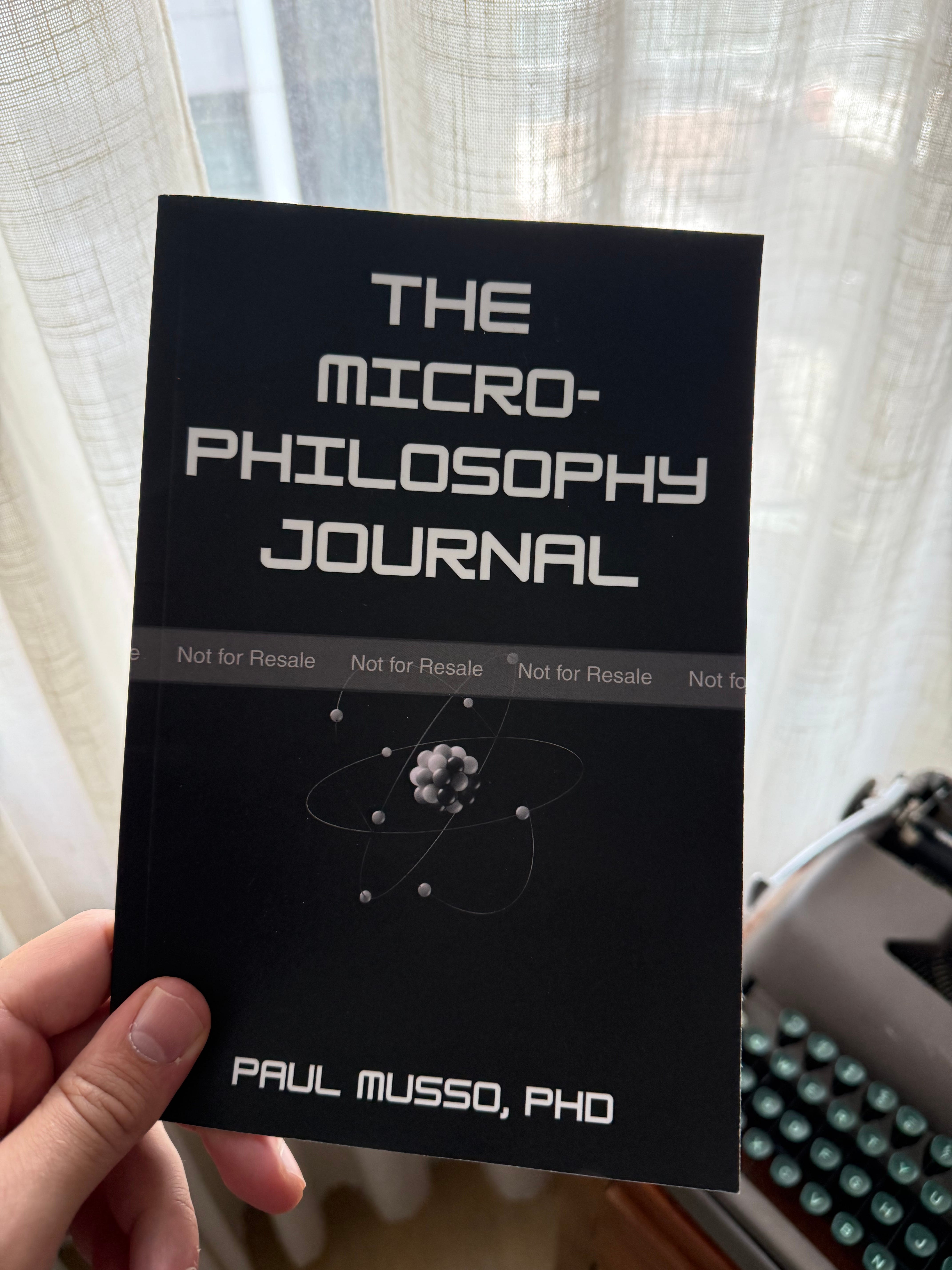
The picture above is the first printed copy of the Micro-Philosophy Journal that I self-published a few weeks ago.
I can’t even describe how incredible it felt to hold this physical copy in my hand for the first time. For the past year, I have been envisioning creating a future in which thousands of people develop their own personal philosophies.
This physical book felt like a huge step towards making that a reality.
As far as I am aware, this is the first journal specifically designed to help people do this in a structured way.
It is possible, of course, to build a philosophy on your own with a blank journal.
I have found, however, that very often what people need is a frame to help focus their thinking. Most people struggle to simply get started and don’t even know what questions to ask.
No one teaches us how to build our own system of beliefs and values in school (in fact, we learn the exact opposite — how to accept what other people have thought).
The Micro-Philosophy Journal asks the right questions that someone would need to answer in order to make progress on building their own philosophy.
For the next month, I will be experimenting with this journal and testing out the questions and writing prompts myself to see what works.
After that, I plan to release an improved version of this journal to the general public on Amazon.
For those of you who enrolled in the Micro-Philosophy: Foundations Course, I will be sending you a free copy at my own expense as a token of my gratitude for your support — more details to come in the private community.
I can’t express just how grateful I am for all of the support, comments, criticisms, and engagement that has made it possible to reach this point.
Most of the ideas that I am thinking and writing about would never have even occurred to me if I wasn’t on Substack — it is a constant source of unexpected and unpredictable inspiration and creativity.
I will be releasing more details about the journal and documenting my experiments and insights over the course of the next month.
In the meantime, I have some writing to do…
-Paul
Is it fair to look at social media posting and commenting as a present-day variation of journaling? If so, how well does what we post serve us and our well-being? How can we do it in a healthier way. :-)
Would you consider putting an electronic copy on Gumroad or similar?