


“When I hear the word philosopher, the first thing I think of is — unemployed”.
These were the words of someone I reached out to for help improving the way I communicate the benefits of philosophy to ordinary people.
If “philosopher” is synonymous with “unemployed”, then I have my work cut out for me.
This experience reminded me that the most common question I have been asked whenever people found out that I studied philosophy was not “What is the good life?”, or “How do I become a better person?”, but “What are you going to do with that?”.
The fact is that 99% of people have absolutely no idea how philosophy may or may not be useful to their lives — and no one should expect them to.
Unfortunately, many people conclude from this lack of understanding that philosophy itself is useless.
This is an example what I have recently started calling “the practical fallacy”.
The practical fallacy occurs when someone concludes from the fact that they don’t know or understand how something is useful or beneficial to the conclusion that the thing itself is not useful or beneficial.
In this essay, I want to argue that the idea that philosophy is useless is simply based on a lack of understanding about how to use it, and that philosophy educators need to do a better job making philosophy personally relevant to the lives of ordinary people.
Why Philosophy Is Not Like Tylenol
Everyone understands the benefits of Tylenol (maybe this isn’t the best example in the current political climate).
You take a pill and you feel better.
Tylenol is not only a physical thing — a consumable — but it is also very directly tied to its benefit. In fact, its value is largely derived from its immediate and obvious effects. This is why you see on the label things like “rapid response” or “fast acting”.
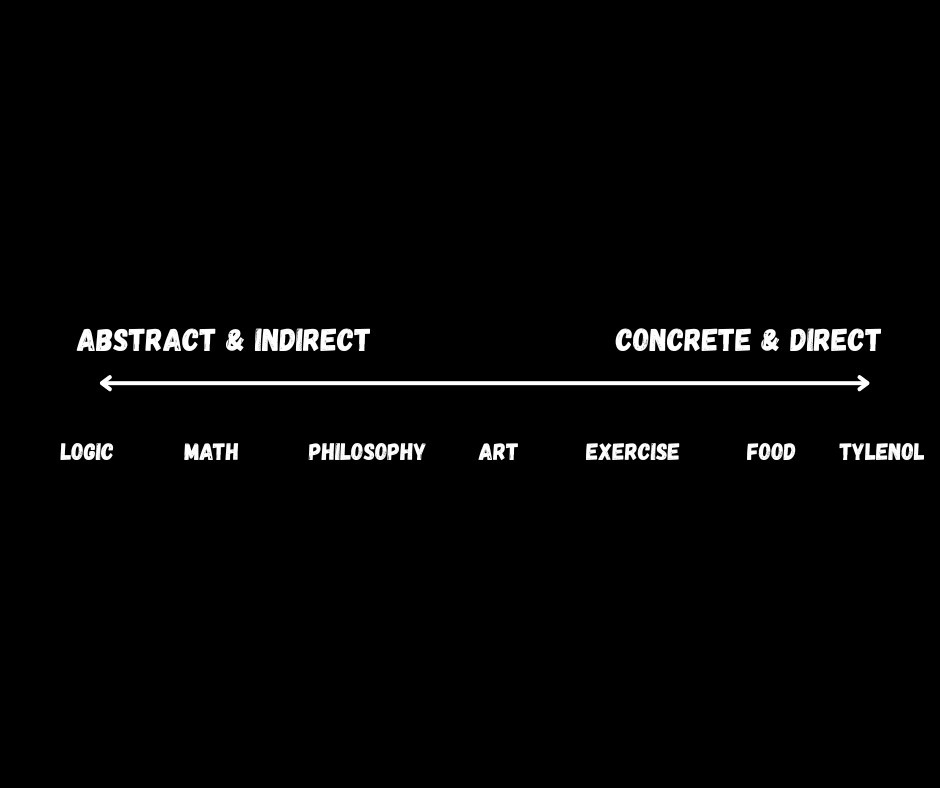
In general, the more concrete and directly beneficial something is the less likely it is that anyone would question its usefulness or benefit. Meanwhile, the more abstract and indirectly beneficial something is, the more likely it is that someone would question its usefulness or benefit.
99% of people view Tylenol as useful because they understand how it benefits them and its benefits are immediately obvious (on some level).
It would be absurd to approach someone at a pharmacy who is purchasing Tylenol and ask them “what are you going to do with that?”. The packaging literally tells you what you can and can’t do with it.

There is good reason for thinking about usefulness in terms of the obviousness and immediacy of a benefit.
On the one hand, if it is very difficult to tell whether something is benefitting you or not, then it is natural to question whether it is actually doing anything and worth continued investment or effort.
On the other hand, if the benefit of something takes too long to be realized, then it would be difficult to get many people to care about it.
This is the issue which causes like environmentalism often face.
The time-scales are too long, and asking people to sacrifice in this lifetime for the benefit of some future humans is a tough sell (by the way, there is some fascinating research in philosophy under the name of “population ethics” that questions whether it is even possible to benefit or harm people who don’t exist yet!).
Even though there is good reason to tie usefulness to concrete and immediate benefits, only thinking of usefulness in these terms is overly reductive and implausible.
There are many things which are not obviously beneficial, take time to reveal their effects, but should still be considered useful.
Philosophy is one of these things.
It would be a mistake to judge the benefits of philosophy in the way that we judge the benefits of Tylenol.
In fact, many of the things which give our lives clarity, meaning, satisfaction, and purpose require valuing and pursuing that which is not immediately beneficial or concrete:
Knowledge
Science
Art
Philosophy
Self-Development
Spirituality
Philosophy is known for being an abstract discipline that often concerns itself with questions and problems that are seemingly disconnected from ordinary human life.
Despite its reputation, this is only partially true.
Although some parts of philosophy are in fact very abstract and disconnected from anything practical, the majority of philosophy is deeply concerned with practical life.
To take one prominent example, Greek philosophy, on some interpretations, can literally be thought of as the art of living — the study and practice of living a good human life. Additionally, many other philosophers between then and now, such as the “Existentialists”, have contributed greatly to deepening our understanding of problems that nearly all human beings face at some point in their lives.
The problem is not that philosophy is useless, but that 99% of people don’t really understand the ways in which philosophy is already playing a fundamental role in their lives.
The reality is that many people are simply unaware of what philosophy is and why it matters to their personal lives.
Why is this the case?
I believe that there are at least two general causes that need to be mentioned here.
First, philosophical knowledge has, for most of its history, been kept behind various barriers, including, but not limited to, institutional barriers, linguistic barriers, financial barriers, and educational barriers.
Put simply, for most of its history, philosophy has been the preserve of the few.
Second, and relatedly, philosophy educators have not always done the best job making this knowledge accessible and relevant to the masses (often for dubious reasons).
Rather than presenting philosophy as something to be consumed and understood (if one is smart enough), it should be presented as something that is already playing a key role in everyone’s lives, whether they realize it or not.
Here’s an easy example.
Everyone has political views that deeply shape their life choices.
Whether or not someone is very politically informed or engaged doesn’t really matter. Your political views are likely to dramatically shape where you lives, who you marry, and who your friends are.
But all political views are rooted in some collection of philosophies and beliefs that can be, and have been, called into question at some point in time.
Why is this way of doing things the best or only way for humans to get on with the business of life?
What you think about morality, justice, property, punishment, religion, and a whole handful of other philosophical topics will have an overwhelmingly strong impact on the content and form of your life.
This is not something you can escape by saying that “I don’t care about politics”.
We are all, whether we accept it or not, living within a particular economic system, political system, culture, society, and worldview.
So, philosophy is not like Tylenol.
It’s benefits are not widely known and understood.
And they are certainly not immediate.
Does this mean that philosophy is not useful?
Unless one adopts a very narrow and reductive sense of usefulness, it would be quite ridiculous to argue that things like philosophy, art, the pursuit of knowledge, spirituality, and self-development are useless.
Think about math.
Most people would agree that Mathematics itself is useful, despite complaining that learning Mathematics for themselves is useless.
What’s going on here is that people are often concerned with whether something would be useful to their life specifically, or related to something that they believe to be useful through what they know or have experienced.
Since math involves numbers and science, even if someone doesn’t see how it is useful for their life, they might still appreciate math as being useful because they can relate it to something.
When it comes to philosophy, this often seems to be where it runs into an issue.
Whether it should be this way or not, it seems that most people have a difficult time relating philosophy to things that they think are useful or valuable, despite the fact that they are able to do this with other abstract disciplines.
This publication is founded upon the belief that philosophy is deeply important for improving the lives of ordinary people, despite its history of elitism and esotericism.
The benefits of philosophy often take time to develop, and are not always easy to appreciate, but they are real.
It would be a terrible shame for millions of people to miss out on the deep benefits of philosophy simply due to a misunderstanding or lack of access to quality guidance and education.
My hope is that The Micro-Philosopher can help alleviate this problem by presenting philosophy in a way that can make a difference to real people’s lives.
If we live in a world of that only consists of quick and obvious benefits, we will all be worse off.
The practical fallacy is a simple confusion between not knowing how to use a thing and dismissing something as useless.
By avoiding the practical fallacy, we can avoid creating a world in which the only things which are understood as valuable are things which we already know how to use.
-Paul
If you enjoyed this essay and want to learn more about how to make philosophy matter to your life, you might also enjoy these essays as well.
Why You Need A Micro-Philosophy (If You Want To Become An Independent Thinker)

The Importance Of Independent Thinking
How To Build Your Own Philosophy

In this article, I provide a general overview of the exact system I teach in order to help people build their own personal philosophy of life — what I call a micro-philosophy.
I consult in the corporate world and half of what I do is driven by philosophy. I wish they taught it in the public school I went to so I’ve been self taught over the years.
Beautifully written. I was surprised my impending book on consciousness will be philosophy rather than the ‘science’ I imagined it would be. :-). I have learned a lot of philosophy in writing it. I still think I’m a novice in non consciousness philosophy. It should be taught more, as should critical thinking.