


You already have a personal philosophy that you live by, but let me ask you these three questions:
Did you choose it?
Where did it come from?
Is it serving you, or are you serving it?
Let me know what your answers were in the comments below. I am genuinely curious.
According to Suzy Welch, a world-renowned expert on human values and professor of management at NYU, only 7% of American adults can accurately identify their own deeply held core values. Why does this matter? Because being able to articulate and act in alignment with your core values is essential for finding purpose in life and career satisfaction.
Imagine a company or business that had no idea what its organizational purpose, values, or ethical principles are — it would probably fail and potentially harm people while doing it.
If you aren’t able to identify or articulate your core values or deeply held personal beliefs, then how do you expect to to act on them consistently?
Nobody just gets in their car and starts driving around without being able to say where they are trying to go. Why would you put your life at risk, and waste time, gas, and money for no particular reason?
The reality is that 99.9% of people have lived this way for at least some portion of their lives.
I know that I have.
But this is how it has to be. We all need time to figure out where we are going and who we want to become. There is nothing intrinsically wrong with this.
Living a random or blurry life becomes a problem when you desperately want to know where you are going and what you are really meant to do in life, but get stuck for years (sometimes decades) unable to make progress.
Even though you “progress” through the game of life that society predetermined for you, it’s impossible to shake that feeling deep down inside that this path isn’t really yours. Even though you don’t fully know what you want for yourself just yet, or how to articulate what you are meant to do in life, you know that this can’t be it.
You silently tell yourself “There must be something else which I am uniquely meant to be”.
What ends up happening when someone realizes this and wants to make a change is that they start looking for answers in the wrong places because they don’t know where to start.
They seek to master things like “productivity” or change their “habits”, hoping that if they can start being productive or get a new habit to stick, the answers to life’s bigger questions will begin to reveal themselves.
This is not to mention the greatest and most tempting trap of all — learn how to start some kind of business that you aren’t passionate about and make $10,000 a month and you will suddenly figure out who you are.
I am not saying that things like habit and behavior change are unimportant.
They are incredibly important.
But they are only half or less than half of what most people really need.
Even James Clear himself, the worlds’ leading expert on this topic, says in the very beginning of his bestselling book Atomic Habits that changing your habits alone isn’t enough. He writes:
“True behavior change is identity change. You might start a habit because of motivation, but the only reason you’ll stick with one is that it becomes part of your identity. Anyone can convince themselves to visit the gym or eat healthy once or twice, but if you don’t shift the belief behind the behavior, then it is hard to stick with long-term changes. Improvements are only temporary until they become part of who you are. In this way, the process of building habits is actually the process of becoming yourself”
James Clear, Atomic Habits
I think a lot of people have either misunderstood or skipped over what I take to be the most important idea in Atomic Habits — the idea that changing your habits without having any idea of who or what you want to become will not make a significant impact on your life.
It is true that acquiring and sticking to new habits can help us learn things about ourselves and who we want to become over time, but doing this without thinking seriously about who you want to become runs the risk of having you end up as the same exact person you were before who just happens to floss or make their bed every morning.
While I agree with Clear that habits are a powerful and practical way to change our identities and, therefore, our lives, I think that he places too much emphasis on the power of actions or habits to help us instigate the fundamental belief shifts underneath of our behavior that he mentions.
Clear says that you must “decide the type of person you want to be” in order to make everything he says in the book actually effective, but he doesn’t really tell us how to go about doing that.
In many ways, Atomic Habits is an incredibly useful practical guide for making and breaking habits that leaves us without any practical steps for tackling the much harder problem of figuring out who we want to become.
He writes:
First, decide who you want to be. This holds at any level—as an individual, as a team, as a community, as a nation. What do you want to stand for? What are your principles and values? Who do you wish to become?
I would ask:
But how do you actually figure out who you are or were meant to be? Do you simply have to live long enough, make a bunch of mistakes, and then suddenly it becomes clear to you?
Some people believe that if they just take enough action and have enough life experiences that they will “find themselves”.
When I look online at all of the wonderful content designed to help people improve their lives, I see plenty of “practical” advice because this is what most people think they need.
It makes sense to them.
Tell someone to go lift weights, then they go lift weights and feel better. But does lifting weights help them figure out who they are?
Clear’s book suggests that we can become things like a “weightlifter”, or a “runner”, but these are not complete identities, they are just parts of what someone is. If you suddenly are able to say that you are a “weightlifter”, does that mean you have figured out your principles and values in life? Does becoming a weightlifter help you determine how you are uniquely capable of creating value for the world and helping others?
I think there is an enormous gap in personal development when it comes to helping people deal with the more intangible problems of life.
Part of the reason this gap exists, in my opinion, is that philosophers have largely failed the public.
It is natural to turn to philosophy to seek answers to life’s big questions (especially since so many people are opposed to turning to religion).
But the overwhelming majority of philosophy content available to the public today fails to do one very important thing:
Teach people how to use philosophy to improve their lives.
The Story I Have Struggled To Tell
On December 17th, I posted a note that seemed to really resonate with readers on Substack.
The headline read:
The reason that philosophy is perceived as useless is because no one writes about how to actually use it.
I received some pushback for this universal generalization since it turned out that there are some people that I didn’t know were doing the sort of thing I am advocating (one example is Donald J. Robertson who teaches Stoicism in a way that can actually help people because of his background in Cognitive Behavioral Therapy).
Exceptions aside, I still stand by my original point, since most of what I see online makes the subtle mistake of writing about useful topics without actually teaching people how to use the thing.
For example, I can write an article or even create an entire course on Aristotle’s Nicomachean Ethics — one of the greatest treatises on ethics of all time that is jam packed with useful content — but end up just getting people to consume a bunch of knowledge about Aristotle without giving them any guidance regarding what to do with it.
Philosophers have been guilty of dumping incredibly valuable and interesting theories and ideas onto students for years only to leave on their own to figure out what to do with what they have learned (leave a comment if you have experienced this before).
This happens for three primary reasons in my opinion:
First, some philosophers think that by making philosophy “useful” you are thereby corrupting it.
Second, some philosophers avoid the work required for becoming a better teacher by hiding behind the idea that we should only study philosophy for its own sake (it’s “intrinsic value”) rather than figure out how to make it relevant to people’s lives.
Third, the majority of modern Western philosophy is a byproduct of the culture and assumptions of the modern research university which has completely lost touch with the idea of philosophy as a way of life that dominated pre-modern philosophy in both the “East” and the “West”.
In a world where everything is increasingly defined by its utility or productivity, I am sympathetic to the idea that we should pursue certain activities for their own sake. What I am criticizing here is the use of this justification as a way to avoid figuring out how to actually make philosophy useful to people so it can benefit their lives.
After realizing that there was this massive gap online, I decided to do something about it by creating this Substack.
I will be honest, working on this problem scared the shit out of me.
Philosophy is the useless discipline par excellence.
I once had someone tell me “when I heard the word ‘philosophy’ the first thing I think of is ‘unemployed’. In other words, ‘useless’.
Who was I to tackle this great problem of figuring out how to make philosophy useful?
Well, I did have one thing going for me.
I spent years studying and teaching Ancient Greek Philosophy at the highest level. If you know anything about Ancient Greek Philosophy, you know that it was primarily concerned with the question of how to live — what Bernard Williams has called “Socrates’ Question”.
So, as I started to work on this problem, I derived some small confidence from the fact that I had a strong grasp of how the Greeks approached philosophy understood as a way of life.
The challenge, then, was to figure out how I could take their incredible theories and ideas and teach them in a way that would make sure students didn’t just learn them in order to say that they “knew what Aristotle thinks about X”, but learn them in a way that could be applied to the unique circumstances of their own life and actually change how they live.
What I ended up deciding to do was, in many ways, inspired by Socrates, the original source of Western philosophy.
Socrates was most famous for his “Socratic method” which was a way of practicing philosophy that did not consist of teaching anyone the answers to philosophical questions, but teaching them how to question and think for themselves.
When I realized how far philosophy had strayed from Socrates’ original method, everything clicked.
What I needed to do was to take everything I had learned after studying philosophy for 15+ years, teaching over 20 undergraduate courses, and getting a PhD from an elite university and use that knowledge to do one thing:
Teach people how to actually think for themselves in a world that is doing everything it can to undermine this ability.
(By the way, I recently wrote an article all about how human life is being intentionally engineered to reduce the quality of human thought in order to extract as much economic value from the human mind as possible)
The Quiet Death Of Human Thinking

The limit of your potential is determined by the quality of ideas which you are able to access.
Okay, so I wanted to use philosophy to teach people how to think for themselves, but how would I go about doing this?
Would I teach a class on critical thinking? A class on formal logic?
These are the standard places that philosophers go to “teach thinking” directly.
I had a different idea.
I would teach people how to think about their own lives by teaching them how to build their own philosophy of life.
I will admit, at first this sounded crazy.
If I were to bring this idea up to most academic philosophers today, they would criticize me as being deeply confused about what philosophy is (several already have).
It was here that I hit upon a huge gap that exists between philosophy as it is understood in the universities, and philosophy as it is thought of in normal life.
Most people who aren’t trained in academic philosophy would think it is a reasonable question to ask someone “what is your philosophy?”.
But to an academic, the idea that an ordinary person can “have a philosophy” would sound deeply confused. Why?
Speaking strictly from my life experience inside and outside of academia, my understanding is that most academic philosophers genuinely do not believe that a non-professional philosopher can have a philosophy of their own. The reason is that if someone thinks they “have their own philosophy” what’s really going on is that they are simply just repeating the ideas of some philosopher who already said what they believe is their own ideas and said it in a way that is much deeper and more sophisticated.
The default assumption in academic philosophy seems to be that the only way to “have your own philosophy” is to say something completely original that no philosopher has published about before. But since it would be incredibly rare for someone who isn’t a professional philosopher to be able say anything original, they cannot therefore have their own philosophy.
I don’t know about you, but I think this is absolutely ridiculous.
I understand the position, given very narrow assumptions about what the project of philosophy is, but I think it is deeply problematic.
After uncovering this conflict between the natural idea that everyone can have their own philosophy of life, and the academic idea that having a philosophy requires being completely original, I set out to justify the very natural idea of having own’s one philosophy against the academy.
My solution was this:
Having one’s own philosophy of life is completely original if philosophy is understood as something that we embody in the world through our thoughts and actions rather than an abstract body of knowledge.
This is something that I have been trying desperately to articulate for over a year here on Substack through many of my posts.
The strategy has been this — present a conception of philosophy as something lived by an individual in order to make the idea that everyone has an original philosophy defensible, since each individual life is completely unique.
One way to put this idea is to say something like the following:
You cannot be a Buddhist because there is no one thing called Buddhism. There are simply people living and thinking Buddhist ideas in the unique circumstances of their own lives. “Buddhism”, then, is an general term that points to all of the concrete and unique individuals living in a way we call “Buddhism”.
I used to be an avid listener of Noah Racheta’s wonderful podcast called Secular Buddhism, and he would begin every with the following statement that captured the spirit of what I was after:
“You don’t need to learn Buddhism to be a Buddhist, you can use what you learn to simply be a better whatever you already are”
Noah Racheta, Secular Buddhism Podcast
At long last, this is how I came up with the idea of teaching people how to create what I would ultimately call their micro-philosophy.
I wanted to make philosophy useful to people by teaching them how to think for themselves through the project of creating their own philosophy of life that could serve as a meta-frame or operating system through which they could live, and which could also provide a well-defined perspective from which they could give context to their life experience and the information they acquired.
Everyone already occupies some perspective in the world that is unique to them, but our perspectives can be developed and leveraged for our own benefit, instead of merely serving as the background conditions of our life.
It has taken me over 15 months of writing consistently on Substack to finally be able to articulate this vision for philosophy education.
But identifying the gap, diagnosing the problem, and articulating it clearly were only half the battle.
The other half was to figure out how to actually execute on this vision.
That is why I created my flagship “build your own philosophy” course called Micro-Philosophy: Foundations.
Micro-Philosophy: Foundations is the only course that I know of which teaches people how to create their own philosophy rather than study someone else’s (only to end up feeling like you still don’t fully know what you believe).
It is my solution to the problem that James Clear left us with, and that the philosophers have failed to address.
The problem of having an actual system for figuring out who you are, who you want to become, and how to unify everything you believe and value into a coherent and livable personal philosophy of life.
The course represents my attempt to do this for myself in the simplest way possible.
Most people want to have more clarity around their beliefs, values, and purpose in life, but they simply don’t know where to begin and it seems like an impossible task.
This is understandable.
We don’t learn any of this stuff in school, or even in universities.
Life-design has largely been ignored by mainstream education and left to coaches, content creators to figure out for people.
The internet has made it possible for so many amazing coaches and creators to help millions of people improve their lives in recent years, but the problem is that the vast majority of these individuals approach this task from the perspective of business or entrepreneurship. Why? Because starting a business is what forced them to figure out their own philosophy of life for themselves.
But, what’s the problem with this?
The problem is that 99% of people are not going to start their own business or become an entrepreneur, so they will not connect with the messaging of these incredible teachers and might get skipped over entirely.
My hope is that by approaching this problem from the angle of philosophy that I will be able to help all of the people who need help thinking about their lives at a high level, but aren’t necessarily trying to become an entrepreneur.
Perhaps they are simply trying to figure some things out in their life so that they can feel less overwhelmed, have a deeper relationship to themselves, and clarify their life purpose.
Micro-Philosophy: Foundations, then, is a course designed to give people a system for doing this that doesn’t require start a business, or becoming an entrepreneur, but simply being a human being who wants to live in alignment with a belief system that they chose for themselves.
At the end of the day, you can master your atomic habits, start a $1,000,000 business, develop the perfect productivity workflow, but still be left wondering “what was this all for? Who am I? And what am I meant to do here on Earth?”.
I believe that by systematically targeting your deepest beliefs, values, and worldview, you can begin to make progress on these questions and avoid having to outsource your answers to “tradition”.
Ultimately, this is what I want to teach people how to do.
What Is A Micro-Philosophy?
A micro-philosophy is not meant to be a theory of everything, or the ultimate truth that everyone must accept.
It is your own personal philosophical belief system.
It is unique to you and your life.
It emerges from what you deeply value, believe, and want in life.
It is a meta-frame or operating system for your life that gives everything you are doing context and therefore meaning.
Our deepest beliefs give our practical goals meaning and also help us make sense of how we are living.
Why are you trying to develop a running habit?
Because it actualizes one of your core personal values in your micro-philosophy which ultimately connects with your life purpose and worldview.
Why are you meditating?
Because you believe that meditation is a practice that elevates the state of your consciousness and brings you closer to the source of ultimate truth.
Why are you afraid of death?
Because you have internalized an atheistic worldview according to which death is the ultimate and permanent annihilation of life and you are struggling to make sense of whether life has any meaning.
A micro-philosophy is not an archive of answers collected from outside of yourself, stored away in your note-taking app, and then “applied” to your life.
It is an organic outgrowth of what’s deep inside of your consciousness.
It is a self-revealing.
The term psychedelic, which was coined by Dr. Humphrey Osmond, literally means in Greek “mind manifesting” or “soul revealing”.
What is the goal of developing a micro-philosophy?
To increase human freedom, agency, and self-knowledge on a mass scale by leveraging the concepts and skills of philosophy.
To teach people how to think, rather than what to think.
That is exactly what Micro-Philosophy: Foundations is designed to do.
Micro-Philosophy: Foundations 2.0
Some of you may have seen that I am relaunching a completely revamped version of my Micro-Philosophy: Foundations course which has been out for several months already.
If you have never heard of the course before, or are curious to learn more about it, I wanted to provide a detailed look inside of it so that you can decide whether it will benefit your life.
Honestly, making this course is the coolest and most rewarding thing I have ever done in my life.
I can’t wait to share it with you on February 22nd when the pre-sale officially ends and the course officially launches.
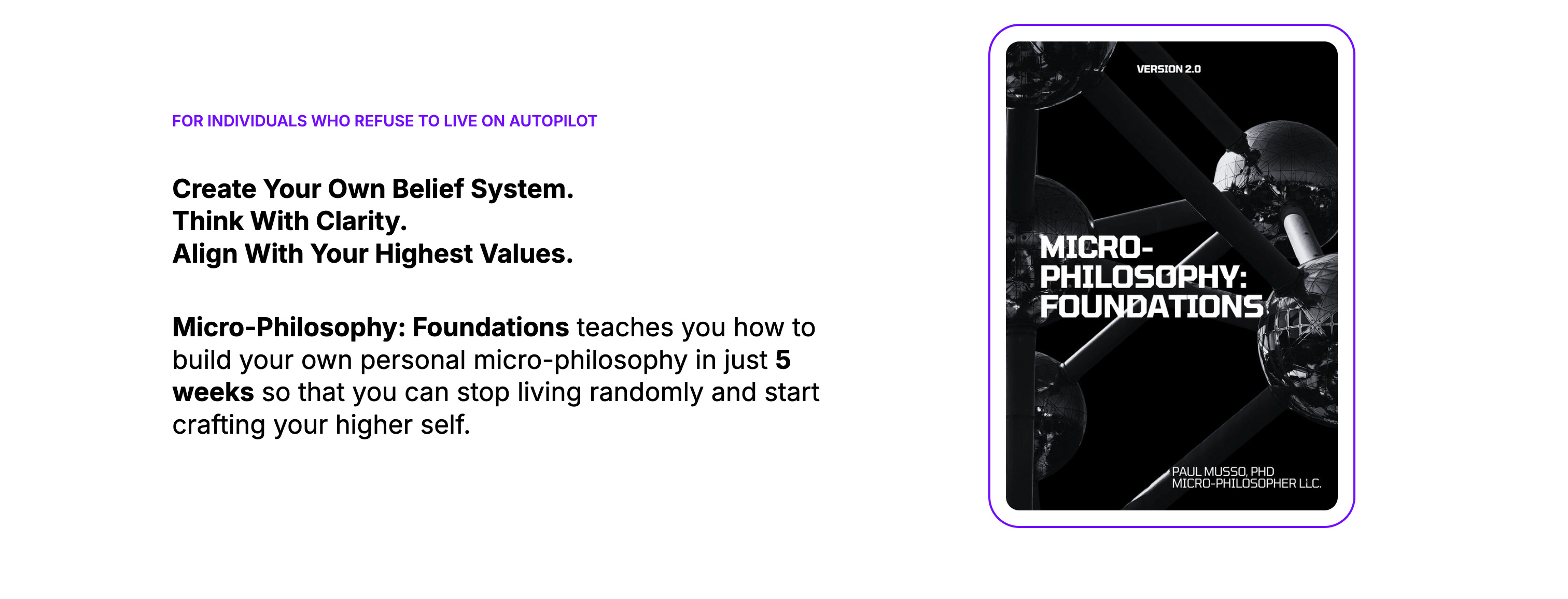
Micro-Philosophy: Foundations is not your typical philosophy course.
It is a philosophy of philosophies course.
A kind of meta-course that teaches you the conceptual frameworks and systems underlying a plurality of philosophies, rather than teaching you any particular philosophy directly.
I spent years looking for answers in philosophy rather than developing them myself.
At the end of the day, you can either develop your own belief system, or follow someone else’s.
This was one of the core insights that led me to design Micro-Philosophy: Foundations.
I wanted to figure out my own philosophy.
World-class motivational speaker and life coach Jim Rohn once said:
“Your personal philosophy is the greatest determining factor in how your life works out”.
By the end of this course, you will create your own micro-philosophy statement which means that you will be able to confidently articulate your fundamental beliefs, core values, and moral principles so that you can live a life of purpose.
Mastering your own beliefs will help you make better decisions, focus your time and energy on what matters, and reshape what you take to be possible for yourself.
The problem isn’t that people don’t want to do these things, it is that they don’t know how to get started and lack a system for making progress.
Take Steve Chae, for example.
Prior to taking my course, Steve was struggling to develop a way to integrate his personal philosophical beliefs and worldviews with his teaching. As a full-time science teacher, Steve wanted a way to develop a teaching philosophy that felt authentic and effective.
After taking the course Steve said:
“I feel like I’ve progressed in leaps and bounds since taking on the course. At the start I remember I wasn’t sure how to philosophize about my teaching philosophy, both in regards to teaching middle school science curriculum and also managing student behaviours”.
And…
“[It] has shown me that philosophy can be highly pragmatic in helping one to solve one’s problems as it did for me as I reoriented my teacher identity into something that aligns with who I want to become. I think there is now a greater awareness in me and from what I read on other Substack posts, mostly those who are educators, that the process of philosophizing or the knowledge of micro-philosophy is vital to this solution”.
Steve took the course while working as a full-time teacher and living in Australia and would wake up at 7am to join our live calls.
Micro-Philosophy: Foundations gives you the system you need to build your own micro-philosophy even if you are already busy with work and life.
In this course, you will learn the philosophical skills, concepts, and frameworks that you need to think clearly about your life, rewrite old beliefs, and act in alignment with your ideal self so that you can live less randomly, reduce overwhelm, and act decisively.
Not knowing what you truly believe or value creates mental drag that ultimately prevents you from acting and living with confidence in your beliefs.
The goal of this course is to help you develop a framework for your life so you can focus on what matters, act decisively, and live more in alignment like Steve.
This course is for individuals who refuse to live on auto-pilot and want to create their own system for living that is grounded in serious philosophy.
If you want to learn more about what you will learn in the course and how it can impact your specific life, then you can visit the course page on my Substack here.
I really appreciate the distinction you’re drawing between studying philosophy and actually using it. The gap you identify is real — especially the way academic philosophy often stops at analysis without guiding lived integration. Your emphasis on embodiment rather than abstract originality is refreshing.
One question your framework raises for me is how a micro-philosophy holds up inside highly structured environments. If someone clarifies their values and worldview, but lives within systems that subtly shape attention, incentives, and even identity, does the work of building a personal philosophy become more urgent — or more constrained? I’m increasingly interested in how individual philosophical agency interacts with large-scale structural forces. Curious how you think about that tension.
Such an interesting post on so many different levels Paul. I'll merely say in regard to my own personal thinking - Do my thoughts and actions help me alleviate aspects of suffering, in other words help me feel better in some fashion and are they good for my health and wellness. I try to use these as guiding principles.
Oh, and your first 3 questions!
1) I didn't choose the principles more fully until after I started writing my first book. Meaning, aspects of it were handed down to me...the first part about alleviating suffering. The second part is the harder piece to pull off for most of us. It is healthy + good for us.
2) My upbringing of course + then my 25+ years of training to become what some might call a healer or a psychologist and psychoanalyst. So how life works....something handed to us + plus, working with the clay we were given to mold it into something different.
3) lol - Depends on the day mate, but mostly I'm learning how to have it serve me.