


In a 2017 earnings call, Reed Hastings, the CEO of Netflix at the time, claimed that the platform’s main competition wasn’t another company, but sleep.
“You know, think about it, when you watch a show from Netflix and you get addicted to it, you stay up late at night … We’re competing with sleep, on the margin. And so, it’s a very large pool of time”.
What would it mean for Netflix to win this competition?
Taken to its logical limit, it would be a dystopian scenario in which human beings never needed to sleep, but could instead spend all of their time watching Netflix.
To the average person, Hastings remarks are likely to make their skin crawl.
Does he really view things so inhumanely? So heartlessly?
But imagine you were the CEO of a major platform like Netflix, Youtube, or Instagram and ask yourself the following question:
What would the mind of your ideal customer look like?
I think the answer is pretty much the same across all major social media platforms.
The mind of the ideal customer would have what I call an informational black hole at its center.
What is an informational black hole?
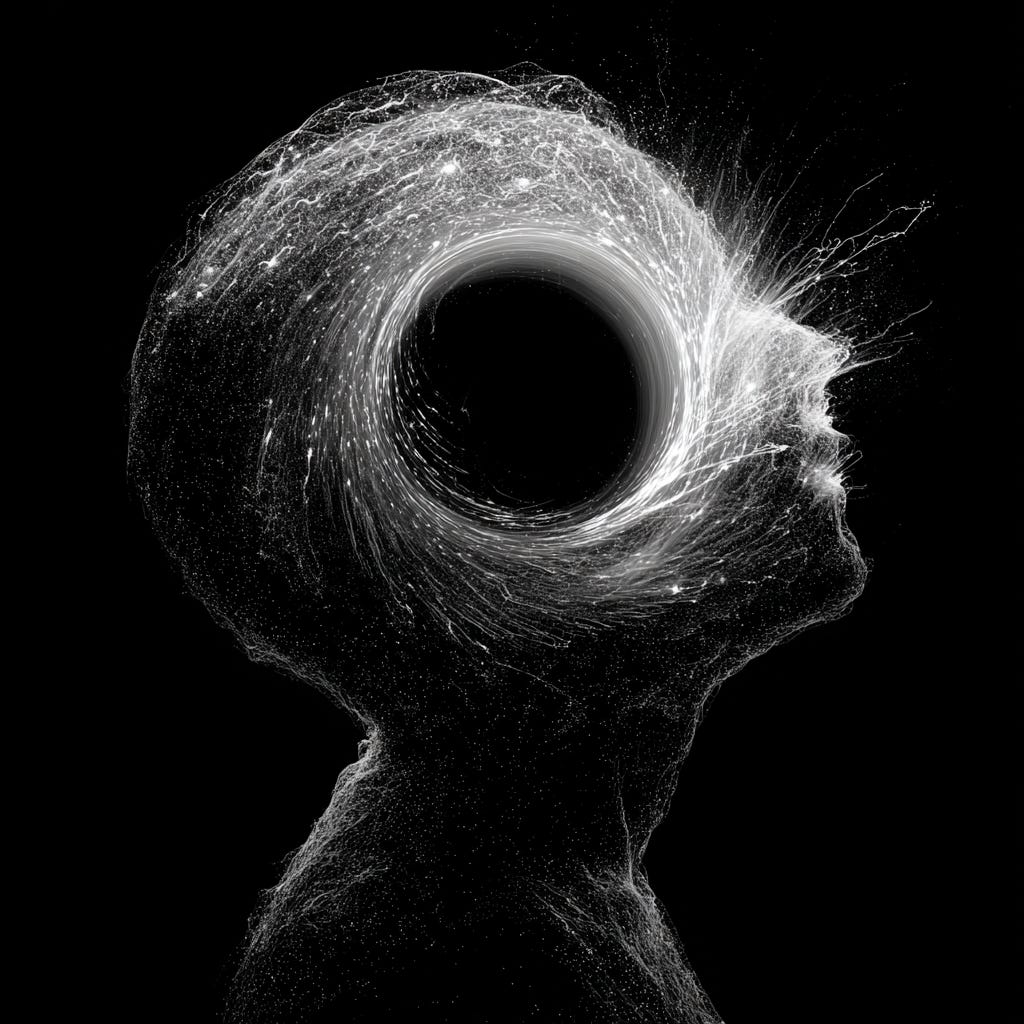
An informational black hole is a collapsed region of consciousness produced by hyper-algorithmic-stimulation and information-overload — when information accumulates faster than the self can integrate it into coherent understanding, action, or identity formation.
An informational black hole appears when the interior structure of an individual human mind collapses under the weight of modern life, but it’s still able (and craving) to receive massive amounts of information within the hyper-consumption environment that we all find ourselves in.
The result is that the massive amounts of information that stream into the mind, which cause pleasure and the feeling of progress, ultimately vanish into nothingness.
Hundreds of hours of consuming videos, lectures, podcasts, and articles amounting to nothing other than the feeling of a strange emptiness, lost time, and a poor memory…
Why would social media platforms and entertainment companies want an informational black hole to form in their users’s consciousness?
The answer is actually pretty simple if you understand what’s called the information-action ratio.
The Information-Action Ratio
In his book Amusing Ourselves To Death, cultural critic Neil Postman introduced the concept of the information-action ratio.
The information-action ratio is the relationship between a piece of information consumed and the actions that the consumer of that information might reasonably be expected to take after they have acquired it.
Postman writes:
“The tie between information and action has been severed. Information is now a commodity that can be bought and sold, or used as a form of entertainment, or worn like a garment to enhance one’s status. It comes indiscriminately, directed at no one in particular, disconnected from usefulness; we are glutted with information, drowning in information, have no control over it, don’t know what to do with it”.
Neil Postman, Informing Ourselves To Death, Speech, October 11, 1990
But things weren’t always this way.
Postman argues that prior to the invention of modern communication technologies, such as the telegraph, the telephone, and the internet, human beings enjoyed a healthy information-action ratio, meaning that there was a high correlation between information and action.
“The information-action ratio was sufficiently close so that most people had a sense of being able to control some of the contingencies in their lives”
Postman, Amusing Ourselves To Death, page 69
While the amount of information that is consumed relative to action is important, it is probably more important to consider the nature of the information and how it is experienced.
Prior to the invention of modern communication technologies, human beings were only able to acquire information through lived experiences such as face-to-face conversations, and social events.
Although it was possible to communicate at a distance through handwritten letters, the handwritten letter is actually a “technology” that promotes a healthy information-action ratio rather than upsets it.
A handwritten letter requires the writer to process a manageable amount of information and synthesize it into a message which is then received and processed on the other end.
By contrast, the invention of the modern print newspaper accelerated the speed at which information could travel across distances.
The ability to rapidly communicate information across time and space naturally led to human beings collapsing information contexts.
Regarding the telegraph, Postman writes:
“the local and the timeless… lost their central position in newspapers, eclipsed by the dazzle of distance and speed… Wars, crimes, crashes, fires, floods … became the content of what people called ‘the news of the day’”
Postman, Amusing Ourselves To Death, pages 66-67
When information is decontextualized is contributes to undermining the relationship between information and action, since human beings lose the ability to know what to do with it.
Suppose you learn about a flash flood in Tennessee, but you live in New York.
What is one to do?
Perhaps you can make an individual choice to send aid to the affected families in Tennessee.
But then the next day’s newspaper comes out about a forest fire in California, and so on…
Postman claimed that the constant access to decontextualized information upsets the information-action ratio by making the relationship between information increasingly “abstract and remote”.
I ended the last section by asking why social media and entertainment companies would want an informational black hole to form in their users’s minds.
The answer is clear.
Almost any action that users take based on the information they acquire from the internet essentially requires disengaging from using the platform.
When user’s form an informational black hole in their minds, the information-action ratio reaches its full potential:
Maximum Information/Minimum Action
A user who can consume massive amounts of information only to see it vanish into nothingness, is a user who fundamentally does not know what to do with what they are experiencing.
In some situations, not knowing what to do with the information you consume can be painful.
The real danger of the modern entertainment platform is that it has been designed to optimally transform information overload into a pleasurable experience.
Pleasure And Mental Exploitation
The easiest way to take something from someone is to have them convince themselves that it will benefit them by making it pleasurable.
Prior to the internet, the exploitation and extraction of value from laborers and the working class was mostly visible, painful, and obvious.
People mostly knew the deal and were forced to accept their circumstances because they needed to survive. When things would get too absurd, people would revolt, protest, and seek political and social reform, until thigns became acceptable again.
This was how things were for thousands of years.
But modern technology has fundamentally changed what’s possible.
It has created the perfect conditions of exploitation.
When you take something tangible or material from people, it’s very easy for them to detect it and feel the pain of its absence.
For example, if someone steals your bike, you would probably be pretty pissed off. Even if the bike wasn’t that expensive, there is a moral harm and indignation that most people naturally feel.
For 99% of human history, if you wanted to get economic value out of another human being, you would have to physically require them to do something for you.
A factory owner needed people to reliably travel to their factory for the majority of the day, spending time away from their family, and build something for their company.
Sacrifices like this hurt.
It’s hard to overstate just how much things have changed — and not for the better.
Modern technology has now made it possible for corporations to penetrate human consciousness and extract economic value by stealing something immaterial — people’s time and attention — without them even realizing something has been stolen.
That’s pretty scary, but I actually think it get’s worse.
Not only do people not realize what they have lost, but they also have enjoyed giving it away.
We are no longer in an era where the factory worker grumbles about waking up at 5am to support his family because he has to (although this still happens all over the world).
We are in an era where human beings are voluntarily giving away their time and mental life on top of everything they were already doing before!
This is, perhaps, the most consequential economic shift in human history.
It is a shift from physical to mental exploitation.
In the past, factory workers would have to work 6 days a week for 10-14 hour shifts (sadly, in many parts of the world this is still the case).
This was (and still is) awful.
Today, most people spend around 10 hours per day working (and commuting), but then give away 1,000+ hours per year being engaged online when they get home because they “just want to feel something”.
It is now possible to extract value from individuals when they aren’t doing anything at all.
When we are riding on the bus, laying in bed, or spending time with our kids.
And this process of extraction is more efficient than ever.
In the past, business owners and rulers had to reconcile with the physical needs of their workers and subjects.
People would get hot, cold, angry, hungry, and complain.
Human capital is the most expensive form of capital there is — if only we didn’t have laws and rights things would be so much easier!
But we are now in an era where human beings can be mined at all hours of the day (even while at work!).
Even just a few decades ago, if you saw an advertisement, you still had to physically go to the store to buy the damn thing.
Now that entire problem has suddenly dissolved before our eyes.
Social media companies can even make money without you buying anything — but merely from paying attention.
This is the endgame.
The extraction of economic value from the last thing that human beings thought could ever be taken away from them, even by the cruelest of tyrants — the contents of their own mind.
-Paul
The Quiet Death Of Human Thinking

The limit of your potential is determined by the quality of ideas which you are able to access.
This sounds close to Yanis Varoufakis’s idea of “techno-feudalism.” The shift is no longer just from labor exploitation to consumption... it’s from physical exploitation to mental extraction. Platforms profit most when information produces endless engagement but minimal real world action: maximum attention, minimum agency.
Also known as “Infinite Jest.” The video tape you watch until you die. Once you start watching, you cannot stop. Quite the novel in its time. Now it’s just today’s news.