


The limit of your potential is determined by the quality of ideas which you are able to access.
Unfortunately, we live in a world that is intentionally designed to reduce the quality of human thinking in order to extract as much economic value from the human mind as possible.
In a recent article, I argued that human beings are living through a mass distraction event that threatens to reduce the human spirit to its minimum viable state— what Nietzsche calls “the last man”.
How To Make Life Interesting Again And Escape The Dopamine Economy
Recently I have felt a renewed zest for life.
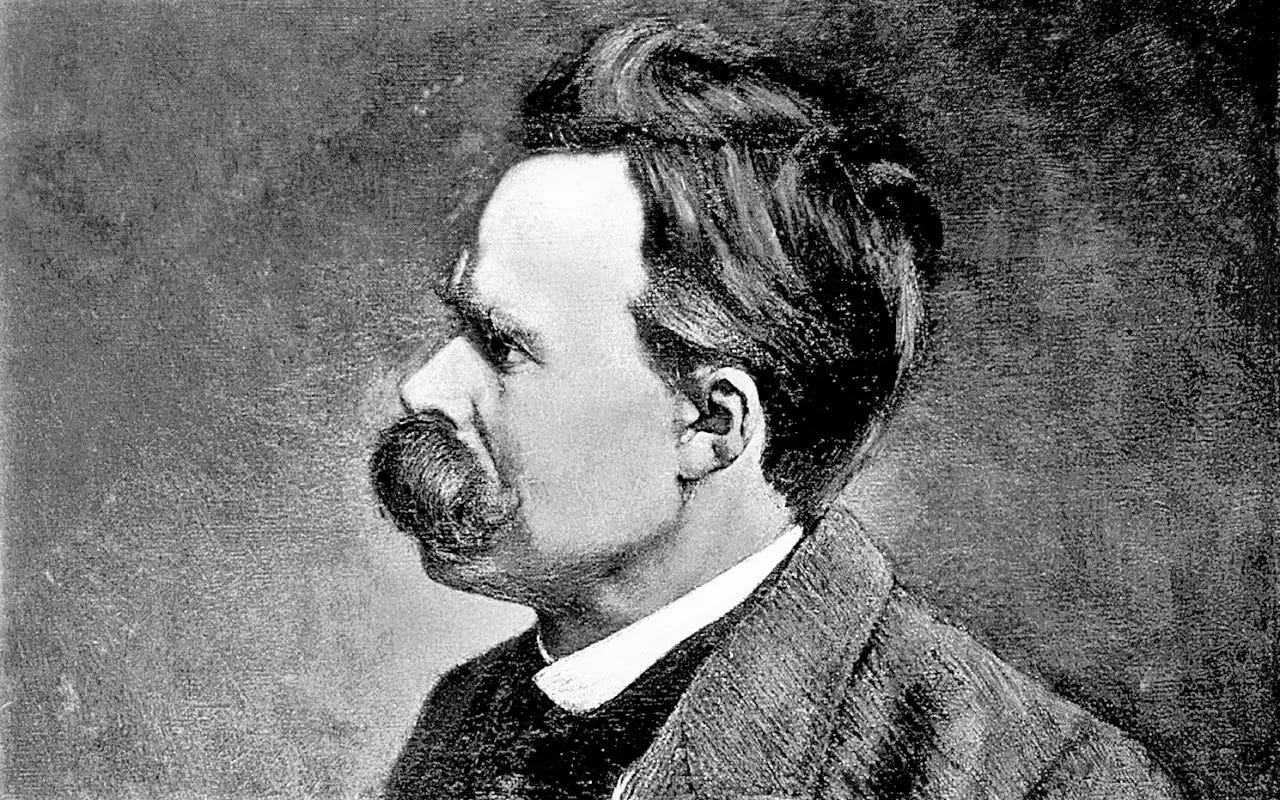
The last man is the term Nietzsche used to describe the antithesis of the Übermensch — a passive nihilist that is tired of life, takes no risks, and seeks only comfort and security. A passive nihilist is someone who has surrendered to nihilism and internalized it as a spiritual condition, giving up on the search for and creation of meaning.
They have no original thoughts of their own and do not even feel the need to become an independent thinker.
They are evangelists for mediocrity.
Nietzsche often blamed resignation to passive nihilism on the weakness of an individual’s will. He argued, at various points, that once the conventional sources of meaning and purpose (e.g. Christianity) are undermined, individuals who are too weak to fill this void by creating their own values and meanings in life will become passive nihilists by joining mass movements. For example, placing their faith in a political party, leader, a nation-state, or organization that promises to solve all of their problems and make them valuable to a cause.
But not all nihilism is voluntary chosen.
In fact, very few people would self-identify as a nihilist.
And yet, if Nietzsche is right, the world is hurling itself towards widespread pessimism, spiritual enslavement, and mediocrity.
The most insidious threat to human existence, according to Nietzsche, is the unconscious acceptance of nihilism — when people begin to live nihilistic lives on a mass scale without even realizing it.
Involuntary passive nihilism is when an individual is transformed into a passive nihilist by society without realizing it.
As a philosopher, Nietzsche was famous for developing a method to critique value/belief systems and expose their hidden assumptions, uncovering the subtle ways in which they undermined human life in the name of a seemingly noble cause.
His favorite target was Christianity, which he believed implicitly conditioned humans to develop a pessimistic attitude towards life on Earth.
The lesson to take from Nietzsche is that we all may not fully understand the implications of our most cherished values, our personal beliefs, or actions, and live our entire lives in ignorance or self-denial, unconsciously undermining ourselves and others.
How do we avoid this?
We need to make sure that the belief systems we occupy, and the values we deeply attach ourselves to, are actually serving us and those around us.
We need to make sure that everything we believe is not simply being used to serve someone else’s interests, to dampen our minds, and to keep us under control.
Can we ever be sure of anything? How do we know when we have taken enough care?
The harsh truth is that we must always continue to think, explore, and question so long as we live.
This is the burden (and joy) of being a free being.
We must never rest content placing our freedom into rigid traditions, or pre-made generic belief systems.
Is this too much to ask? Is this too much of a burden to place on people?
Not if you care about freedom.
Freedom is the heaviest of burdens for a human being.
I want to be clear, I am not saying that everyone should become philosophers, if by that someone means dedicating their life to studying, writing, and thinking about academic philosophy.
That is silly and naive.
But I do think that everyone should dedicate at least some meaningful portion of their lives to critical self-examination and self-creation.
The reality is that we live in a world where self-inquiry, self-examination, and self-creation are simply too inconvenient to be done.
Writing for thirty minutes feels harder than going to the gym.
Reading a book rather than an outline feels like an unproductive use of time.
Speaking about interesting ideas while sharing a meal is viewed as impolite or annoying because it requires others to think (which is a lot to ask after they have spent an entire week working).
Most people live their lives going through the motions and convince themselves that they are thinking deeply about what they are experiencing, but never stop to write anything down.
Sure, it is possible to be a genuinely deep thinker without ever writing anything down, but I would argue that you would have to be a pretty rare individual to be able to deeply analyze, criticize, and revise your thoughts entirely in your head.
It is not an accident that the greatest minds in history wrote journal entries, letters, manifestos, articles, and books.
Again, you don’t spend all your time writing, reading, or thinking.
The point is that there is a huge difference between spending no time doing these things, and a reasonable amount of time.
Billions of people have lived entire lives without dedicating even a few hours to genuinely thinking hard about their beliefs and values.
This is sad.
Especially when it is because they were denied the opportunity to do so because of war, oppression, and lack of freedom.
But billions of other people have little to no excuse, especially in hyper-abundant countries.
It is not possible for an individual human being to wake up the entire world.
But every individual owes it to themselves to wake themselves up first and, if they are able to, to do everything they can to wake up those around them.
If enough people do that, the world will be more interesting and more free.
Nietzsche did what he could by writing famous work Thus Spake Zarathustra: A Book For All And None, which is the story of a prophet trying to warn humanity about the growing threat of nihilism.
The Micro-Philosopher Substack is my attempt to contribute what I can.
I dedicated the last year of my life to trying to figure out one thing:
How to teach people to build their own philosophy of life so that they can figure out what they believe and value, consciously choose whether these beliefs and values empower them to become their best selves and how to change them if they don’t.
In order to do this, I spent 1,000+ hours working out an entire system designed to help people create what I call a micro-philosophy.
A micro-philosophy is your personal belief system for living that is created by you and for you.
I don’t teach people what to believe, I just teach them a framework to figure out their own beliefs for themselves.
My hope is that this framework, and the skills I teach with it, can help people get started on their own philosophical journey.
If you want to read more about this idea and the motivations behind it, I recommend one of my oldest articles (linked below).
If you want to support me on this journey as I continue to develop my system, consider subscribing to this publication and sharing anything that resonates with you.
Thank you for reading.
-Paul
I read the main essay and then your older article on micro-philosophy as well. I really like the intention behind it: pushing people toward reflection instead of pure consumption.
I did struggle with the tone and some of the big claims though. Especially the line about living in a world “intentionally designed” to reduce the quality of human thinking to extract economic value. I’m not denying market incentives or attention engineering, but “intentionally designed” makes it sound like one coordinated project called “the world.” That feels a bit totalizing and, ironically, close to the kind of pessimism you’re warning against.
Also, I don’t really recognize the picture of widespread passive nihilism. People aren’t just sleepwalking. There’s a lot of conscience and agency out there: mass protests, community organizing, mutual aid, resisting systems, and big personal life changes happening every day.
So when you state “evangelists for mediocrity" i wonder why you assume mediocrity is the enemy? A lot of human life is ordinary by nature. Caring for other people, crafting things, deep conversations with loved ones, traveling and experiencing new realities. There’s meaning there too, and a lot of reflection happens inside that.
Stating that self-inquiry is “too inconvenient to be done,” or that billions never spend "even a few hours" thinking about their beliefs, feels unverifiable and also a bit unfair. It starts to pathologize normal life. Besides, let's not forget there's a group of people who are forced to spend all there hours surviving and dealing with life, rather than having the luxury to sit back and write deeply about who they would like to be.
Finally, the micro-philosophy pitch left me torn. I get the intent, but the whole system/framework/templates vibe can read like a self-help product aimed at the same anxiety the piece diagnoses. And “I don’t teach people what to believe” sounds nice and neutral, but some ethical guardrails aren’t optional if you’re encouraging people to create their own belief system. We still need shared rules, rights, and responsibilities. I’m curious where you draw that line.
Paul - I appreciate how you lay out and frame why the slow erosion of thinking happens inside ordinary life, not just as an abstract problem or philosophical idea. The picture you’re drawing is of a gradual shift in how people live with their own minds, and I find this extremely fascinating and a bit sad given what you highlight. Over time, the work of forming values, questioning assumptions, and creating a personal orientation toward life is replaced by ready-made frameworks, incentives, and distractions. That feels very close to what you’re pointing to with passive nihilism: not the loss of thought, but the loss of responsibility for it.
One layer that feels important here is how much the mind is already shaped to privilege what is wrong. The negativity bias keeps our attention oriented toward perceived threat, conflict, and deficiency. In an environment built to capture and monetize attention, that bias becomes a natural vulnerability in the mind. It steadily trains our nervous system toward being on high alert or being geared toward the negative rather than spending time for reflection and thinking about aspects of positive experience. Over time this could easily reshape the inner conditions under which thought happens at all. What I respect in what you’re building is the insistence that people can take our authorship back. That a micro-philosophy is not a set of answers, but a practice of examining what/why one is living by.
All to say, I love what you are doing! It gels well with my own thinking about how to better contend with the difficult human condition to begin with.