


The greatest punishment for a human being is mental slavery.
Mental slavery is a complex human condition in which someone’s agency, imagination, and judgment are severely restricted because of false beliefs that were inherited uncritically, unconsciously, or out of fear.
A human being would choose to suffer any hardship, even death, before they would choose to enter into mental slavery voluntarily.
Most human beings are not complete mental slaves.
Complete mental slavery is an extreme condition in which an individual has lost the capacity to escape the clutches of their own delusion.
The vast majority of us have enough internal agency to improve our lives through learning, critical thinking, and imaginative mental and spiritual exercises.
But here’s the problem…
Even though most people have the capacity to critically examine and rewrite harmful beliefs they have unconsciously inherited, we all carry with us packages of unexamined assumptions that operate insidiously in the depths of our sub-conscious, causing all sorts of problems for our ordinary lived experience.
Imagine that your mental life is like a computer operating system that is built upon thousands of lines of code.
Your automatic biological functions allow your mind to continuously process this code and construct a mental reality for you.
But somewhere in this code there exists, and has existed for years, harmful lines of code that slow you down, cause emotional pain, and secretly undermine your personal development.
How did they get there?
We are all born in a physically, emotionally, and mentally vulnerable state due to our complete dependence on others for our survival.
This is a fundamental fact of human life.
It applies equally to every human being without exception.
Because this fact is so fundamental to who we are, it is taken for granted and few people ever take the time to think deeply enough about its significance for their lives (this article is my attempt to do just that, since I have been guilty of this too).
Plenty of human beings blame their childhood, their parents, or other people for causing all sorts of problems in their lives (I certainly have). But at the same time, they forget to consider the deep significance of the fact that every human life began in the same exact vulnerable condition as your own.
Why is this significant?
Because every human minds is forced to accept the reality program of its environment before it develops agency or choice.
It is forced to accept the reality program of its environment in order to survive.
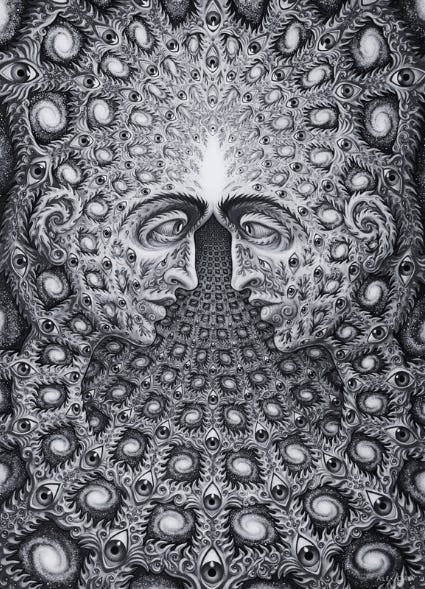
Properly understanding this basic fact makes it possible to experience what I call existential empathy.
Existential empathy is the ability to recognize another as oneself.
Strangers passing in the street
By chance, two separate glances meet
And I am you and what I see is me
And do I take you by the hand
And lead you through the land
And help me understand the best I can?Pink Floyd, “Echoes”

Storm Thorgerson, “Echoes: The Best Of Pink Floyd”, Album Cover
An existential empath does not merely recognize the fundamental unity of the human species through something biological, like shared DNA (although this is significant as well), but through a shared existential fact.
The fact that the initial trajectory of our lives is determined by the universal human experience of entering the world in a state of pure innocence and complete dependence and having a unique reality program inserted into our consciousness without our consent.
Many human beings try to empathize with others by thinking about what their parents might have been like or how they were treated as a child. These are very valuable imaginative exercises. When we think about these things, we can make sense of why people do what they do by gaining a deeper understanding of the causes that led them to where they are, leading to feelings of empathy.
But this does not go far enough.
It fails to appreciate the fundamental sub-conscious programming that we all experience before we even develop a personality.
Psychologists have argued that the mental states of sleeping infants are affected by arguing parents, leading to higher sensitivities to certain kinds of speech/behavior later in life.
Before we have the ability to choose, we are already being deeply molded to fit our environments. Before we have any agency or self-awareness, our minds are forced to accept the reality program of our environment for our own survival. Without the acceptance and internalization a minimum reality program an organism will die pre-maturely.
While this is a good thing when it comes to survival, as life progresses, many of these survival mechanisms undermine human development. One of the obvious reasons for this is that, as life progresses, the human environment changes, thereby rendering the previous survival mechanisms irrelevant.
But if you never take the time to delete or rewrite these deeply embedded lines of code in your mental operating system, then they will stay there forever.
The deep awareness that we all have inherited packages of beliefs that we never even had the opportunity to choose, makes it possible to view oneself (and others) with deep empathy.
Why do you continue to make the same mistakes?
Maybe it just that you are “lazy” or “selfish”.
Maybe your entire self-conception and worldview are founded upon beliefs that you don’t even know you have and that undermine you at every turn.
Maybe you were mistreated before you were even aware of it and have unconsciously internalized self-hatred as a response to an injustice?
The human psyche runs far deeper than the surface level narrative in our head that propels us through an ordinary work day. The way we speak to ourselves is merely the byproduct of mysterious forces operating deep within our consciousness.
Understanding the fundamental fact that we were all thrown into an existence that we didn’t fully choose provides a deeper basis for regarding others as equals than conceptual ideals such as political equality.
Our equality is rooted in a fundamental fact of the human condition that precedes all notions of morality, justice, fairness, and respect for persons.
Man is born free, and everywhere he is in chains.
Jean-Jaques Rousseau, The Social Contract
When we recognize that every other was born out of the same existential shock as ourselves, thrown into a pre-made world and forced to adopt its rules, we allow ourselves to look past the shallow judgments of human behavior and begin to understand the deeper causes of human suffering.
The ability to deeply empathize with another allows us to bypass the shallow obstacles to human connection and, for the first time, truly see and be seen.
-Paul, The Micro-Philosopher
If you would like to download a free prompt that I created specifically to help people discover their inherited worldview, you can visit: https://discovermybirthview.com/
Let me know what your results are and how you think I can improve the prompt!

If You Don't Understand Anyone Else's Worldview, Then You Don't Understand Your Own

“For any of us to be fully conscious intellectually we should not only be able to detect the worldviews of others but be aware of our own — why it is ours and why in light of so many options we think it is true”

In critical care you meet people at their rawest, and it’s tempting to shrink them into a label: noncompliant, difficult, dramatic, stoic.
But wha you’re naming here: most of us are running a “reality program” we didn’t write. We arrived as soft, innocent bodies and started borrowing beliefs before we had language, before we had anything resembling consent.
That’s important to know so you can slow down and seek out that person’s fear under the behavior. Less judgment. More curiosity. More mercy.
One small thought you might explore further: if existential empathy is “recognizing another as oneself,” it also implies recognizing your past self as another. That seems crucial for growth. You can’t debug code you only know you don’t like.
Overall, this feels like an invitation to slow down our moral reflexes and widen the frame. Not to say “everything is fine,” but to say “everyone started from fragility.” That’s a solid grounding to start from.