


Recently I have felt a renewed zest for life.
There are a lot of reasons for this, but the primary one has been a rapid expansion of my consciousness and intellectual flexibility that was trigged by an altered state of consciousness.
I learned so many lessons during this transformational experience that it will take months to adequately process, synthesize, and share everything with you.
My hope is that eventually millions of people can feel the same level of excitement, freedom, and joy that I have been fortunate enough to experience recently.
This article is a step towards realizing that vision by offering a solution to what I take to be one of the leading existential problems facing humanity today.
We are living through a mass distraction event that threatens to reduce the human Spirit to its minimum livable state — what Nietzsche calls “the last man”.
We Are Living Through A Mass Distraction Event
We live in a world that is increasingly anesthetizing the higher faculties of our souls, and reducing our thoughts and desires to their most simplistic and atomistic form.
Meaning-making, wondering, and intellectual risk, are being replaced with an assured blandness and uniformity of existence.
While the mainstream economy continues to extract wealth from labor and slowly erode human freedom between 9am and 5pm, the Dopamine Economy has extended the extraction of wealth beyond business hours, diminishing the human spirit on a mass scale between 5pm and 12am.
By the way, if you are interested in exploring this topic further, one of my favorite authors, and fellow philosophers, Jared Henderson, recently released an excellent video essay on how what’s being called “The Attention Economy” subtly controls what we are able to think about.
The Dopamine Economy generates in a downward spiral which threatens to rob our finite and precious lives of their highest potentialities.
The master equation of the Dopamine Economy can be expressed simply as:
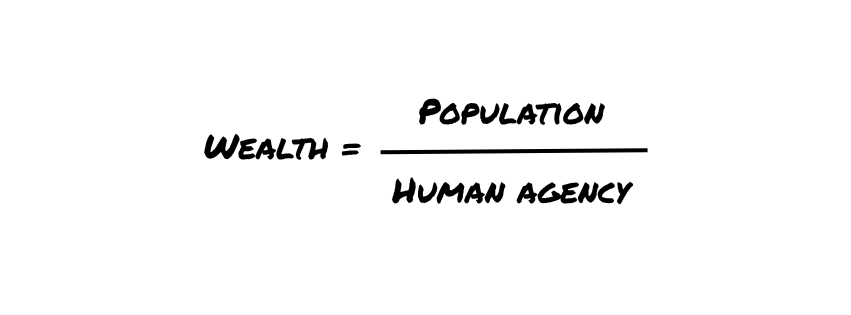
In other words, the greater the reduction of human agency relative to a population, the greater the extraction of wealth from human minds in the form of the creation of dopamine and the control of human attention.
While the dinosaurs faced a mass extinction event, humanity is now living through a mass distraction event.
The locus of this mass event is the streaming platform.
If the logic of the dopamine economy is fully realized, there will be a mass reduction in human potential, agency, free thought, creativity, and most of all, meaning.
Let’s imagine what life looks like if we execute what I call an existential limit test on the central equation of the Dopamine Economy.
Existentially Testing The Central Equation Of The Dopamine Economy
It is often valuable to think about the hypothetical limits of a philosophy or worldview by imaging what a life would be like that fully realizes a system of thought.
I call this existential limit testing.
The idea is to test the livability of a philosophy or value system and see if it is existentially palatable, or possible.
There is a strong case to be made that the logic of the Dopamine Economy reaches its optimal point in a scenario like that depicted in the 2008 Pixar film WALL-E.
In the film, an ecocide caused by rampant consumerism and environmental neglect, rendered Earth uninhabitable for humans. The entire human race was thereby forced to evacuate Earth and indefinitely live out their existence on a space ship owned by a mega-corporation named Buy-n-Large.
Human existence on the ship has devolved into what is perhaps its most de-actualized and minimally functional state.
The film depicts immobile human bodies that are utterly dependent upon robots for meeting their basic needs and controlling dopamine levels to ensure a predictably pleasing existence.
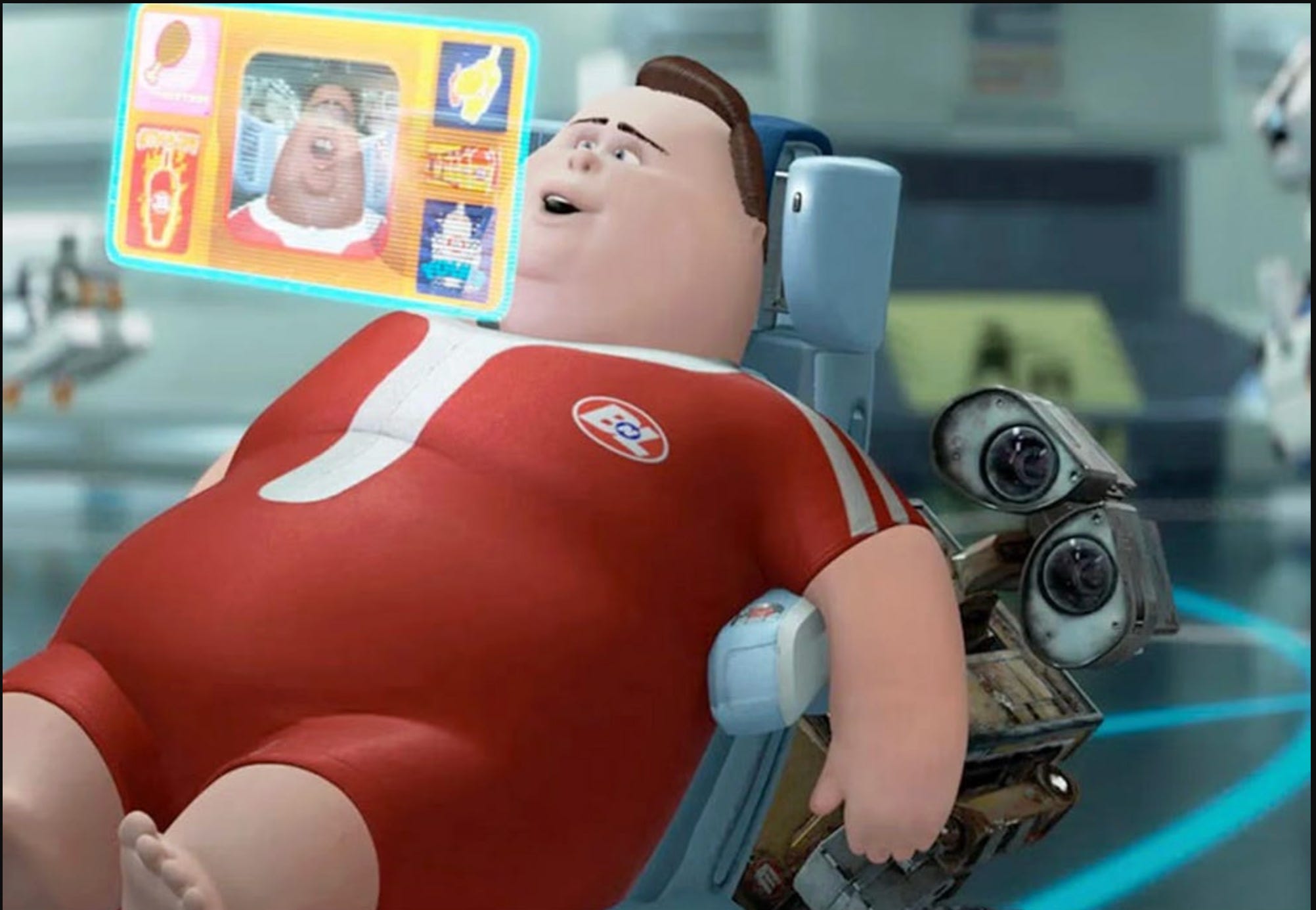
The depiction of humanity in WALL-E is one representation of the full realization of the logic of the Dopamine Economy — an existence in which nearly every second of one’s life is designed to have a positive valence, no matter how small.
No philosopher was more critical of this mode of existence than Friedrich Nietzsche.
In his famous book Thus Spoke Zarathustra, Nietzsche presented a provocative image of what he called “the last man”.
The last man is the antithesis of his famous idea of the Übermensch.
The Übermensch is a life-affirming, self-creating, free spirit that overcomes Nihilism through the power of their human spirit.
The last man, meanwhile, is a passive nihilist who takes no risks, seeks perpetual comfort and security, and has no potential for self-actualization. Additionally, the last man not only fails to elevate their own spirit, but has no potential for elevating anyone else’s spirits, since they live only for their own dull gratification.
In Thus Spake Zarathustra, Nietzsche famously announced the “death of God”, warning of a darkening period of nihilism— the result of which would be a mass reduction of the human spirit, human potential, and ultimately life.
WALL-E vividly portrays just how close humanity is to realizing such a state.
The Solution Is To Recognize And Seek Dark Value
The forces of the Dopamine Economy are powerful and there is very little that any single individual can do to stop them.
What you can do, though, is to recognize the pernicious effects of participating in the Dopamine Economy on your own life and to take steps to begin liberating yourself.
Eventually, if enough individuals resist these forces, they may be able to help others do the same, and humanity can avoid Nietzsche’s nightmare scenario.
So what can you do to make sure that your life doesn’t fall victim to the worst effects of the Dopamine Economy and contribute to advancing its logic?
There are many solutions, but I want to discuss one of the most important solutions here.
Recognizing what I call Dark Value.
Hegelian Aesthetics And Dark Value
I recently taught a class on Hegel’s aesthetics (philosophy of art) which forced me to completely rethink the value of art for life, and also led me to write this essay.
For most of my philosophical education, I ignored Hegel.
This is deeply unfortunate, because he is not only one of the most important philosophers of all time, but his ideas have a radical potential for helping humanity.
Part of the reason I ignored Hegel was that I was trained in what are called “Analytic” philosophy departments.
In these kinds of philosophy departments, they like to make fun of philosophers such as Hegel, despite not even knowing anything about him (other than the fact that he is hard to read and talks about “Spirit”).
Recently, largely thanks to my interactions with readers on Substack, I have become much more interested in figures like Hegel, and I am truly grateful to be in a position to appreciate his thought.
Hegel’s philosophy is changing my life, and I wanted to share a piece of what I have learned about his philosophy of art with you.
In his lectures of Art and Aesthetics, Hegel argues that the creation and appreciation of art is only a stage in a larger process of the ultimate development of Mind or Spirit.
Hegel writes:
“Art in its seriousness is for us something that is past. For us other forms are necessary in order to make the divine into an object. We require thinking. But art is an essential manner of the representation of the divine, and we must understand this form. It does not have as its object the agreeable nor subjective skillfulness. Philosophy has to consider what is truthful in art”
In this important quote, Hegel argues that although art has been an essential way in which mankind has represented the divine — the absolute truth of reality — it has reached its natural limit and must be superseded by thought.
The object or aim of art is not our own entertainment or pleasure (“the agreeable”), but representing truth. At some point, though, the ability of art to “make the divine into an object” reaches its limit.
Why?
Because Hegel thought that the divine, or absolute reality, is itself thought.
In order to fully actualize or awaken truth, thought must be liberated from the material constraints of art and representation.
This point is sharpened in Hegel’s thoughts about fine art.
He writes:
“Fine art is only a stage in liberation, not the highest liberation itself. — The true objectivity, which is now in the element of thinking, the element in which alone the pure spirit is for the spirit, in which liberation is joined with reverence, is lacking in the sensibly-beautiful of the work of art.”
In a very Platonic mood, Hegel argues that Spirit, which is active or pure thought, must liberate itself from the limitations of the material world.
What’s fundamental to art is not the material it is made with, but the underlying thought or truth about reality that it contains. Matter or medium is merely a dispensable vehicle that artists must use in order to represent the higher truths of reality.
Ultimately, Hegel believed that art would give way to pure thought — which is what he understands philosophy to be — thereby liberating the active Mind of the universe.
Hegel is hard.
I am not even fully confident in my understanding of his basic metaphysical view.
The main lesson seems to be that if reality is fundamentally Mind, then nothing in the material world of sensible experience can be the ultimate end of life or truth for which we live.
Our individual minds cannot find their full realization or actualization in seeking or living for such things, and neither can collective or universal Mind or Spirit.
And yet, the vast majority of what is valued by human societies around the world (and American society in particular) is the material, sensible, and pleasurable.
In fact, the Dopamine Economy has reduced what is considered valuable by human beings so thoroughly, that often times what is really valued is simply the feeling of being stimulated.
We have collectively realized the anti-thesis of Hegelian Spirit — a world in which people often just “want to feel something, anything”.
A world in which the lack of stimulation is existentially painful.
This led me to consider the following set of questions:
What is the relationship between what we value as a society, or a species, and what is actually valuable? Isn’t what’s actually valuable simply reducible to what we value? Isn’t there no remainder?
Reflecting on these questions led me to the conclude that value is, in many ways, like Dark Matter in modern Physics — the vast majority of it is invisible, intangible, and largely misunderstood.
And yet, it’s undeniably there.
I call this Dark Value, and I believe it provides a solution to many of the existential and spiritual problems facing humanity today.
Dark Value
Dark Value is the analogue to Dark Matter in Physics.
The material world that we know and love primarily consists of what’s called Light Matter.
Everything that we can see in the universe is thought to be made up of Light Matter.
We are able to interact with Light Matter through different wavelengths of light such as infrared, visible light, and gamma rays.
But Light Matter is not all that exists…
In fact, according to our best theories, it is only a fraction of all the matter in the universe.
The majority of matter in the universe cannot be seen or interacted with directly through the electromagnetic spectrum.
This is Dark Matter.
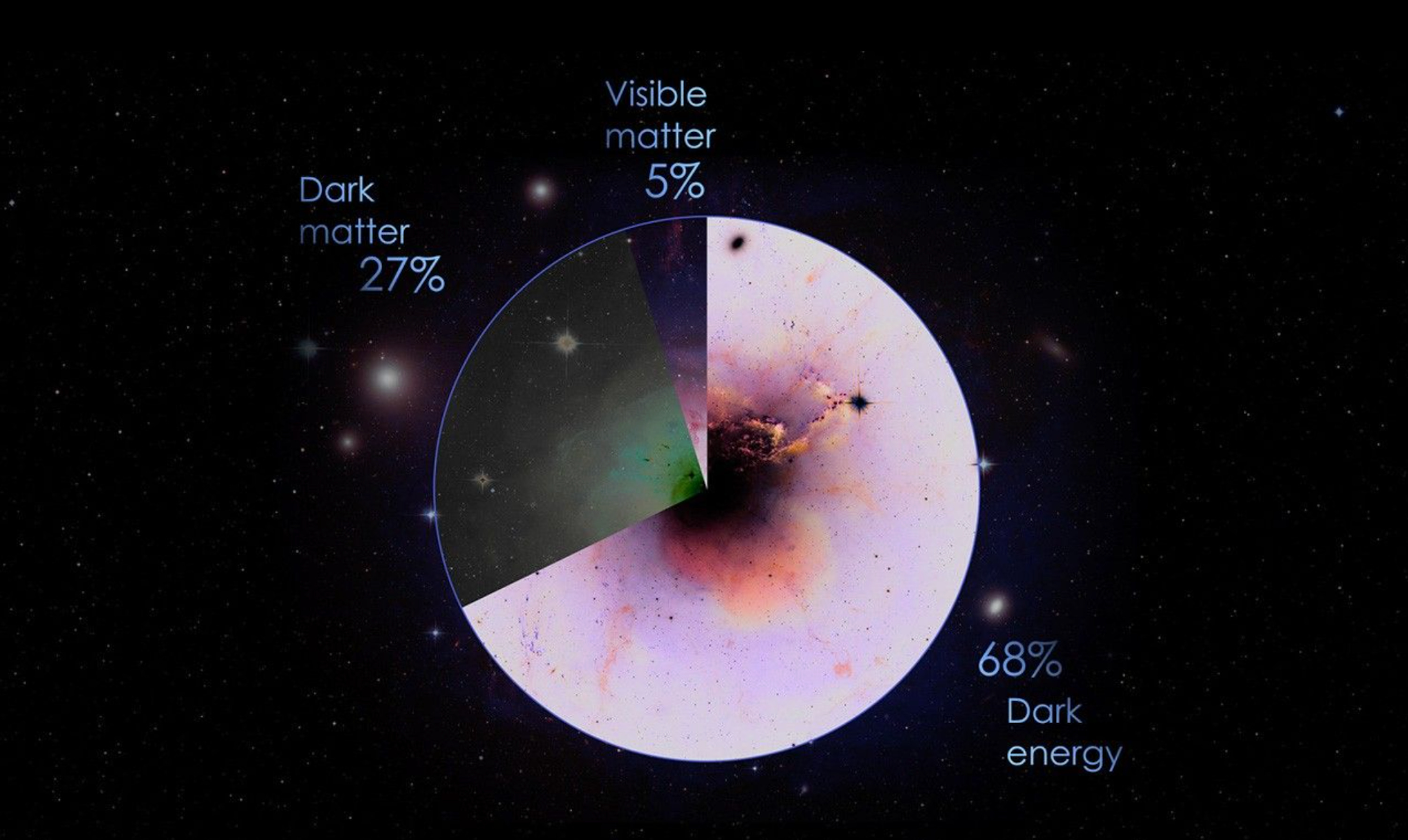
Dark Matter doesn’t absorb, reflect, or emit any light.
And yet, it exists.
Dark Matter not only exists, but it takes up physical space and has a mass.
One of the explanations of Dark Matter is that it is constituted by what are called WIMPS, or Weakly Interacting Massive Particles.
WIMPS are said to be “weakly” interacting because they do not interact with the electromagnetic spectrum in the ways that Light Matter does. Additionally, they are said to be “massive” because they do not simply have mass, but they make up the vast majority of mass in the known universe.
What I want to argue is that the vast majority of what is valuable in life, and which ultimately makes our lives most interesting and meaningful, is to be found beyond the material and tangible world.
Instead, it is to be found in the world of Dark Value.
Perhaps I have simply spent too much time living in the United States, but it overwhelmingly obvious that what is valued most in this country is that which can be immediately perceived, and requires little or no thought to understand.
For example, if someone is in great shape and has obvious muscles mass, then there is an automatic value perception + judgment.
This perception and judgment is often overwhelmingly positive, and even if one is critical of gym culture, there is an unavoidable psychological bias towards the aesthetics of fitness which often overrides one’s personal beliefs subconsciously.
The fact that someone has muscles gives us a kind of immediate knowledge that, regardless of anything else we might want to know about their character, this person has done something objectively difficult and noteworthy.
This is how status works in the vast majority of cases.
While there are some subtle and complex status games that cannot be immediately understood or perceived by the average person, like the status games of people born into New England Old Money (who knows what’s going on there), most status games are based on strong and immediate connection between what’s visible and valuable.
The basic idea is that something is valuable only if its value can be immediately seen such that it requires little to no thinking to understand or appreciate it.
This clearly applies to things such as:
Food
Water
Money
Muscles
House
Car
Clothes
Physical Beauty
These are all things in which it is easy to see value because it is being physically instantiated (manifested) in the world and presented to our senses.
It is almost as if you can literally see the value in the world.
Oil is “liquid gold”.
Alcohol is “liquid courage”.
Bitcoin is … well, does anyone know what Bitcoin is?
With things like food or beauty, the value is in the substance, it’s in someone’s face.
(Strictly speaking, there is no value in someone’s face. There is the perception of value which is caused by a highly complex combination of evolutionary and cultural factors. But the effect is the same).
The value of things like food, water, and clothes is quantifiable, tangible, direct, and as “objective” as it gets.
Let’s call this kind of value physical or material value.
Physical value is the analogue to Light Matter (or just Matter/Value).
It is Light Value.
Light Value is “light” because it is easily seen and interacted with.
It is also light because it is, as I will argue, less existentially weighty and spiritually significant than Dark Value.
If Dark Matter is constituted by WIMPS, then Light Value is constituted by SIMPS (that’s a joke, but not really).
A simp is someone who excessively tries to win over someone’s affection and attention.
Light Value is simpy because it is always trying to grab our attention, make us desire it, praise it, and distract us from what’s truly valuable.
Sometimes this is for our own survival, but more often it is to serve the aims of a corporation which wants us to pay attention to it.
Too much Light Value prevents us from seeing into the dark by blinding us with its distracting light.
Too much Light Value creates value pollution in the same way that too much light creates light pollution and prevents us from peering into the cosmos. This is why people in cities easily become disconnected from nature.
They lose the ability to see stars.
I want to be clear, my aim is not to demonize Light Value.
It has an important role to play in our lives.
In fact, I think it is a great mistake to think that Light Value is not valuable at all.
Just as we need Light Matter to navigate our environment and survive, we need Light Value to help us meet our basic needs and be in a position to do anything interesting.
It is a mistake to think that Light Value has no value, but it is an even greater mistake to think that Light Value makes up all the value that there is.
Sadly, the vast majority of our lives, especially in hyper-capitalist economies, are arranged to make it as difficult as possible to see anything beyond Light Value as valuable.
We are blinded by it so thoroughly, that we give up on exploring the world of Dark Value altogether.
This is why Dark Value is so wimpy.
Despite there being an infinitely vast and complex world of value that human beings are able to explore through through art, education, contemplation, and conversation, this world of values only interacts with us very weakly.
Just as it requires a concerted effort to find a place in which it is actually possible to see stars in the modern world, it requires a concerted effort to even become aware of just how much Dark Value exists, let alone to fall in love with it.
Most human beings, often for reasons that are no fault of their own, rarely have any time or energy to set aside for reading great literature, contemplation, or deep conversation.
But even when we do manage to overcome the innumerable obstacles to deep thinking, or deep experiencing, even when we begin to active the incredible faculties that we possess in order to contemplate and appreciate art, be creative, investigate the ultimate nature of reality, these activities are far too often instrumentalized to serve our own, or others’ material aims.
This is another form in which a culture obsessed with Light Value threatens Dark Value.
It constantly reduces the value of difficult, complex, and impractical ideas into the language of Light Value in the form of questions such as:
“What am I going to do with that?”
There is an overwhelmingly strong tendency — a gravitational pull — towards the physical, material, and tangible.
The difficulty of finding and appreciating Dark Value in the modern world is deeply unfortunate.
Although Light Value makes it possible to live, Dark Value is what makes life worth living.
Only a sliver of what we value, think about, worry about, or know, is representative of what’s really out there.
Dark Matter makes up ~85% of all matter in the universe (Dark Energy, which is a significantly more mysterious and complex topic to discuss, accounts for the rest of what “exists”). Dark Value makes up an unknown, yet immeasurably large amount of what’s valuable.
Dark Matter and Dark Value are the grand and hidden forces that are govern much our lives.
Why Value Dark Value?
At this point it is worth addressing the question of why we should care about exploring the world of Dark Value.
Why not live in the light and pursue value which can be easily measured, seen, and shared? After all, if something is less material or less physical, then how can it benefit you? Also, if it is so far removed from ordinary life, then how can it be applied to daily life?
There is a lot to be said here, but a simple answer is that life without higher values, challenging ideas, and a sense of awe and wonder, is simply boring.
The value of the material world quickly runs out, leaving us forced to confront the emptiness of our lives.
A world without art would be a boring that no human being would want to live in.
A world without philosophy, theology, literature, and poetry, would be a boring world that no human being would want to live in.
A beautiful world.
A mysterious world.
A infinitely complex world.
These are the kinds of worlds that allow for human meaning to sustain our spirits.
It is important not to deny or downplay the very strong and very real connection between our physical bodies and value.
Very simply, physical pleasure and pain are the most direct and basic sources of value for us.
This is for good reason.
It helps us survive.
But survival is not the only thing which should be valued.
We need something to live for.
We need things to think about and care about which can sustain our spiritual needs throughout (and potentially beyond) a single human lifetime.
Our eyes let us experience a painting.
Our ears let us listen to a symphony.
But our minds allow us to contemplate the meaning of the ideas embodied in the art and explore infinite possibilities of meaning making.
The human spirit cannot grow, let alone flourish, on a material diet alone.
In the end, if we only value that which is bound to the physical or material realm, then we prevent ourselves from realizing our full human potential and exploring the seemingly infinite immaterial world of ideas that silently waits for us.
We must venture into the dark, lest we become boring.
-Paul
P.S.
For years I dreamed about creating my own online school for philosophy in order to make it more widely accessible.
Although I haven’t quite created an entire “school” (not yet), I just released a completely revamped version of my Micro-Philosophy: Foundations course.
Micro-Philosophy: Foundations is the only online philosophy course specifically dedicated to teaching adults how to create their own personal philosophy of life.
If you’re interested, the course is available for pre-sale here.
It’s funny Paul. Everyone talks about escaping the dopamine economy like it’s some mystical quest, but half the time it’s just remembering you used to have a prefrontal cortex before TikTok leased it out. Dark Value is real though. The richest parts of being human never show up on a dashboard or a progress bar. They show up in curiosity, wonder, and the five quiet minutes when no algorithm is shouting your name.
If we don’t learn to love the dark again, we end up like WALL E’s chair people. Spiritually padded, intellectually horizontal, and wondering why life feels like airplane mode.
Your article makes me think that the "Dark Value" that humans inherently desire is that value in which they create, rather than consume. This value can take many forms: one may sit in front of abstract artwork and contemplate how the artist used a certain medium to convey a deeper meaning, or one may read an article and feel they have an original thought they must espouse...
That said, the essence is that the Dark Value comes from higher-order thinking or "creation" of unique ideas or interpretations. The modern world (social media in particular) compresses this natural human instinct. With a book or conversation, one is almost FORCED to use their higher-order capabilities vs. the cadence of a TikTok or IG Reels pulling you to another 15 second clip.
This consumption flywheel erodes key elements of higher-order thinking like attention, memory, and persistence, which hamstrings us from creating the Dark Value that we so desire. If you have not read a book in a decade, how are you meant to understand Dostoevsky? If you have not looked for motifs in a piece of art, how can you derive the artist's meaning? You don't have the prerequisite skills to harness the Dark Value without effort.
Even those who do not have the willpower or discipline to reject the Dopamine Economy are acutely aware of its consequences-- simply ask an everyday person if they feel fulfilled after a TikTok binge or if they feel satiated after eating a whole pizza. But they do not stop... and will not stop. My cynicism over this whole matter is that people predisposed desire Dark Value will, in large part, find it (although with some effort), while the majority of human animals engorge themselves on content.