


Everyone has beliefs that they live by whether they think about them or not.
They are there.
The problem is that most people don't know or understand what their own beliefs even are.
If you don’t know or understand what your own beliefs are, then you are not in control of your thoughts and actions, someone else is.
Knowing what you believe is the bare minimum if you want to become an independent, self-creating, high agency thinker.
How can you think for yourself if you can't separate what you believe from what you have been conditioned to believe by society?
Last week's newsletter, "How To Discover Your Atomic Beliefs", explained the first steps you need to take to begin gaining control over your own thoughts (In case you missed last week's lesson, you can access it here).
These basic beliefs are the starting point of a radical transformation that you will experience as you become an independent thinker.
In this week's newsletter, I am going to teach you how to identify 5 core beliefs and construct your first Core Belief Statement.
Ultimately, this organized system of beliefs will become a complete micro-philosophy, consisting of core beliefs, fringe beliefs, definitions, axioms, values, principles, and actions.
A micro-philosophy is a coherent and concise framework that brings your ideas together in structured and holistic way (Holism = the idea that the whole is greater than the sum of its parts).
A micro-philosophy is not just a list of everything that you think.
This is true because you are not just a list of categories or identities.
Your essence or true self cannot be reduced to:
Political Party
Gender
Nationality
Race
Etc.
Even if these things shape who you are, you cannot possibly be fully understood or comprehended by a mere list of these generic categories.
You are a holistic being, utterly unique, and utterly irreplaceable.
Don't tell yourself stories that reduce you to one or a handful of these things.
Your micro-philosophy is the embodiment of your irreducibility and uniqueness.
When your different ideas come together, they form combinations that can only exist at one point of time in the history of the universe.
That is you.
No one has your life story.
Let's figure out who you are.
What Are Core Beliefs?
Your beliefs are like an atom.
Every atom consists of an atomic core surrounded by a cloud of electrons.
Likewise, some of your beliefs are core beliefs, while other beliefs are what I call fringe beliefs.
A core belief is a fundamental conviction or assumption that serves as the foundation for an individual’s worldview, values, decisions, and actions. It is deeply held, often influences other beliefs, and is central to a person’s sense of identity and understanding of the world.
Core beliefs are like the nucleus of the atom, while fringe beliefs are like the electrons surrounding it.

Core beliefs are fundamental to who you are.
Core beliefs hold the greatest significance to you as a person and exert considerable influence over your entire belief system.
In the same way that the nucleus contains the majority of an atom's mass, your core beliefs hold the most weight in your micro-philosophy.
Core beliefs are also foundational — they provide the support for all of your other ideas, holding everything together.
Given their foundational nature, they are also very resistant to change. This isn't necessarily a good or bad thing. It is just a fact about how core beliefs function.
For example, a metaphysical core belief of yours might be the idea that "reality is fundamentally physical" (this is metaphysical because it is a meta-statement about the nature of reality).
From this core belief, many things logically follow.
You can conclude that there are no spirits or souls (unless these are physical entities).
You can conclude that reality must obey physical laws.
You might even conclude that there is no afterlife.
The single core belief that "reality is fundamentally physical" can support hundreds of related beliefs that are logically derived from it.
Core Beliefs: Fundamental Parts and Properties
The nucleus of an atom is composed of a proton and a neutron.
A proton is a positively charged particular, while a neutron has no electric charge.
In a similar way, core beliefs are composed of two fundamental parts:
A positive belief: A statement that asserts a positive claim about the nature of reality, knowledge, value, or morality.
A definition: A statement that clarifies how you understand the meaning of key terms in your positive belief statement.
The positive belief represents the proton of a nucleus, while the definition represents the neutron.
Before 1971, physicists did not understand how an atom was held together.
In fact, it was a mystery at the time why atoms did not simply just split apart, since positive charges repel one another.

The nucleus of an atom is incredibly stable because it is held together by the strongest of the four fundamental forces — the strong nuclear force.
These two elements of a core belief are held together by the strongest fundamental force of the intellect — reason.
In formulating your core beliefs, you should take care to choose beliefs and definitions that are not only incredibly clear, foundational, but also rational.
If your core beliefs are irrational, you risk living a life of instability.
You want your core beliefs to be incredibly stable like an atom.
At the same time, it is important not to become dogmatic or closed-minded.
Under extreme conditions, even atoms can change and be destroyed.
Why Atomic Beliefs?
In Atomic Habits, James Clear chose the metaphor of atoms because of their size.
Clear was interested in the idea that our lives are built up out of incredibly small and manageable habits.
When it comes to the concept of a micro-philosophy, the idea that a micro-philosophy is built up out of fundamental elements, like atomic beliefs, is appealing.
But I did not choose to think of a micro-philosophy in terms of atoms because atoms are tiny (just how small atoms are is actually mind-bending if you look into it).
I chose the atomic metaphor because a micro-philosophy is a structured set of ideas, and the structure of an atom, as well as the physical laws that govern its properties, map on nicely to a belief system.
Core and fringe beliefs do not exist in isolation. They form a holistic system.
A system is a collection of parts that influence and depend upon each other. When taken together, they form a whole greater than the sum of its parts (holism).
In a system, atoms interact with other forms of matter in accordance with the laws of physics.
In your belief system, your atomic beliefs interact with each other in accordance with the laws of logic and reasoning.
While it is theoretically possible for an electron to float free and exist outside of a system altogether, almost everything in physics exists within a system.
Likewise, while you may have random beliefs in your head that you take to just float free from any other beliefs, it is much more likely that your beliefs exist in a system which you just haven't figured out yet.
Finally, philosophy can be quite abstract, so thinking in terms of something physical such as atoms, can help make it more concrete.
What makes your micro-philosophy unique is the relationships and connections between your beliefs that define who you are.
Here are 3 features of your micro-philosophy, understood as a system of beliefs, that give it structure:
Hierarchy: All of your beliefs do not have equal status. There is a hierarchy to them. Core beliefs are foundational to who you are and how you think. Fringe beliefs, meanwhile, are less foundational and can be understood as dependent upon core beliefs.
Interconnectedness: Just like atoms, none of your beliefs exist in isolation. They are all related to one another by logical connections, personal experience, memories, and the strength of your convictions.
Stability: Some of our beliefs are very stable and may never change throughout our lifetime. Others are more dynamic and may change or disappear from our belief system altogether.
If you want to write your beliefs down in a structured and organized way, you need the right tool.
Before the invention of computers, if you wanted to write out your personal philosophy, you would have to do it by hand.
We are incredibly lucky in the modern world to have access to technology that can help us systematize and organize our thinking in ways that people like Aristotle would have only dreamed of!
This is why I am creating resources and templates in the second-brain writing app Kortex.
A Second Brain For Philosophers
Kortex is a completely free app specifically designed for writers, content creators, and lifelong learners.
The power of Kortex lies in its ability to help you to organize and connect ideas by using various features such as #tags and connections.
To help you get started building your micro-philosophy, I designed a free Kortex template that you can use to complete Assignment #2 below.
The Belief Finder Template contains everything from today’s lesson, as well as more detailed instructions, explanations, and the ability to #tag and connect your ideas together.
Here is a preview of the template:
If you sign up for Kortex using my affiliate link below, you can access the Belief Finder Template in just 2 steps.
Here’s how:
1) Create a Kortex account using this link in a new tab:
Then
2) Follow this link to the template and click “duplicate” in the top right corner: Duplicate The Belief Finder Template
This template was specifically designed for Kortex because it is the only app I know of that allows you to easily connect and synthesize ideas in an organized way. This makes Kortex great for building your micro-philosophy (and content creation in general).
I hope the value of the atomic metaphor is more clear after reading this section, and you can see how it helps think about the structure of your micro-philosophy in a more tangible way.
Let’s move on to this week’s assignment.
Assignment #2: Identify Your Core Beliefs
Alright, now that you have a clear idea of what core beliefs are and why they matter, let's get started figuring out 5 core beliefs that you hold!
By the end of Assignment #2 you will have created your first Core Belief Statement.
Follow the 3 steps below to complete Assignment #2.
Step One: Set A Timer For 20 Minutes
This step is straightforward.
Setting a timer can help focusing your mind by putting constraints on your thinking. It provides structure and forces you to complete the task without worrying about quality or getting things perfect.
Most of you will probably take more than 20 minutes once you get started, because you will get into a flow state. That is totally fine. Don’t stop! Go deeper!
The timer is merely a trick to help you get into the right mindset.
Step Two: Answer The 5 Fundamental Philosophical Questions (15 Minutes)
The 5 Fundamental Philosophical Questions are designed to help you get to the very bottom of your worldview.
The 5 Fundamental Philosophical Questions are derived from broad patterns that have emerged in debates that have lasted thousands of years, spanning multiple philosophical traditions.
The questions are written in such a way that forces you to take a stand on fundamental philosophical issues and locate your position in what is called conceptual space — the space of conceptual possibilities or what is thinkable.
You can think of these 5 questions as outlining out the borders of conceptual space so that you can begin to find your bearings.
Here are the 5 Fundamental Philosophical Questions:
1. Is reality fundamentally material or immaterial (mind, idea, spirit)?
2. Is truth itself objective or subjective?
3. Do we acquire true knowledge through pure reason or experience?
4. Is morality objective or relative?
5. Is there a purpose to human life, or is life ultimately meaningless?
For each question, spend about 2 minutes considering which option feels more right to you, and then write a one sentence response.
To help you get started, here is a sample answer for Question 3:
"I believe that morality is relative and that there is no universal moral truth that applies to everyone across cultures"
Additionally, here are 5 Tips (one for each question) to help you understand in more detail what each question is about:
Tip #1: Reflect on whether you think the physical world is all there is or if there are non-physical modes of existence or being.
Tip #2: Reflect on whether you think there are objective truths in nature, or whether all truth depends on subjective experience.
Tip #3: Consider whether you think moral principles are universal or depend on culture and context.
Tip #4: Consider whether we can know anything without justifying it through specific life experiences.
Tip #5: Explore whether you think life has inherent meaning, no meaning, or if meaning is created individually.
Step Three: Craft Core Belief Statement (5 Minutes)
Step Three is where you take your answers in Step Two, briefly review them, and turn them into your Core Belief Statement.
The questions in Step Two were meant to force you to think more deeply about fundamental questions in philosophy.
Your answers to these 5 questions provide a foundation which allows you to identify an initial list of your core beliefs.
In next week's newsletter, we will go even further in unpacking your core beliefs and also connecting them with your initial list of 20 philosophical beliefs as well as new idea you haven't yet considered.
For each of the answers above, do the following:
Ask yourself whether this answer conflicts with any of your other beliefs, values, principles, or characteristic actions
If yes, then rewrite your answer in a way that reduces or avoids the conflict.
If no, then proceed to step 4.
Ask yourself whether this answer is fundamental, or depends upon an even deeper assumption.
If you judge your answer to be fundamental how you think, then add it to your Core Belief Statement.
If you judge your answer to depend on an even deeper assumption, then add that to your Core Belief Statement instead.
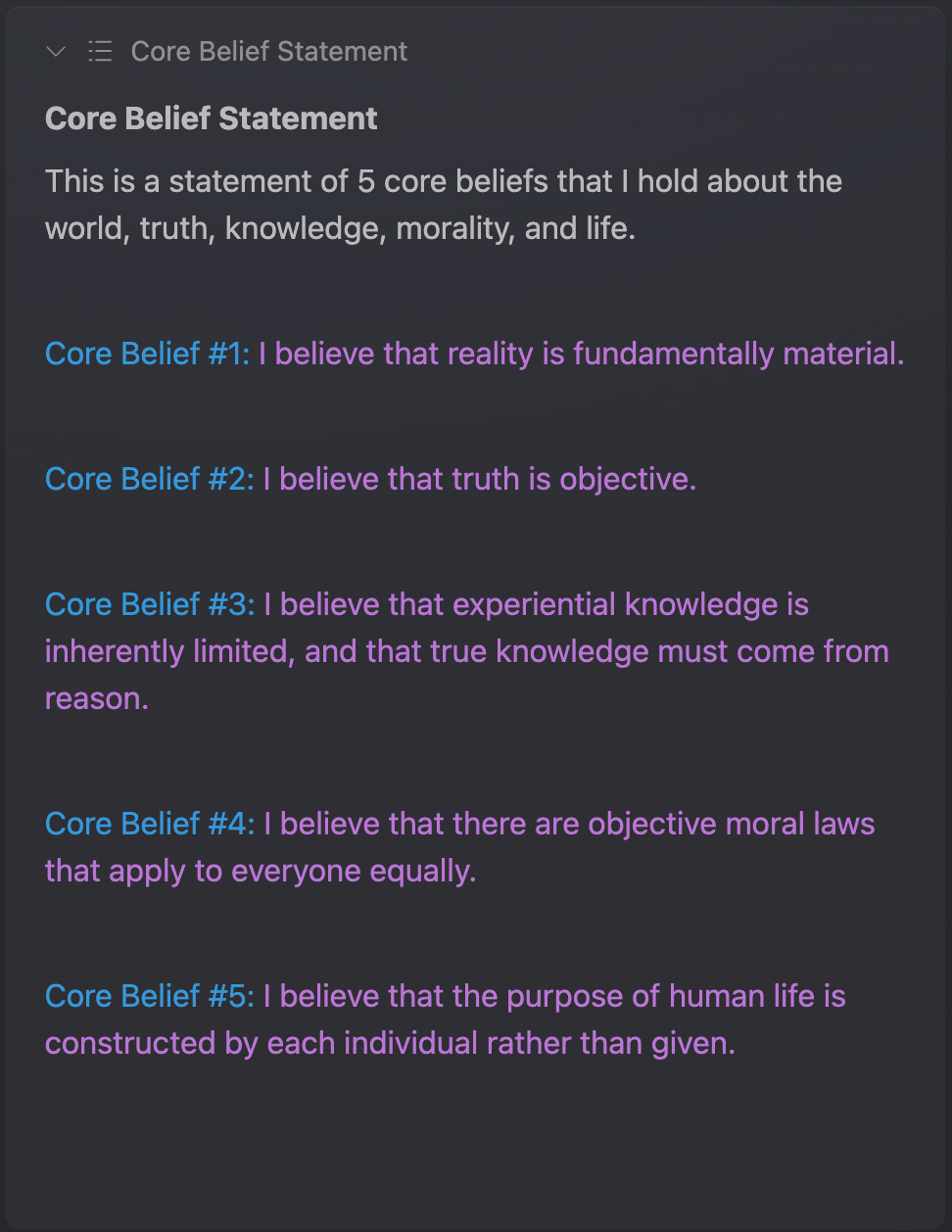
Core Belief Statement
Here is an example of what your Core Belief Statement might look like in the Belief Finder Template:
One Last Thing
Great job crafting your Core Belief Statement!
You now have a structured list of 20 philosophical beliefs and a Core Belief Statement.
Well done.
In next week’s newsletter, we will go even deeper in identifying and connecting your beliefs in a systematic fashion. Following this, we will begin to take a similar approach to your Values, which will eventually allow you to begin connecting your beliefs to specific Actions.
If you would like to join a free community of micro-philosophers, I have created a place for like-minded free thinkers to meet and discuss their ideas on a platform called Circle. You can sign up here.
See you in there!
-Paul
I'm not sure the atom analogy works—it's unclear to me that there exists some foundational belief without which I would not exist. It seems that I am the sum of my parts, and it is through their interaction that the concept of myself emerges.