


This article is a introductory philosophical guide to Heraclitus of Ephesus.
Heraclitus was one of the most important philosophers in history, even though few people know about him outside of the academy. As you will see throughout this course, many of his ideas would go on to have a considerable influence on the golden age of Greek philosophy (5th & 4th century BCE) and beyond.
Overview
As far as we know, Heraclitus was born in 540 BCE to an aristocratic family in the famous city of Ephesus and lived for around sixty years.
Despite being in line for a kingship, Heraclitus gave up the political life in order to dedicate his life to philosophy. As far as we know, he was an individualist and outsider. He has been nicknamed “the weeping philosopher” because many have read him as being a pessimist (although this is debatable). It is true that he was often arrogant, judgmental, and opposed to common thinking.
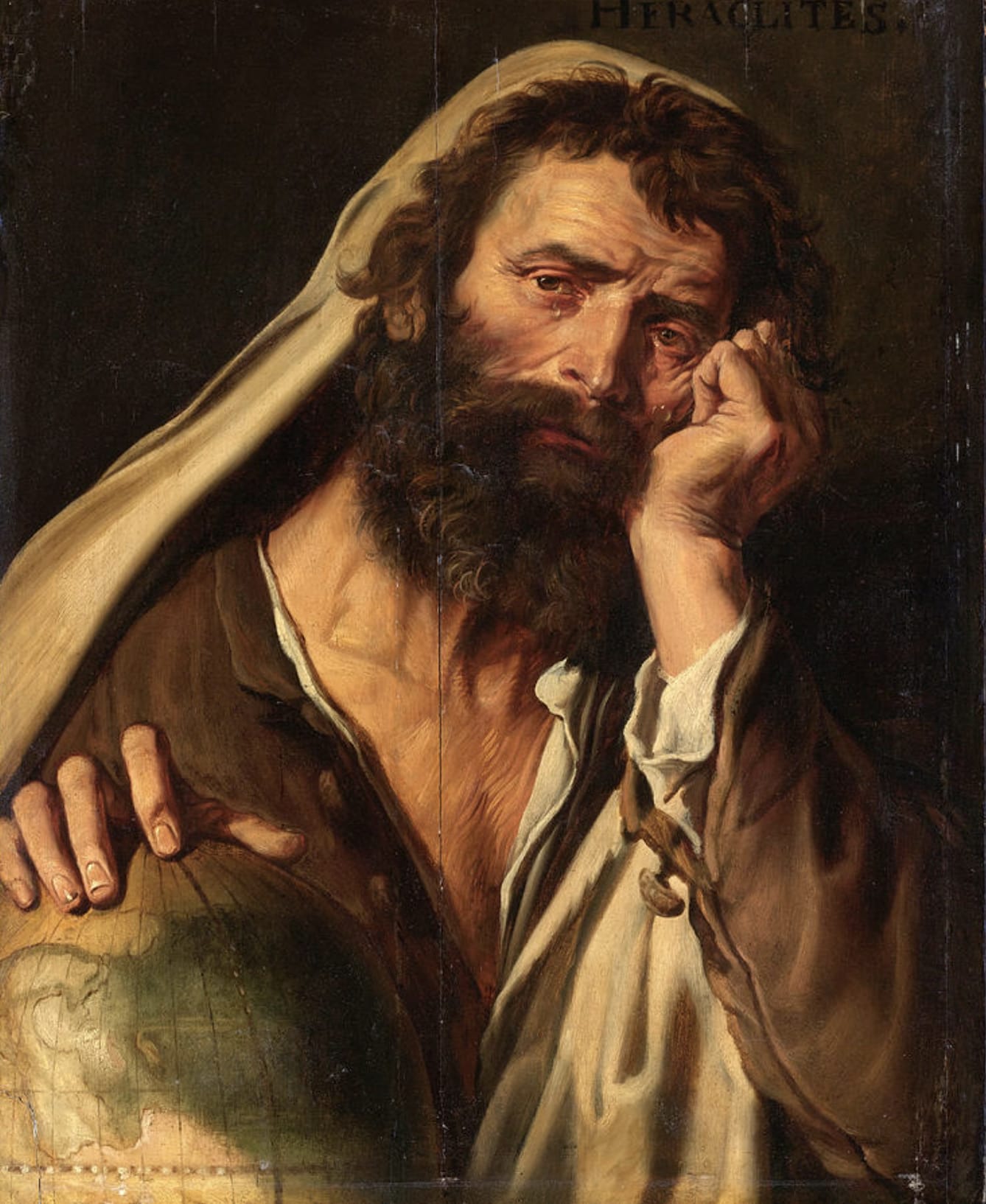
Heraclitus is reported to have written a single great book titled On Nature.
While most of his book has been lost to history, we do possess the beginning of the work as well as several hundred fragments. Although Heraclitus wasn’t the first philosopher, in many ways he is the first philosopher that we can study with confidence. Despite the fact that many of his writings were destroyed, and we know very little about his life, he would go on to exert a considerable influence on the development of Western ideas.
Nearly every great philosopher has written about Heraclitus at some point. The list includes figures such as: Plato, Aristotle, Epictetus, Marcus Aurelius, Nietzsche, Hegel, and Heidegger. His works have even been blamed as providing the source of Christian heretical thinking!
Heraclitus believed himself to have made a discovery of great importance — what he took to be the key to understanding everything.
He believed that this discovery was captured by a single term or concept — Logos.
The word Logos (λόγος) is, arguably, the most important word in the history of philosophy other than sophia (σοφία), which means “wisdom”.
What does Logos mean?
Heraclitus’ big idea was that the meaning of Logos is that all of reality is unified and explained by a single rational principle which held that all things are one.
While I will explain Logos, as well as Heraclitus’ theory, in a bit more detail below, we can take the definition above as a starting point from which we can proceed to move deeper into Heraclitus’ philosophy.
Illusion & Reality
Heraclitus had much in common with early Advaita Vedanta school of Hindu philosophy famous for the concept of “māyā”. According to this tradition, māyā is the powerful force that creates the universal cosmic illusion that the world of appearances represents true reality. Māyā has the connotation of constant change and is contrasted in Advaita Vedanta with ultimate and unchanging reality — what they call “Brahman” or the Absolute.
In a similar vein, Heraclitus believed that despite being surrounded by the Logos, most people live their lives as if they are asleep and dreaming, fundamentally unable to see or understand true reality.
“One ought not to act and speak like people asleep”
Heraclitus, B73 (Marcus Aurelius, Meditations, IV, 43)
Heraclitus believed that we can escape from this illusory condition by learning how to wake up our minds (the theme of liberation from illusion and suffering was very common in the ancient world). At the same time, he also believed, much like Socrates, that human beings are fundamentally limited in what they can know when compared to the divine. Part of being human is to occupy a normal state of ignorance and misunderstanding. Although it’s unclear whether he believed that we are in principle unable to attain true wisdom or understanding, Heraclitus still believed that we could make progress towards this goal, and that it is the proper goal for a human being to aim at. In this sense, Heraclitus was a strong advocate for “the examined life” over 100 years before Socrates famously declared that “the unexamined life is not worth living for a human being” (Plato, Apology, 38a5-6).
