


People today are dying for a real education.
But what does that even look like anymore, and why does it seem so difficult to find?
Where can you go?
You already paid over $50,000 for a college degree…
You already consumed 1,000+ hours of high quality podcasts and videos…
Despite having instant access to more information than ever before and the ability to connect with others through the internet, people are finding it harder and harder to get the real thing.
Not hoarding notes in a second brain…
Not arguments in the comments section…
But a real education.
Real conversations with real people about things that matter.
An education where you learn how to think for yourself.
I wanted to stop you here and let you know that this article is quite long.
If you are someone who wants to think more deeply about how mass education ultimately serves the economic interests of corporations and institutions at the expense of the individual student, then I think you will find it worth your time.
In the second half of the article, I offer three positive visions of what a “real education” could look like and how that fundamentally differs from the mass education most of us have experienced.
Finally, I end up arguing that the potential for delivering a real educational experience through the internet has not been fully realized yet, but there is reason to be optimistic.
An education where you learn how to ask the right questions, come up with your own answers, and become an independent, unique, creative, and lifelong contributor.
An education where you can teach others and challenge them about things you care about — about those things where getting the details right matters because of how much people care about the details.
Sadly, some people have never experienced the joys of this kind of education and may have lost their love of learning (along with their intellectual self-confidence). Some people may have become convinced that education is merely a means to an end because they have forgotten what it is like to wonder, what it’s like to experience one of those rare “aha!” moments.
What it’s like to approach reality with a childlike enthusiasm.
This is what happens when people are forced through an “education system” that wasn’t designed for them on a mass scale and into careers that don’t move their soul and leave them with no room to develop or express their individuality.
When I look online, I see people desperately searching for this because they really have nowhere to go.
Mainstream institutions have mostly failed to provide this experience because their fundamental aim is the economic development of “human capital” rather than spiritual development of the individual (you might get lucky and have one or two rare and incredible professors — or they might be on leave doing research).
The internet contains plenty of amazing videos and courses that provide much of the same knowledge and information found in universities, but what often happens is that people consume high-quality content and are left with nothing to do with it and no one to talk to except some random person in the comments section.
Real education requires an intellectual community where people can have deep and meaningful conversations about the things they love, take intellectual risks, and learn from people of different backgrounds and life experiences.
Some people may not even know what this feels like because they have never had the opportunity to experience one of those rare “aha!” moments.
Some people may have become convinced that education is merely a means to an end because they have forgotten what it is like to wonder.
Because they were forced through an “education system” and into a career that doesn’t really speak to them and leaves them no room to develop or express their individuality.
This all leads to one big question — why?
Why are things this way for so many people despite record levels of wealth and opportunity?
Why are so many people alienated from the joys of reading, writing, learning, and deep discussion despite the fact that they desperately crave these truly human activities?
The short answer is that, in the modern world, education has largely become an economic tool and opportunity rather than a spiritual one.
The result is that millions are forced to spend a quarter or more of their lives progressing through an “education system” that was not designed for them.
People don’t want to check off boxes, receive meaningless grades, and “progress” through a series of steps to get things they didn’t want in the first place.
They want to have their mind’s blown.
They want to discover something that makes them absolutely obsessed — that makes them feel alive and need to get up in the morning.
They want real conversations with real people about things that matter to them and others.
When is the last time you had a deep conversation that felt like it could never end but wasn’t about some personal problem?
Seriously.
Can you remember? Let me know in the comments below. What was it about? What did it feel like for you? Was it about space, aliens, philosophy, physics, politics?
Leave a comment to see if you can remember.
A real education.
When I look online, that’s what I see people desperately searching for because mainstream institutions have mostly failed to provide it.
An education where you learn how to think for yourself.
An education where you learn how to ask the right questions, come up with your own answers, and become an independent, unique, creative, and lifelong contributor.
An education where you can teach others and challenge them about things you care about — about those things where getting the details right matters.
How did we reach a point where so many people don’t know where to go to find these things despite there being more opportunity than ever before?
The answer can be found by taking a brief look at the history of mass education since the Industrial revolution.
It is the story of how education, once understood as aiming at spiritual transformation and personal growth, became transformed into the main source of development of “human capital” in order to grow the economy and reinforce social order.
A Brief History Of Mass Education: Productivity And Conformity
The global system of mass education that exists today is mostly an outdated byproduct of the 19th century industrialist idea that the ultimate purpose of education is economic.
In any value system that has an ultimate aim or purpose, this ultimate purpose will create a hierarchy of value that serves it.
This is what structures the hierarchy of subjects taught in school.
The most highly valued and prioritized subjects are those that are viewed as most useful for work.
This is why the arts and creativity are the least prioritized and most mocked.
What does the fact that you don’t need to learn or practice creativity say about the nature of the work that an education is preparing you to perform?
Mass education serves one ultimate master — the economy.
Economics And Education
A major shift in human economics occurred when people suddenly realized that education increases the economic productivity and earning potential of human beings by transforming them into “human capital” which can then be used to create and extract wealth on a mass scale.
Prior to the rise of modern education, human capital was like an unrefined or undeveloped natural resource.
It was primarily found in the uneducated laborers of the world, such as serfs and slaves.
Their economic value was comparable to the value of a horse or a plow (and thought of in these terms), since they were viewed as having little to contribute beyond their physical output.
Being an intelligent serf gave no added value to your master.
Due to a lack of modern technology, the methods of wealth extraction were quite simple — get people to produce things like food or goods, and take the majority of the physical stuff for resale.
Education was viewed as completely unnecessary.
But major developments in moral and legal thinking, as well as new technologies, radically altered the role that education could play in the growth of economies around the world and forced governments and companies to innovate by finding new ways of creating and extracting wealth.
For example, slavery was outlawed in the United States in 1865 with the 13th Amendment To The Constitution.
If people could no longer be enslaved, then how was one to “use” them to make money?
The primary answer ended up being wage labor.
It is worth mentioning the sad truth is that more people are enslaved today than ever before in human history despite the fact that it is illegal pretty much everywhere in the world. It has been claimed that more human beings are living, working, and dying in slavery today than at any point in human history (the total number is estimated at 49 Million, and includes labor slavery, sex slavery, and other forms).1
Human beings are widely thought of today as “capital”.
What is capital?
Capital is a broad term for the assets used by a business to generate returns. It most commonly refers to cash that is used for the purposes of production or investment, but it has also become common to apply the concept to human beings themselves.
This is what’s called “human capital”.
What is “human capital”?
Well, it’s the economic value of a worker’s skills and experience to a business and the economy overall. It is the value employees bring to a company that translates to productivity or profitability.
It is an intangible asset that is not listed on a company’s balance sheet, but absolutely vital to increasing productivity and profitability.
So if you are no longer able to literally enslave people, how can you find new ways to treat them as an economic resource that serves the bottom line?
You treat them as human capital to be educated, up-skilled, and maintained in order to guarantee perpetual increases in productivity, profits, and economic growth.
Seem’s like a pretty good deal, right?
The Rise Of Human Capital Theory
In the 1960s, economist Theodore Schultz analyzed the value of human capacities. Schultz compared human capital to other forms of capital that improve the quality and level of production, and argued that companies must invest in the education, training, and enhanced benefits of an organization’s employees.
Since human capital is based on improving employee skills and knowledge through education, these investments can be easily calculated. Any return on investment (ROI) of human capital can be calculated by dividing the company’s total profits by its overall investments in human capital.
All of this has great economic value for employers and the economy.2
The basic idea is that people who participate in the workforce with higher education will often have larger salaries, which means they can spend more in the local economy
As more physical capital accumulated, the cost of education decreased, making it an essential part of the workforce. Although educational institutions seemed to have found a way to make themselves indispensable when the cost of education was low, building themselves into the foundation of the economy, and then turn around and raise prices once their position was solidified.
Ultimately, students end up paying for the corporate investment in human capital without realizing it (under the belief that they are paying to improve themselves for themselves).
It is a subtle trick that has worked on a mass scale.
It’s one of the great American tricks — getting people to pay for things that should have been built into the basic structure of society under the belief that it is an optional form of self-improvement, but actually it’s a way to fund someone else’s investment.
After the 60’s, the term “human capital” was adopted by corporations and viewed as a renewable resource that drives productivity and innovation.
In his original paper, which was published during the Civil Rights Movement in the United States, Schultz was well aware of the moral hazards with this kind of thinking. He writes:
“The mere thought of investment in human beings is offensive to some among us. Our values and beliefs inhibit us from looking upon human beings as capital goods, except in slavery, and this we abhor. We are not unaffected by the long struggle to rid society of indentured service and to evolve political and legal institutions to keep men free from bondage. These are achievements that we prize highly. Hence, to treat human beings as wealth that can be augmented by investment runs counter to deeply held values. It seems to reduce man once again to a mere material component, to something akin to property. And for man to look upon himself as a capital good, even if it did not impair his freedom, may seem to debase him”
Schultz, “Investment In Human Capital” (1961)
After raising his moral concerns, and discharging his obligation to do so, Schultz presses on with his argument and presents his central claim:
The failure to treat human resources explicitly as a form of capital, as a produced means of production, as the product of investment, has fostered the retention of the classical notion of labor as a capacity to do manual work requiring little knowledge and skill, a capacity with which, according to this notion, laborers are endowed about equally. This notion of labor was wrong in the classical period and it is patently wrong now.
The basic idea is that human laborers are too complex to be reduced to a mere body count when trying to understand the impact on the economy.
Counting humans is not like counting tractors.
Instead, each human being is understood to have the capacity to produce a unique level of economic output depending on the level of development of their knowledge and skill.
Now I am not an economist, and I am not here to argue against Schultz’s theory.
I am here to draw a connection between this line of thinking and the purpose of mass education.
I think their purposes are the same.
Our minds are to be “educated” for the subtle purpose of wealth creation and extraction without us realizing it, all the while believing that we are improving ourselves and “doing a good job” by progressing through the system.
If you were interested in critiques of Human Capital Theory and Neo-Classical Economics, the main source of criticism is Marxism. Marxists argue that labor should not be thought of as a commodity because it leads us to erase class as a category, undermine worker’s rights, and de-humanize the workforce.
Note: I have been thinking about running a two-part series through The Micro-University on Adam Smith and Marx. We would read an abridged version of The Wealth Of Nations and then The Selected Writings Of Marx.
Comment below if you would be interested in this course and reading through these important texts with me and other members of this community.
In short, there is reason to believe that the “education system” is really a system designed for the production and development of human capital, rather than the enrichment and development of the human spirit.
By “going through” the system, our beliefs and desires are shaped and manufactured for the ultimate aim of increasing economic spending, productivity, and output.
If we taught everyone to become Buddhist monks, our economy would collapse because no one would desire anything.
Perpetual economic growth requires desire manufacturing.
Human Capital And Education
When the foundation of the value of your own education is your economic value to a corporation, something has gone wrong.
The main thing that has gone wrong is that individuals believe they are investing in themselves but they are really investing in the development of society and corporations at their own expense.
I am genuinely curious to see what you think about this argument.
This is the part of this piece that I think will be most controversial, and I am very open to hearing your criticisms if you treat myself and others respectfully.
Do you agree with me that the nature of the economic exchange behind mass education has become obscured in order to charge exorbitant prices?
The point here isn’t to say whether it is a good or bad overall to have such a system — that is what the Capitalists and Marxists are arguing over endlessly — the point is to make it clear to us that this is how things are.
To clarify what the actual foundation of the education system is.
Education is another kind of economic exchange which ultimately generates more wealth and returns for the institutions and corporations than for the student (although the student obviously must get something out of it to make it worth it).
There is intrinsically nothing wrong with an economic exchange where one person benefits more than another so long as both people understand what is happening in a way that allows for genuine consent.
I think the problem is that people don’t realize what’s happening and end up suffering greatly for it.
It would be one thing if the costs that people incurred were transparent and they knew exactly what they were signing up for such that they could meaningfully consent.
I think there are a lot of areas of the economy where this is the case.
If you sign up for a course to become an electrician at the end you become an electrician — it’s pretty straightforward.
What’s interesting is that these kind of exchanges are often more transparent and cheaper.
My hunch is that a lot of people believe they are paying substantial amounts of money and going into debt to receive a highly unique educational experience that will radically transform their soul, help them self-actualize, and get a dream job on top of it all.
The reality is that in many cases they are going into considerable debt to pay for their own job training to eventually end up in a narrowly defined role that eliminates their individuality and self-expression.
“We don’t need no education
We don’t need no thought control
No dark sarcasm in the classroom
Teachers leave them kids alone
Hey, teachers, leave them kids alone
All in all it’s just another brick in the wall
All in all you’re just another brick in the wall”Pink Floyd, “Another Brick In The Wall”
The sad truth is that I personally know several students who have spent tens of thousands of dollars and years of their lives receiving a “higher education”, only to end up feeling like they completely missed something and wish they had taken one or two literature or philosophy courses and learned how to think more deeply about their life.
Obviously there will be many cases where students do flourish and receive an outsized return (depending on how you measure this…).
But that misses the point.
The point is to clarify the foundation of the system as a whole and to recognize that it is not about the individual student, despite the marketing efforts and cultural myths around college that make them believe that it is on the front-end.
There is a suspicious misalignment between the incentives, outcomes, and foundation of our education system, and what individual students and parents believe about it.
What’s so slippery about this is that systems are not individuals, so there is plausible deniability everywhere and no specific person to really blame for the way things are.
The only thing left to do is try to change the system and raise awareness, or put yourself in a position to benefit from it and do good elsewhere.
There is another idea of the ultimate purpose of education which comes from modern Sociology.
It is the idea the purpose of education is to shape individuals to fit into “society”, transmit shared cultural and social values, morality, and beliefs, and create a moral and cultural foundation that is necessary to sustain and reproduce social life.
Education is the means by which society reproduces and upholds itself.
As you will see, the second purpose of mass education powerfully feeds back into the first.
Education As Social Transmission: Durkheim
David Émile Durkheim (1858-1917) was a French sociologist who formally established the discipline of sociology.
Durkheim was considered a “functionalist sociologist” and saw education as performing two major functions in advanced industrial societies – transmitting the shared values of society and simultaneously teaching the specialized skills for an economy based on a specialized division of labour (we already covered that).
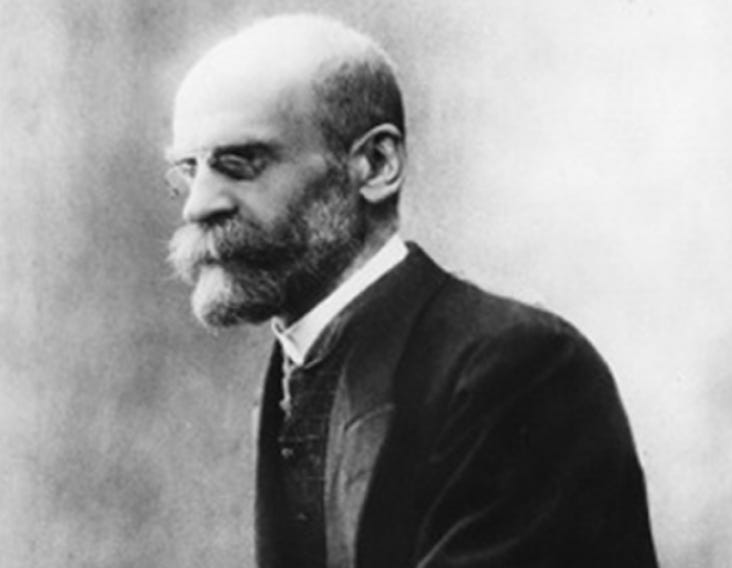
He believed that schools were one of the few institutions uniquely poised to assist with the transition from traditional society to modern society.
Durkheim believed that education realizes this transition to modern society by creating a sense of social solidarity in the individual which will tie them together as society grows more abstract and complex.
This involves instilling in them a sense of belonging and a commitment to the importance of working towards society’s goals and a feeling that the society is more important than the individual. He writes:
“To become attached to society, the child must feel in it something that is real, alive and powerful, which dominates the person and to which he owes the best part of himself”.
“Society can survive only if there exists among its members a sufficient degree of homogeneity: education perpetuates and reinforces this homogeneity by fixing in the child from the beginning the essential similarities which collective life demands”
-Durkheim
Durkheim also argued that a second crucial function for education in an advanced industrial economy is the teaching of specialized skills required for a complex division of labour.
In other words, the development of “human capital”.
In pre-industrial societies, skills could be passed on through apprenticeships and familial knowledge, which rendered formal education unnecessary.
The nature of labor changed dramatically in industrial modern societies leading to the breaking apart of the artisan economy, the disruption of the family unit, and mass education (as a form of child rearing and childcare).
Parents no longer worked the fields shoulder to should with their children, but sent them off to school while they went to the factory or office.
If the purpose of education is social cohesion and the development of human capital, and the historical, social, and cultural values of a country like the United States are strongly capitalist, it is no surprise that the education system fundamentally devalues subjects like the humanities and the arts.
The education system is optimized for conformity and productivity rather than independence.
Both of these great masters, the economy and social stability, conspire to undermine the unique needs and interests of the individual and deprive them of a real education.
This is the core of my argument.
Human individuality, creativity, uniqueness, have no role serious to play in such a system and are, in many ways, a threat to its longevity.
Anything which cannot be measured or reproduced is disincentivized as counter-productive, wasteful, or flat-out harmful.
Ultimately, this makes what the individuals needs and wants of the student to be viewed as problematic, in many cases leading to the elimination of the individuality entirely.
The Elimination Of Individuality
So far, we have examined at a high level two big ideas about the purpose and nature of mass education: economic and social training.
What both of these ideas have in common is that eliminate the individual subject and absorb them into some abstract plan.
Mass education is engineered to absorb individuals into larger social projects fundamentally devaluing creativity, independent thinking, and risk-taking.
In his famous Ted Talk, Sir Kenneth Robinson (1950-2020), who was a British author, speaker and international advisor on education in the arts to government, non-profits, education and arts bodies, argues that modern mass education is killing human creativity, which is the very thing that we will need in an uncertain future.
In the 15th century Europe, the world was slow and predictable.
There was war, sickness, and death, but the world itself would not change.
Back then the world changed at a glacial pace that would only be accelerated by technological breakthroughs like the printing press.
For most of human history the world you were born into was, for the most part, the same world you would die in.
Today, we are all living in a world that is rapidly changing such that we have no idea what it will be like in 1-5 years, let alone 50!
And yet, Robinson points out, we still need to educate people for a future we cannot even begin to understand.
This raises an important question:
How do you educate human beings for an unpredictable future?
The answer is that you teach them how to be flexible, adaptable, and creative.
You teach them the skills that allow human beings to adapt to novel problems by creating novel solutions.
As Robinson puts it, we need to teach people how to be more childlike.
Children are highly creative, innovative, and unafraid to take intellectual risks. Robinson believes that human beings have a extraordinary creative potential that comes in many forms, arguing that “creativity is as important in education as literacy and we should treat it with the same status”.
Modern mass education, understood as a form of economic development and social training, is optimized to kill creativity at every turn.
Kids will take a chance if they don’t know something.
They aren’t frightened of being wrong.
“If you are not prepared to be wrong, you won’t come up with anything original”.
Sir Ken Robinson, “Do Schools Kill Creativity?”
But by the time they become adults most people have lost that capacity entirely.
They have become frightened of being wrong, paralyzed by imposter syndrome, and afraid to take big risks.
Robinson argues that this is unsurprising because we run companies in a way that stigmatizes mistakes, and we run our education system in a way that prepares students to work in such companies.
Robinson quotes one of my favorite lines from Picasso to drive home his point:
“Every child is an artist. The problem is how to remain an artist once we grow up”
-Pablo Picasso, Artist
Think about it.
Every kid draws, dances, plays music, and even writes or makes up stories.
These are all things which are at the core of “the humanities”.
They are what separate us from everything else we know of in nature — including AI.
“We don’t grow into creativity, we grow out of it”.
Sir Ken Robinson, “Do Schools Kill Creativity?”
Robinson argues that most education systems around the world share a similar hierarchy of subjects — one shaped by university admissions and industrial-era economic priorities.
At the top of the hierarchy are “high-status” and economically “useful” subjects like:
Mathematics
Science (Physics, Chemistry, Biology)
Engineering
Technology / Computer Science
What is ironic, though, is that you aren’t supposed to become too interested in a subject like Mathematics and turn yourself into a researcher, because then it is less clearly “useful”, except for goal of becoming a university researcher.
You are supposed to learn Mathematics, or coding, to do something deemed economically useful.
These subjects are valued because they are “objective”, “rigorous”, and pathways to high-status careers.
Next up is the large collection of subjects rooted in human language and communication — what’s often thought of as “the humanities” broadly speaking:
Law
Philosophy
Literature
Sociology
Anthropology
Political theory
Cultural studies
These are considered important and can be high-status, but are viewed as less obviously “useful” or “practical” because they are not “objective” or “technical”, and inessential to certain fundamental forms of “production”, such as infrastructure and weaponary.
In last place are “the arts”, which include things like:
Visual arts
Music
Creative writing
Theater / Drama
Dance
The Arts are often mocked for being a complete waste of money, a politically immature wasteland, and not something that can lead to a valuable career.
“What can you do with a dance major!?”
Robinson’s overall point is that this hierarchy reflects certain deep assumptions about the fundamental purpose of education, such as:
Academic intelligence (especially analytical and abstract) is superior to creative or embodied intelligence
Economic utility defines educational value
Robinson argues that education systems are organized around a narrow definition of intelligence — one that prioritizes analytical and technical ability over creative, philosophical, and expressive forms of thinking.
We train young people to start doing the thing they will eventually do in school, rather than developing them as people and allowing them to chose the thing for themselves later.
What’s strange about this is that most students who go on to start a job in a field that aligns with their major end up saying that the things they learned in school didn’t even help them do the job and that they learned almost everything after graduating by just doing the job itself.
If people pay tens of thousands of dollars to study business only to end up getting a job in that field and realize that nothing they learned actually helped them do the job, then why are people studying these things?
These students would have been better off studying something like Russian Literature and spending their early twenties filling their soul with meaning so that they would be less burnt out after a few years in corporate, feeling regret that they haven’t read a novel in 5 years.
“If an alien visited and asked ‘what’s it for? what is the ultimate output if you do everything you should?’
The answer would be a university professor”
Sir Ken Robinson, “Do Schools Kill Creativity?”
I think Robinson is mostly correct that what we are often teaching students is how to become something like a university professor, but another answer might just be that we are teaching them how to become “an employable citizen”.
Modern mass education teaches us to devalue our bodies and become rewarded for our academic ability using our non-creative parts of our brains.
The result, Robinson argues, is that many highly talented, brilliant, creative people think they are not.
Consider the story of Gillian Lynne.
In 1930’s England, Gillian Lynne was a young girl whose teachers thought she had a learning disability because she couldn’t sit still and was disruptive in class.
Seeking help, her mother met with a child psychologist and explained what the teachers had said. Today, the girl would have been diagnosed with ADHD (but that wasn’t a thing at the time). The psychologist listened for a bit, then told the girl he needed to speak with her mother privately and left her alone in the room with the radio on.
The mother observer her daughter begin to get up and dance.
The psychologist said to the mother that her daughter doesn’t have a learning disability, “she is a dancer and you need to enroll her in dance school”.
Gillian Lynne would go on to become one of the most influential choreographers of all time and a multi-millionaire.
The tragedy of Gillian’s story is made clear by Robinson, who points out that “somebody else would have put Gillian on medication and told her to calm down”.
The suggestion here, of course, is that there are millions of kids who never get to realize their true potential because of ignorance.
Because the thing they were good at in school wasn’t valued or was actually stigmatized.
Robinson doesn’t just complain, he has a broad vision for what the future of human education might look like and require.
He argues that “We need to radically rethink our view of intelligence”.
Intelligence, according to Robinson, is three things:
It is diverse
It is dynamic
It is distinct
Intelligence is diverse because “we think about the world in all of the ways that we experience it” — through sight, sound, movement, abstraction, and so on.
Intelligence is dynamic “wonderfully interactive” and creative. Robinson argues that creativity, which he defines as “the process of having original ideas that have value” more often than not comes about through the interaction of different ways of seeing things that go across discipline.
Finally, Robinson argues that intelligence is distinct. By this, he means that it is unique to the individual.
Robinson’s puts his positive vision for education in ecological terms. He says that “Our only hope for the future is a new conception of human ecology”.
What he means by this is that we must rethink the relationship between human beings and the world.
“Our education system has mined our minds in the way that we have mined the earth for a particular commodity”.
Sir Ken Robinson, “Do Schools Kill Creativity?”
We must rethink the richness of human potential and what it means to develop human beings rather than mine them as a resource.
Robinson argues that, in the future, this approach won’t work anymore.
We have to rethink the fundamental principles with which we are educating children.
Our job is to prepare them for the future.
In the next section, I provide three alternative visions for what a humanistic education might look like and aim to accomplish.
Three Visions For A Humanistic Education: John Dewey, Paulo Freire, Maria Montessori
I want to sketch three visions of what education is about that I find particularly attractive and that I take to be compelling alternatives to the economic and social training models.
They come from John Dewey, Paulo Freire, and Maria Montessori.
John Dewey (1859-1952) was an American philosopher, psychologist, and educational reformer, and one of the most prominent American scholars in the first half of the twentieth century.
Paulo Reglus Neves Freire (1921-1997) was a Brazilian educator and Marxist philosopher whose work revolutionized global thought on education and is widely regarded as one of the most important educational theorists of the twentieth century, alongside figures such as John Dewey.
Maria Tecla Artemisia Montessori (1870-1952) was an Italian physician and educator best known for her philosophy of education (the Montessori method) and her writing on scientific pedagogy. Her educational method is in use globally in many public and private schools.
1) Dewey’s Vision: Democratic Participation
Like Durkheim, Dewey does think that there is a social function to education, but it is a democratic social function in which individuals are taught how to actively participate in democracy, use their individual capacities for reflective judgment, and think critically and creatively.
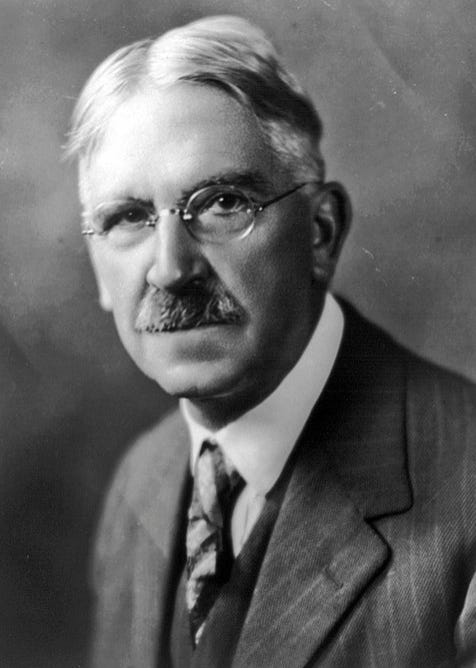
Dewey’s philosophy of education connects the uniqueness and development of the individual with the health and development of democratic society as a whole. He thought that schools are the primary institutions that shape democratic society, and it is important for a democracy to develop citizen’s thinking capacities.
In short, education prepares people to participate intelligently in a democratic community.
In order to make this possible, Dewey thought that teaching should be treated as a profession on equal footing with professions such as medicine or law. He thought that teachers serve a crucial public function to not merely deliver content but guide human growth and development.
The problem is that the promotion of the teaching profession does not have direct economic benefit beyond a certain point, unlike medicine and law.
In general, Dewey viewed education as a guided experience for personal growth and development, not the reception of content, or pre-job training.
Several themes recur throughout these writings. Dewey continually argues that education and learning are social and interactive processes, and thus the school itself is a social institution through which social reform can and should take place.
In addition, he believed that students thrive in an environment where they are allowed to experience and interact with the curriculum, and all students should have the opportunity to take part in their own learning.
The ideas of democracy and social reform are continually discussed in Dewey’s writings on education. Dewey makes a strong case for the importance of education not only as a place to gain content knowledge, but also as a place to learn how to live.
In his eyes, the purpose of education should not revolve around the acquisition of a pre-determined set of skills, but rather the realization of one’s full potential and the ability to use those skills for the greater good.
He writes that:
“To prepare him for the future life means to give him command of himself; it means so to train him that he will have the full and ready use of all his capacities”
John Dewey, “My Pedagogic Creed”, 1897
In short, education, for Dewey, is not the delivery of information, or skills-training, but the guided construction of human experience and intellectual independence.
2) Freire: Emancipatory Pedagogy
Freire argued that education always does one of two things:
Reinforces the existing system (produces conformity), or
Liberates people by helping them critically understand and change their world.
In other words, it is never “neutral”. Even education that appears neutral, such as “technical training”, is not actually neutral. Being a mere technician still means that you are participating in the technical economy and whatever it does.
Education either integrates people into the existing order or becomes a “practice of freedom.”
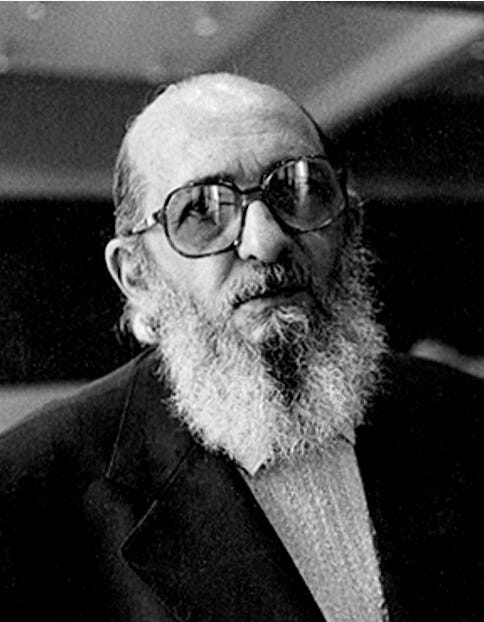
Freire’s core idea is that education is political and transformative — it shapes how people see reality and their place within it.
Freire was critical of what he called the “Banking Model” of education. This was his most famous concept.
According to this model, the teacher is treated as the authority and the students are passive recipients of knowledge-deposits into their “bank”. Learning, then, becomes the consumption, retention, and reproduction of knowledge.
Like a bank, you must be able to withdraw a previous deposit.
The problem, as most of you are probably aware, is that this produces passive learning, discourages critical thinking, and reinforces dependence on authority and social conformity for success and self-worth.
This model treats students as objects rather than independent thinkers.
Instead, Freire thought that education should be dialogical and that teachers and students should co-create knowledge.
It should engage them in real dialogue, teachers and students should learn from and with one another, and knowledge emerges through the push and pull of questioning, discussion, and reflection on real experience.
Learning happens through conversation about real problems, not one-way instruction.
Freire believed this this kind of education could lead to the development of what he called critical consciousness, or the ability to recognize the social, cultural, and ideological forces that shape life, uncover power relations, question assumptions, and act towards improving unjust conditions.
The teacher aims to develop in students intellectual agency, awareness of social conditioning, and resistance to manipulation. Freire thought that this type of education was necessary to free the minds of oppressed groups who often internalize dominant beliefs and stop questioning them.
In short, education should help people become authors of their own lives, not objects shaped by others.
3) Montessori: Natural Freedom
Maria Montessori argued that education should support the natural psychological development of the child, rather than impose external instruction.
Her approach held that children are naturally motivated to learn, that education should adapt to the unique individual rather than follow a fixed curriculum, and that the teacher’s role is to observe and guide development.
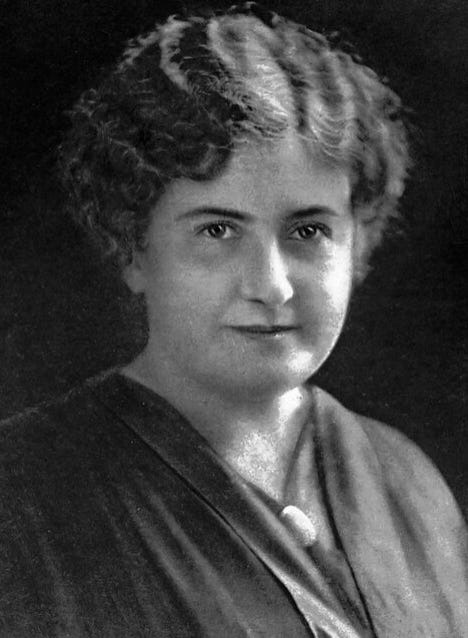
One crucial aspect of this approach was creating an environment in which children could learn independently, explore, and grow.
The goal is independent learning without constant teacher intervention or rigid requirements.
This approach emphasizes promoting autonomy in children by allowing them to select their own activities within a flexible set of structured options.
Eventually, children would learn how to freely construct their own identity through guidance rather than control, leading to increase self-reliance, intrinsic motivation, and meaningful engagement with learning.
The Future Of Humanistic Learning
A common thread running through Dewey, Freire, and Montessori is that a humanistic education involves the formation of the self.
It is not job training or the development of human beings as an economic resource.
A real education is the process of intellectual and personal formation — learning to understand reality, think independently, develop a coherent worldview, and direct your own lifelong learning.
This is what I have begun referring to as perspective development.
In many ways, this is what I teach in my Micro-Philosophy: Foundations course.
The goal of that course is to use philosophy to teach people how to think for themselves about what their own philosophy of life is rather than consume someone else’s.
Being able to develop and think from your own perspective has always been essential to a good human life, but is becoming increasingly rare and valuable in the digital age with the rise of artificial intellgience.
The traditional approach to mass education is fundamentally threatened by artificial intelligence because we are now living in a rapidly changing world where fixed curriculums and pre-determined tracks in life no longer make sense.
Teaching “safe skills” to prepare students to enter into a predictable economic job market no longer seems viable.
It is a real possibility that we spend decades teaching students a specific skill like coding only to realize that it was rendered obsolete overnight.
We are leaving an era of extreme credentialism and degrees as proof that you endured something difficult and onerous and now entering an era of educational anarchy.
We are entering an era of educational anarchy.
So what are we to do?
How are we to educate human beings for this uncertain future?
The answer is that we need to return to developing systems that deliver a real education because that is the only thing that empower us to flourish in an uncertain and rapidly changing future.
A Real Education
What is a real education?
A real education is the process of forming a self-directed, truth-seeking, critically independent person who can continue learning and contribute responsibly to society.
It teaches someone how to:
Ask their own questions
Evaluate ideas independently
Build a coherent worldview
Learn anything they need to learn
Contribute original thought
Direct their own intellectual life
In short, it teaches people how to leverage their unique human intelligence and how to become themselves.
But how do you teach these things? Aren’t these things that cannot really be taught?
Only if you think of teaching according to Freire’s “banking model”.
Philosophy has been teaching these “critical thinking” skills for thousands of years by demonstrating them and actively involving students in the practice of them.
Literature teaches these skills by helping students understand what it means to think about a text for themselves and develop their own interpretation.
The humanities teach these skills by doing them with others.
I have often said that philosophy should be taught like a dance class.
In a dance class, you don’t just watch videos about how to dance, you spend the majority of the time actually dancing yourself, practicing the steps, and receiving feedback.
Why can’t we teach philosophy the same way?
Many of the best philosophy professors already do, but most people don’t have access to them.
Fortunately, the internet has now made is possible for millions of people around the world to come together and receive a real education for a fraction of the cost of traditional education.
But event though this is a real possibility, it’s potential has not even begun to be realized.
The fact is that there are still few places online where people can go to receive a real education.
That is why I decided to do something about it by creating The Micro-University.
My hope is that by creating an online school for philosophy that is founded on the idea of teaching people how to practice and think philosophically, rather than giving them a bunch of information to consume, I can play my part in building the future of online education.
What human beings need is to leverage the power of technology like social media to not just create massive content libraries of video courses that people passively consume, but real learning environments where adult-learners can practice the skills of thinking independently and developing their own perspective and worldview.
That project lights my soul on fire and gets me to wake up every morning and figure out what I can do to make it happen. There is nothing more exciting to me right now than the challenge of helping people develop their own perspective through philosophy.
If you are interested in learning more about how I plan to do that, there is a link to The Micro-University below. Thanks for reading.
-Paul
The Micro-University

What if you could receive a complete philosophy education for less than 1% of the cost of a bachelor’s degree? The Micro-University is a completely new online school of philosophy designed to provide exactly this.
https://www.walkfree.org/global-slavery-index/
https://www.investopedia.com/terms/r/returnoninvestment.asp
This ends quickly,
we want "real education" in an era where only ads put food on the table.
I was a music ed student as an undergraduate, and in choir and band in middle and high school. More than 30 years later, I can still sing melodies from pieces that we learned. And if I was to sing in choir again, I could sing my part in many songs with little practice.
How can I remember this so many years later? Because it was spiritual. Because I was deeply connected with my fellow students and teachers through music.
We need to encourage as many students as possible to join choir, band, drama - the arts! We need less technology and more time spent making music and art to ensure that we deeply connect with the people around us.
I believe that taking fine arts courses throughout school should be a requirement, and I also believe that it would solve many problems in schools.