


This article is the fourth installment in my 8-week Introduction To Philosophy. I provide a general introduction to Descartes as a person and thinker, as well as a commentary and introduction to his famous text Meditations.
René Descartes was one of the greatest minds that ever lived.
His contributions to human thought extend far beyond philosophy into areas as diverse as optics, physics, and geometry (to name a few).
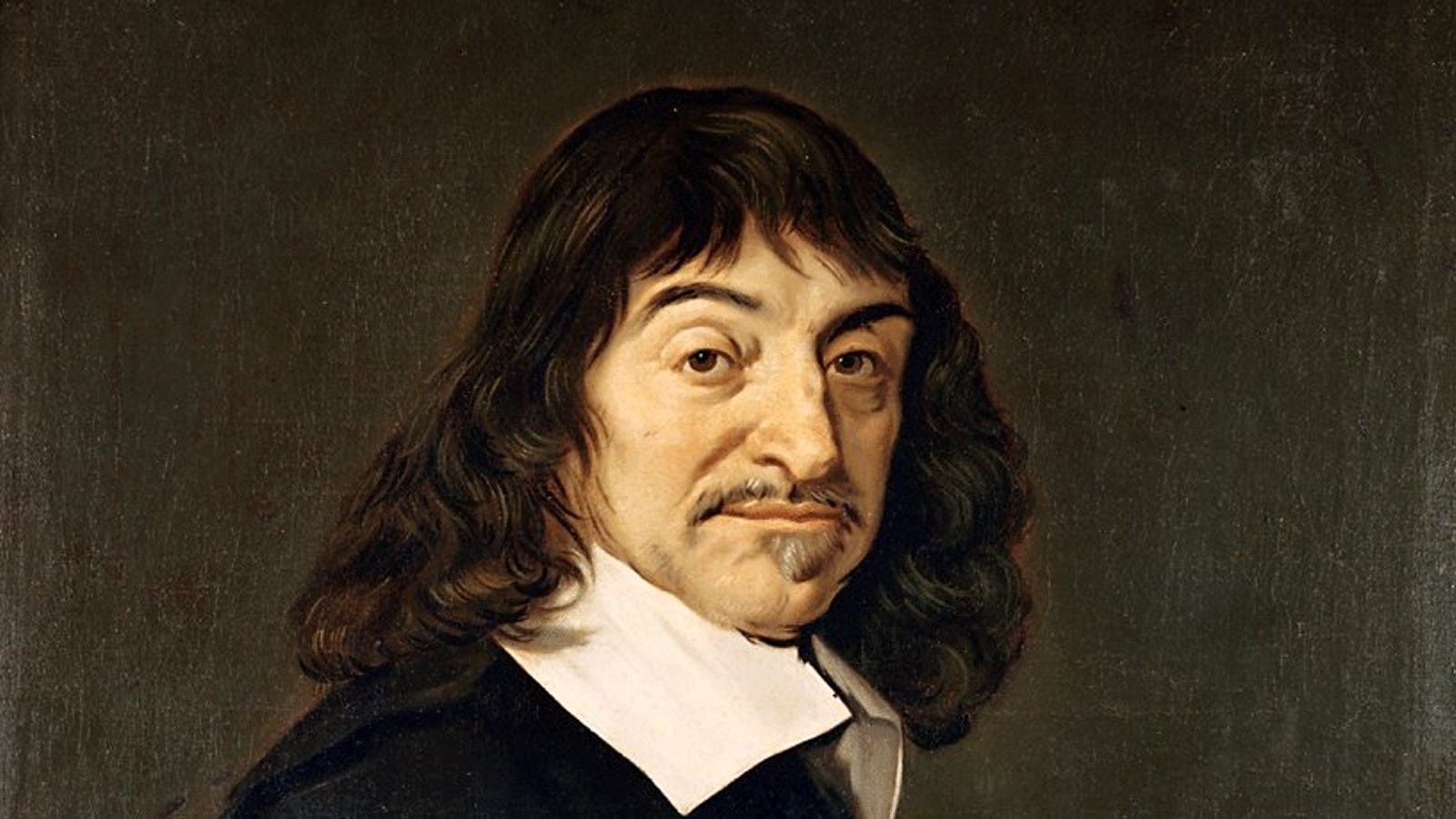
Descartes is also the most heavily criticized philosopher in the Western tradition.
Every great philosopher after Descartes makes it a point to criticize his conclusions as well as his methods either directly or indirectly. This fact should not be taken the wrong way, however. The perpetual criticism Descartes has faced is a testament to his greatness as a philosopher.
Descartes argued forcefully for bold conclusions and, even if he was wrong or made mistakes, the clarity and depth of his reasoning opened up new avenues of thought for later thinkers. It is ironic that the best philosophers are those who everyone takes to be “wrong”, since they are also the philosophers who built the ground that their opponents are standing on.
In this guide, I provide a general introduction to Descartes as one of the most consequential thinkers in the history of the world, and a more focused introduction and commentary on his most famous text, Meditations.
Descartes’ Life And Thought
Descartes was born in 1596 and died in 1650 at 54 years old.
In 1641, at the age of 45, Descartes published his famous Meditations on First Philosophy.
Meditations is one of the most ambitious and significant philosophical texts ever written. In the work, Descartes sought to help his readers understand the ultimate nature of reality and human knowledge, arguing not only that it is possible to prove our own existence on rational grounds (cogito ergo sum), but also the existence of God. (The term “first philosophy” in the title is one that we have seen before with Aristotle — it refers to metaphysics).
In order to properly understand the genius of Descartes and the nature of Meditations as a work, it is important to place him in the proper context of his life and thought.
Descartes did not begin as a philosopher and never restricted himself to a single intellectual or academic pursuit. He lived a rich and varied life and made groundbreaking contributions to many areas of human thought — always aiming as highly as possible.
He began as a mathematician and “natural philosopher”, which is how philosophers generally thought of themselves before the sharp and, in my judgment, artificial separation that exists between philosophy and natural science today (the first philosophers, the “Pre-Socratics” were also referred to as “natural philosophers”).
Descartes was incredibly successful in his intellectual endeavors and came to believe that he had discovered unique methods and insights that would allow him to displace the then dominant Aristotelian worldview and revolutionize philosophy and science. Like Aristotle, Descartes was a systematic philosopher who sought to extend results from one area of thought to all of nature and life.
In many ways, he succeeded in this pursuit even if many of his specific conclusions are no longer tenable.
Descartes was educated in a Jesuit school that introduced him to philosophy.
The Jesuits are a Roman Catholic religious order, known formally as the Society of Jesus, founded in Spain in 1539 by Ignatius of Loyola.
The Jesuit mission is to improve the spiritual character of humankind, with a special emphasis on education. The order founded new colleges and universities and assumed control of many existing schools in France and elsewhere throughout the seventeenth and into the eighteenth century.
Jesuit schools, renowned for their quality, drew students of various backgrounds and aspirations, including prospective clergy, students preparing for law or medicine, and future civil servants, military officers, and merchants. The first six years of study focused on grammar and rhetoric. Students learned Latin and Greek and studied selections from classical authors, especially the ancient Roman orator Cicero, whose works were read as models of style and eloquence but also contained surveys of philosophical positions”.
The early modern arts curriculum was not confined to the medieval “seven liberal arts.” Those seven arts consisted of the “trivium” (grammar, rhetoric, and logic), which except for logic were covered in the first six years (“grammar school”); and the “quadrivium” (geometry, arithmetic, astronomy, and music). The primary curriculum for the arts degree, earned in the final three years of instruction, consisted in the branches of philosophy: logic, natural philosophy (also called physics), metaphysics, and morals.
(Hatfield, 2014)
At the time, a particular interpretation of Aristotle formed the core of the European worldview and was taught widely across Europe. The particular flavor of Aristotle that Descartes was brought up on came from the work of Roman Catholic scholars in the middle ages who carefully studied Aristotle’s texts and synthesized them with Christian doctrine. The official Jesuit curriculum required that philosophical instruction follow Aristotle. The study of logic, physics, metaphysics, and morals drew upon Jesuit commentaries on Aristotle’s texts, or on independent treatises (including simplified textbooks) that covered the Aristotelian subject areas.
Over time, Descartes began to question Aristotelian philosophy largely as a byproduct of his rigorous training in mathematics. The clarity of mathematics made Descartes want to challenge and improve upon pre-existing philosophy. He decided that philosophy was badly in need of reform, and he had good reason to believe that he was the person for the job. For example, in 1619, Descartes solved various long-standing mathematical problems and laid the groundwork for “analytical geometry”.
In Descartes’ time, the pre-existing world order was undergoing a radical change.
The ancient sciences of astronomy and optics were changing rapidly. Johannes Kepler published works in mathematical optics in 1604 and 1611 that contradicted ancient theory by showing that the eye forms an image on the retina. The sixteenth-century astronomer Nicholas Copernicus opposed the previous geocentric astronomy by hypothesizing that the Earth moves around the Sun. This directly threatened Aristotelian physics, since a moving Earth would violate Aristotle’s physical principle that all earthly matter naturally strives to reach the center of the universe, making the Earth a unique central globe around which all other heavenly bodies revolve. Galileo Galilei, using the newly invented telescope, discovered moons around Jupiter in 1610, which challenged Earth’s uniqueness and also threw Aristotelian cosmology into question.
But Descartes was not just a nerd, he was also, like Socrates, a soldier.
While serving in the French army, Descartes met the Dutch natural philosopher Isaac Beeckman.
This event would change his life.
Beeckman was not only a natural philosopher and mathematician, but he spoke Latin like Descartes. The exchange of ideas that took place between these two men would eventually lead Descartes to developing one of his most significant metaphysical positions — the conclusion that all material things are composed of small round spheres.
This position, which is referred to as “Corpuscularianism”, “corpuscles” being the tiny atom-like bodies out of which all material objects are composed, would have significant effects not only on Descartes thought, but the Western scientific worldview.
On March 26, 1619, Descartes proclaimed to Beeckman that he now envisioned a “completely new science” for solving “all possible equations”.
The impulse to universal solutions would never leave Descartes and color all of his thinking. He would spend his entire life obsessed with method and go on to extend his methodological insights to metaphysics in Meditations and later works.
Despite his early achievements in mathematics, Descartes was uncertain where “fate” would lead him in life.
One winter, while on his way to rejoin the armed forces, Descartes was caught in a winter storm in Neuburg, Germany, which was a peaceful Catholic town north of Munich.
During this time, Descartes allowed himself to pause and set his life onto a new course.
In his famous Discourse on the Method, Descartes writes that he found himself with no one to talk to, nothing to worry about, and nowhere to go. So what he did was shut himself up in a cozy stove-heated room for several days and dedicate his entire being to thinking about his life. Descartes reflections convinced him that he should seek a completely clear and systematic account of how ideas across the various sciences and connect together philosophically into a unified whole.
He wrote that the principles of other sciences “must all be derived from philosophy” (including natural philosophy), and resolved “to try and establish some certain principles” in that field.
Descartes decision was partly inspired by three dreams he reported himself experienced on the night of November 10, 1619.
His dreams were complex and involving images of whirling wind, a melon, acquaintances he passed by in the street without greeting, thunder, sparks, pain in the side, disappearing books, and the title of a poem by Ausonius, “What road in life shall I follow?”.
Descartes interpreted these dreams as commanding him to reform all of science, beginning with philosophy as the foundation. By his own account, it was nine years before he took himself to have discovered a new foundation for philosophy.
One of the key techniques Descartes used in service of this project was temporarily adopting a skeptical stance towards all pre-existing knowledge.
Philosophical skepticism was experiencing a great revival in France during Descartes’ lifetime and although Descartes would use these powerful ideas in service of his own aims, he himself was in no way a skeptic.
He treated many of his opinions as doubtful, as skeptics do, but his ultimate aim was more Socratic — to eradicate incorrect opinions by retaining only those that were certain. He writes:
“I was not imitating the skeptics, who doubt only for the sake of doubting, and pretend to be always undecided; on the contrary, my whole aim was towards certainty”.
Full-blown skeptics don’t simply have doubts about whether they know some particular item of knowledge.
They seek to use various arguments to place themselves in a state of sustained doubt, in which they suspend judgment about any theoretical knowledge going beyond mere appearances. Descartes used the skeptical technique of suspending judgment in order to bracket, for further investigation, areas of potential knowledge now lacking the clarity and evidence found in mathematics.
We will see him apply this technique again and again in Meditations.
In Discourse, Descartes reports that, upon leaving his warm room, for “the next nine years” (1619–28) he did nothing but “roam here and there in the world, trying to be a spectator more than an actor in all the comedies that play there”.
During this period, Descartes continued to work on mathematical and scientific problems, fought a duel and won (without slaying his opponent), and composed a treatise on fencing which is now lost.
During this time Descartes composed an unfinished manuscript titled Rules For The Direction Of The Mind, in which he made the important claim that all the sciences in general depend on certain “pure and simple natures,”which any investigator should seek first. This search for simple natures or simple ideas lay at the heart of his generalized method and epistemology (theory of knowledge). As we will see in a bit, Descartes’ arguments largely turn on belief that there are certain ideas which are clear and indubitable.
Descartes was a paradigmatically “reductive” philosopher (Roughyl: “Reductionism” is a general method/approach in philosophy according to which complex phenomena/entities are reduced to and/or explained by simpler phenomena/entities).
In Discourse on the Method, which was a later work inspired by his previous Rules, he distilled a much larger list into four rules for which he is now famous:
The first: “never to accept anything as true if I did not have evident knowledge of its truth: that is, carefully to avoid precipitate conclusions and preconceptions, and to include nothing more in my judgments than what presented itself to my mind so clearly and so distinctly that I had no occasion to doubt it”.
The second: “to divide each of the difficulties I examined into as many parts as possible and as may be required in order to resolve them better”.
The third: “to direct my thoughts in an orderly manner, by beginning with the simplest and most easily known objects in order to ascend little by little, step by step, to knowledge of the most complex, and by supposing some order even among objects that have no natural order of precedence”.
And the fourth: “throughout to make enumerations so complete, and reviews so comprehensive, that I could be sure of leaving nothing out”.
Descartes’ Metaphysical Turn
After reflecting on his “fate”, Descartes decided to dedicate the rest of his relatively short life to intellectual pursuits.
He woudl go on to publish four major books on topics as various as geometry, optics, physics, the human body, emotions, and metaphysics. He would also leave a substantial amount of unpublished writings behind after his death.
Around 1628, Descartes thought took a metaphysical turn.
While staying in the Netherlands, he worked on nothing else for nine months straight.
In April 1630, he wrote to his friend Mersenne about the results of this work, claiming that he had discovered:
“how to demonstrate metaphysical truths in a manner which is more evident than the demonstrations of geometry”.
My former teacher Gary Hatfield notes that:
“For someone who previously regarded mathematics as providing the ultimate standard of certainty, this statement marks a significant change”.
In the same letter, Descartes also reports that his metaphysical investigations concerning God and the soul had led him to discover “the foundations of Physics”.
Around this time, Descartes thought would become highly rationalistic in the style of Plato, who held that fundamental truths can be known through pure intellectual activity. Unlike Plato, however, Descartes combined his abstract rationalism with a strong conception of God, arguing, for example, that mathematical truths are completely dependent on God, who freely created them (and could have willed them to be otherwise).
This is an incredible claim which I encourage you to pause on for a moment.
Is it possible that God could change the laws of mathematics such that the three angles of a triangle do not add up to 180 degrees?
